Results by title
3 books match the query 'Timor-Leste'
Claiming Impartiality
Peacebuilding Organizations as Actors in Multiple Fields of Global GovernanceAndrea Warnecke
University of Michigan Press, 2026
Why has multilateral peacebuilding in conflict-ridden states emerged as a depoliticized practice that rarely engages with local actors and agendas? And why has depoliticization persisted despite continued criticisms? Claiming Impartiality offers an innovative answer to the puzzling persistence of depoliticization in post-war peacebuilding that focuses on the institutional mandates, interests, and practices of those international and bilateral organizations that design and implement most peacebuilding interventions.
Drawing on and expanding a Bourdieusian field perspective, the book examines international organizations as actors in multiple fields of global governance. Using the case studies of Bosnia and Herzegovina and Timor-Leste, it traces the emergence and transformation of peacebuilding practices by leading international and bilateral organizations during the first two decades of the field’s existence. The organizational lens highlights the tensions that exist between the objectives of simultaneously acting as a peacebuilding organization and as a peacekeeping, humanitarian, or development organization whose practices are to varying degrees committed to observing the twin principles of impartiality and neutrality. By thinking through these sometimes contradictory roles, the book offers new insights into how these organizations sideline questions of political agency in favor of expanding their influence into related fields of global governance. Claiming Impartiality discusses the future of peacebuilding and explores avenues for addressing political challenges to peace itself.
Drawing on and expanding a Bourdieusian field perspective, the book examines international organizations as actors in multiple fields of global governance. Using the case studies of Bosnia and Herzegovina and Timor-Leste, it traces the emergence and transformation of peacebuilding practices by leading international and bilateral organizations during the first two decades of the field’s existence. The organizational lens highlights the tensions that exist between the objectives of simultaneously acting as a peacebuilding organization and as a peacekeeping, humanitarian, or development organization whose practices are to varying degrees committed to observing the twin principles of impartiality and neutrality. By thinking through these sometimes contradictory roles, the book offers new insights into how these organizations sideline questions of political agency in favor of expanding their influence into related fields of global governance. Claiming Impartiality discusses the future of peacebuilding and explores avenues for addressing political challenges to peace itself.
[more]
The Unruly Dead
Spirits, Memory, and State Formation in Timor-LesteLia Kent
University of Wisconsin Press, 2024
“What might it mean to take the dead seriously as political actors?” asks Lia Kent in this exciting new contribution to critical human rights scholarship. In Timor-Leste, a new nation-state that experienced centuries of European colonialism before a violent occupation by Indonesia from 1975 to 1999, the dead are active participants in social and political life who continue to operate within familial structures of obligation and commitment. On individual, local, and national levels, Timor-Leste is invested in various forms of memory work, including memorialization, exhumation, reburial, and commemoration of the occupation’s victims. Such practices enliven the dead, allowing them to forge new relationships with the living and unsettling the state-building logics that seek to contain and control them.
With generous, careful ethnography and incisive analysis, Kent challenges comfortable, linear narratives of transitional justice and argues that this memory work is reshaping the East Timorese social and political order—a process in which the dead are active, and sometimes disruptive, participants. Community ties and even the landscape itself are imbued with their presence and demands, and the horrific scale of mass death in recent times—at least a third of the population perished during the Indonesian occupation—means Timor-Leste’s dead have real, significant power in the country’s efforts to remember, recover, and reestablish itself.
With generous, careful ethnography and incisive analysis, Kent challenges comfortable, linear narratives of transitional justice and argues that this memory work is reshaping the East Timorese social and political order—a process in which the dead are active, and sometimes disruptive, participants. Community ties and even the landscape itself are imbued with their presence and demands, and the horrific scale of mass death in recent times—at least a third of the population perished during the Indonesian occupation—means Timor-Leste’s dead have real, significant power in the country’s efforts to remember, recover, and reestablish itself.
[more]
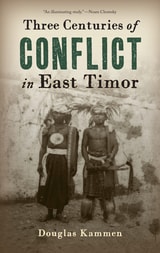
Three Centuries of Conflict in East Timor
Kammen, Douglas
Rutgers University Press, 2015
One of the most troubling but least studied features of mass political violence is why violence often recurs in the same place over long periods of time. Douglas Kammen explores this pattern in Three Centuries of Conflict in East Timor, studying that region’s tragic past, focusing on the small district of Maubara.
Once a small but powerful kingdom embedded in long-distance networks of trade, over the course of three centuries the people of Maubara experienced benevolent but precarious Dutch suzerainty, Portuguese colonialism punctuated by multiple uprisings and destructive campaigns of pacification, Japanese military rule, and years of brutal Indonesian occupation. In 1999 Maubara was the site of particularly severe violence before and after the UN-sponsored referendum that finally led to the restoration of East Timor’s independence. Beginning with the mystery of paired murders during East Timor’s failed decolonization in 1975 and the final flurry of state-sponsored violence in 1999, Kammen combines an archival trail and rich oral interviews to reconstruct the history of the leading families of Maubara from 1712 until 2012.
Kammen illuminates how recurrent episodes of mass violence shaped alliances and enmities within Maubara as well as with supra-local actors, and how those legacies have influenced efforts to address human rights violations, post-conflict reconstruction, and the relationship between local experience and the identification with the East Timorese nation. The questions posed in Three Centuries of Conflict in East Timor about recurring violence and local narratives apply to many other places besides East Timor—from the Caucasus to central Africa, and from the Balkans to China—where mass violence keeps recurring.
Download open access ebook here.
Download open access ebook here.
[more]