Results by title
3 books match the query 'Tlaxcala (State)'
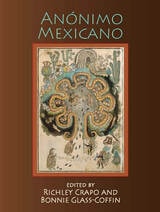
Anonimo Mexicano
Richley Crapo and Bonnie Glass-Coffin
Utah State University Press, 2005
Anonimo Mexicano is the first publication of the full Nahuatl text and English translation of a rare and important Native history of preconquest Mexico. Written circa 1600 by an anonymous Tlaxcaltecan author, it is an epic account of the settling of central Mexico by Nahua peoples from the northern frontier. They developed a sophisticated culture with powerful city states and an agricultural economy, fought great wars, established dynasties, and recorded their history and legends in painted books. The Mexica became the most powerful of these nations until their conquest by the Spanish with the help of the Tlaxcalteca, who were rivals of the Mexica and whose national origin tale was recorded in Anonimo Mexicano.
[more]
Bloodsucking Witchcraft
An Epistemological Study of Anthropomorphic Supernaturalism in Rural TlaxcalaHugo G. Nutini
University of Arizona Press, 1993
In the rural areas of south-central Mexico, there are believed to be witches who transform themselves into animals in order to suck the blood from the necks of sleeping infants. This book analyzes beliefs held by the great majority of the population of rural Tlaxcala a generation ago and chronicles its drastic transformation since then.
"The most comprehensive statement on this centrally important ethnographic phenomenon in the last forty years. It bears ready comparison with the two great classics, Evans-Pritchard's Witchcraft Among the Azande and Clyde Kluckhohn's Navaho Witchcraft."—Henry H. Selby
"The most comprehensive statement on this centrally important ethnographic phenomenon in the last forty years. It bears ready comparison with the two great classics, Evans-Pritchard's Witchcraft Among the Azande and Clyde Kluckhohn's Navaho Witchcraft."—Henry H. Selby
[more]
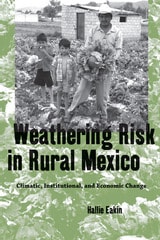
Weathering Risk in Rural Mexico
Climatic, Institutional, and Economic ChangeHallie Eakin
University of Arizona Press, 2006
From floods and droughts to tsunamis and hurricanes, recent years have seen a distressing and often devastating increase in extreme climatic events. While it is possible to study these disasters from a purely scientific perspective, a growing preponderance of evidence suggests that changes in the environment are related to both a shift in global economic relations and these weather-related disasters.
In Weathering Risk in Rural Mexico, Hallie Eakin draws on ethnographic data collected in three agricultural communities in rural Mexico to show how economic and climatic change are not only linked in cause and effect at the planetary scale but also interact in unpredictable and complex ways in the context of regional political and trade relationships, national economic and social programs, and the decision making of institutions, enterprises, and individuals.She shows how the parallel processes of globalization and climatic change result in populations that are “doubly exposed” and thus particularly vulnerable.
Chapters trace the effects of El Niño in central Mexico in the late 1990s alongside some of the principal changes in the country’s agricultural policy. Eakin argues that in order to develop policies that effectively address rural poverty and agricultural development, we need an improved understanding of how households cope simultaneously with various sources of uncertainty and adjust their livelihoods to accommodate newly evolving environmental, political, and economic realities.
[more]