Results by title
12 books match the query 'Tlingit Indians'
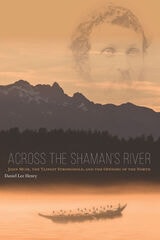
Across the Shaman's River
John Muir, the Tlingit Stronghold, and the Opening of the NorthDaniel Lee Henry
University of Alaska Press, 2017
Across the Shaman’s River is the story of one of Alaska’s last Native American strongholds, a Tlingit community closed off for a century until a fateful encounter between a shaman, a preacher, and John Muir.
Tucked in the corner of Southeast Alaska, the Tlingits had successfully warded off the Anglo influences that had swept into other corners of the territory. This tribe was viewed by European and American outsiders as the last wild tribe and a frustrating impediment to access. Missionaries and prospectors alike had widely failed to bring the Tlingit into their power. Yet, when John Muir arrived in 1879, accompanied by a fiery preacher, it only took a speech about “brotherhood”—and some encouragement from the revered local shaman Skandoo’o—to finally transform these “hostile heathens.”
Using Muir’s original journal entries, as well as historic writings of explorers juxtaposed with insights from contemporary tribal descendants, Across the Shaman’s River reveals how Muir’s famous canoe journey changed the course of history and had profound consequences on the region’s Native Americans.
[more]
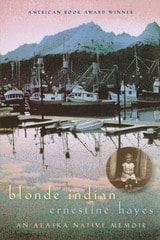
Blonde Indian
An Alaska Native MemoirErnestine Hayes
University of Arizona Press, 2006
In the spring, the bear returns to the forest, the glacier returns to its source, and the salmon returns to the fresh water where it was spawned. Drawing on the special relationship that the Native people of southeastern Alaska have always had with nature, Blonde Indian is a story about returning.
Told in eloquent layers that blend Native stories and metaphor with social and spiritual journeys, this enchanting memoir traces the author’s life from her difficult childhood growing up in the Tlingit community, through her adulthood, during which she lived for some time in Seattle and San Francisco, and eventually to her return home. Neither fully Native American nor Euro-American, Hayes encounters a unique sense of alienation from both her Native community and the dominant culture. We witness her struggles alongside other Tlingit men and women—many of whom never left their Native community but wrestle with their own challenges, including unemployment, prejudice, alcoholism, and poverty.
The author’s personal journey, the symbolic stories of contemporary Natives, and the tales and legends that have circulated among the Tlingit people for centuries are all woven together, making Blonde Indian much more than the story of one woman’s life. Filled with anecdotes, descriptions, and histories that are unique to the Tlingit community, this book is a document of cultural heritage, a tribute to the Alaskan landscape, and a moving testament to how going back—in nature and in life—allows movement forward.
[more]

Fighter in Velvet Gloves
Alaska Civil Rights Hero Elizabeth PeratrovichAnnie Boochever with Roy Peratrovich Jr.
University of Alaska Press, 2019
“No Natives or Dogs Allowed,” blared the storefront sign at Elizabeth Peratrovich, then a young Alaska Native Tlingit. The sting of those words would stay with her all her life. Years later, after becoming a seasoned fighter for equality, she would deliver her own powerful message: one that helped change Alaska and the nation forever.
In 1945, Peratrovich stood before the Alaska Territorial Legislative Session and gave a powerful speech about her childhood and her experiences being treated as a second-class citizen. Her heartfelt testimony led to the passing of the landmark Alaska Anti-Discrimination Act, America’s first civil rights legislation. Today, Alaska celebrates Elizabeth Peratrovich Day every February 16, and she was honored on the gold one-dollar coin in 2020.
Annie Boochever worked with Elizabeth’s eldest son, Roy Peratrovich Jr., to bring Elizabeth’s story to life in the first book written for young teens on this remarkable Alaska Native woman.
[more]

Fighter in Velvet Gloves
Study GuideAnnie Boochever
University of Alaska Press, 2021
In 1945, Elizabeth Peratrovich stood before the Alaska Territorial Legislative Session and gave a powerful speech about her childhood and her experiences being treated as a second-class citizen. Her heartfelt testimony led to the passing of the landmark Alaska Anti-Discrimination Act, America’s first civil rights legislation. Today, Alaska celebrates Elizabeth Peratrovich Day every February 16, and Elizabeth Peratrovich was honored on the gold dollar coin in 2020.
Annie Boochever worked with Elizabeth’s eldest son, Roy Peratrovich Jr., to bring Elizabeth’s story to life in the first book written for young teens on this remarkable Alaska Native woman. Written about an Alaska Native civil rights leader, Fighter in Velvet Gloves has been incorporated in school curricula around the country, and won the 2019 Lumen Award for Literary Excellence, in addition to receiving many other national recognitions. This study guide is a custom work designed to help instructors teach the story of Elizabeth Peratrovich to students in grades 6 through 12.
Annie Boochever worked with Elizabeth’s eldest son, Roy Peratrovich Jr., to bring Elizabeth’s story to life in the first book written for young teens on this remarkable Alaska Native woman. Written about an Alaska Native civil rights leader, Fighter in Velvet Gloves has been incorporated in school curricula around the country, and won the 2019 Lumen Award for Literary Excellence, in addition to receiving many other national recognitions. This study guide is a custom work designed to help instructors teach the story of Elizabeth Peratrovich to students in grades 6 through 12.
[more]

Gagaan X'usyee/Below the Foot of the Sun
PoemsX'unei Lance Twitchell
University of Alaska Press, 2023
Identity and understanding are fluid and plural, yet the histories of violence and oppression influence and shape everything in the world because the past, present, and future exist in the same plane and at the same time. Gagaan Xʼusyee / Beneath the Foot of the Sun is a unique collection of Indigenous cultural work and Lingít literature in the tradition of Nora Marks Dauenhauer and in the broader contemporary company of Joy Harjo and Sherwin Bitsui. Focused on the history of place and the Lingít and Haida people, who recognize little separation between life and art, these forty-six poems reach into the knowledge of the past, incorporate visions currently received, and draw a path for future generations.
The collection is divided into four sections based on how the Lingít talk about g̱agaan—the sun. Featuring some poems in English, some in Lingít, and some that combine the beauty of the two, Gagaan Xʼusyee / Beneath the Foot of the Sun displays an equal dignity in both languages that transcends monolingual constrictions.
The collection is divided into four sections based on how the Lingít talk about g̱agaan—the sun. Featuring some poems in English, some in Lingít, and some that combine the beauty of the two, Gagaan Xʼusyee / Beneath the Foot of the Sun displays an equal dignity in both languages that transcends monolingual constrictions.
[more]

Harriman Expedition to Alaska
Encountering the Tlingit and Eskimo in 1899George Grinnell
University of Alaska Press, 2007
In 1899, George Bird Grinnell journeyed to Alaska on the Harriman Expedition, a scientific cruise from Seattle to the North Pacific. Accompanied by explorer John Muir and photographer Edward S. Curtis, Grinnell spent two months chronicling the lives of the Natives of Alaska and Siberia.
A keen observer of his surroundings, Grinnell provides a unique perspective on northern life in the late nineteenth century. He documented hunting techniques and material culture of the Eskimo of Siberia, as well as the totem poles and architecture of the Tlingit of Southeast. As a pioneer conservationist, Grinnell was one of the first to express concern over the effects of trade and industry on Alaska's peoples and natural resources.
Illustrated with photos and drawings by Harriman Expedition members, including Edward S. Curtis, this volume makes the work of a passionate observer available to a new generation of readers.
[more]

Life Woven with Song
Nora Marks Dauenhauer
University of Arizona Press, 2000
The Tlingit Indians of southeastern Alaska are known for their totem poles, Chilkat blankets, and ocean-going canoes. Nora Marks Dauenhauer is a cultural emissary of her people and now tells the story of her own life within the context of her community's. Life Woven with Song re-creates in written language the oral tradition of the Tlingit people as it records memories of Dauenhauer's heritage--of older relatives and Tlingit elders, of trolling for salmon and preparing food in the dryfish camps, of making a living by working in canneries. She explores these recurring themes of food and land, salmon and rainforest, from changing perspectives--as a child, a mother, and a grandmother--and through a variety of literary forms.
In prose, Dauenhauer presents stories such as "Egg Boat"--the tale of a twelve-year-old girl fishing the North Pacific for the first time alone--and an autobiographical piece that reveals much about Tlingit lifeways. Then in a section of short lyrical poems she offers crystalline tributes to her land and people. In a concluding selection of plays, Dauenhauer presents three Raven stories that were adapted as stage plays from oral versions told in Tlingit by three storytellers of her community. These plays were commissioned by the Naa Kahidi Theater and have been performed throughout America and Europe. They take the form of a storyteller delivering a narrative while other members of the cast act and dance in masks and costumes.
Collectively, Dauenhauer's writings form an "autoethnography," offering new insight into how the Tlingit have been affected by modernization and how Native American culture perseveres in the face of change. Despite the hardships her people have seen, this woman affirms the goodness of life as found in family and community, in daily work and play, and in tribal traditions.
[more]
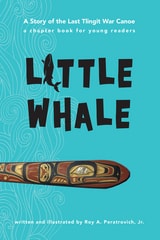
Little Whale
A Story of the Last Tlingit War CanoeRoy A. Peratrovich, Jr.
University of Alaska Press, 2016
Keet, a ten-year-old Tlingit Indian boy, stows away for a voyage on his father’s canoe . . . and soon finds himself caught in the middle of a wild seastorm. The story carries him far from his home village, and when he makes land, he winds up right in the middle of a dangerous dispute between two Indian clans. The story of how he copes with these surprises and extricates himself from danger is dramatic and unforgettable.
And it’s mostly true. Roy Peratrovich here builds a wonderful children’s tale on the bones of a story his own grandfather passed down. His accompanying illustrations bring the people and landscapes of Alaska—to say nothing of the adventures!—to stunning life, drawing young readers into a long-gone time when the whims of nature and man could suddenly test a boy’s courage.
And it’s mostly true. Roy Peratrovich here builds a wonderful children’s tale on the bones of a story his own grandfather passed down. His accompanying illustrations bring the people and landscapes of Alaska—to say nothing of the adventures!—to stunning life, drawing young readers into a long-gone time when the whims of nature and man could suddenly test a boy’s courage.
[more]

Picture Man
The Legacy of Southeast Alaska Photographer Shoki KayamoriMargaret Thomas
University of Alaska Press, 2015
In 1912, Shoki Kayamori and his box camera arrived in a small Tlingit village in southeast Alaska. At a time when Asian immigrants were forbidden to own property and faced intense racial pressure, the Japanese-born Kayamori put down roots and became part of the Yakutat community. For three decades he photographed daily life in the village, turning his lens on locals and migrants alike, and gaining the nickname “Picture Man.” But as World War II drew near, his passion for photography turned dangerous, as government officials called out Kayamori as a potential spy. Despondent, Kayamori committed suicide, leaving behind an enigmatic photographic legacy.
In Picture Man, Margaret Thomas views Kayamori’s life through multiple lenses. Using Kayamori’s original photos, she explores the economic and political realities that sent Kayamori and thousands like him out of Japan toward opportunity and adventure in the United States, especially the Pacific Northwest. She reveals the tensions around Asian immigrants on the West Coast and the racism that sent many young men north to work in the canneries of Alaska. And she illuminates the intersecting—and at times conflicting—lives of villagers and migrants in a time of enormous change. Part history, part biography, part photographic showcase, Picture Man offers a fascinating new view of Alaska history.
In Picture Man, Margaret Thomas views Kayamori’s life through multiple lenses. Using Kayamori’s original photos, she explores the economic and political realities that sent Kayamori and thousands like him out of Japan toward opportunity and adventure in the United States, especially the Pacific Northwest. She reveals the tensions around Asian immigrants on the West Coast and the racism that sent many young men north to work in the canneries of Alaska. And she illuminates the intersecting—and at times conflicting—lives of villagers and migrants in a time of enormous change. Part history, part biography, part photographic showcase, Picture Man offers a fascinating new view of Alaska history.
[more]
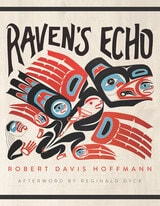
Raven's Echo
Robert Davis Hoffmann, Afterword by Reginald Dyck
University of Arizona Press, 2022
In Raven’s Echo, Tlingit artist and poet Robert Davis Hoffmann calls on readers to nurture material as well as spiritual life, asking beautiful and brutal questions about our individual positions within the universe and within history. The poems in this collection are brimming with an imaginative array of characters, including the playful yet sometimes disturbing trickster Raven, and offer insights into both traditional and contemporary Native life in southeast Alaska.
Raven’s Echo is divided into two books, “SoulCatcher” and “Reconstruction.” “SoulCatcher” artfully explores human alienation and spiritual longing through poems that describe the speaker’s enduring struggle to find a place in Tlingit tribal history and contemporary experience. It takes up topics like colonialism, government subordination, painful acculturation, assimilation, and an array of other challenges, while it also addresses human loneliness in a world of spirits who often elude rather than nurture. The poems in “Reconstruction” present ways of integrating traditional Tlingit culture into contemporary life by honoring the significance of the land, subsistence fishing, warrior identity, and the role of elders. The two books are woven together by the constant thread of finding a way to live humanely in a world that is historically fractured yet spiritually inviting.
Hoffmann’s poetry is acutely aware of economic, political, and social tensions, while still highlighting the joy of traditions and the beauty of Alaskan nature throughout the collection. The destructiveness of colonialism brings a profound darkness to some of the poems in Raven’s Echo, but the collection also explores the possibility of finding spiritual healing in the face of historical and contemporary traumas. As Hoffman’s poetry grapples with reconstructing a life within Tlingit tradition and history, the speaker urges that the importance of honoring and remembering traditions through art is ever present: “Listen, I’m trying to say something— / always our stories have lived through paintings, / always our stories stayed alive through retelling.” Raven’s Echo may tell stories about living in a world of guns and horsepower, global warming, cops, and drunks—but Raven always lurks in the background.
[more]
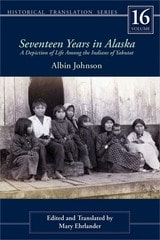
Seventeen Years in Alaska
A Depiction of Life Among the Indians of YakutatAlbin Johnson
University of Alaska Press, 2014
Swedish missionary Albin Johnson arrived in Alaska just before the turn of the twentieth century, thousands of miles from home and with just two weeks’ worth of English classes under his belt. While he intended to work among the Tlingit tribes of Yakutat, he found himself in a wave of foreign arrivals as migrants poured into Alaska seeking economic opportunities and the chance at a different life. While Johnson came with pious intentions, others imposed Western values and vices, leaving disease and devastation in their wake.
Seventeen Years in Alaska is Johnson’s eyewitness account of this tumultuous time. It is a captivating narrative of an ancient people facing rapid change and of the missionaries working to stem a corrupting tide. His journals offer a candid look at the beliefs and lives of missionaries, and they ultimately reveal the profound effect that he and other missionaries had on the Tlingit. Tracing nearly two decades of spiritual hopes and earthbound failures, Johnson’s memoir is a fascinating portrait of a rapidly changing world in one of the most far-flung areas of the globe.
Seventeen Years in Alaska is Johnson’s eyewitness account of this tumultuous time. It is a captivating narrative of an ancient people facing rapid change and of the missionaries working to stem a corrupting tide. His journals offer a candid look at the beliefs and lives of missionaries, and they ultimately reveal the profound effect that he and other missionaries had on the Tlingit. Tracing nearly two decades of spiritual hopes and earthbound failures, Johnson’s memoir is a fascinating portrait of a rapidly changing world in one of the most far-flung areas of the globe.
[more]

Water Mask
Monica Devine
University of Alaska Press, 2019
Water Mask is an adventurous memoir from Monica Devine, an itinerant therapist who travels to villages throughout Alaska and builds a life in this vast, captivating landscape. She traverses mountains, navigates sea ice with whalers, and whirls two thousand feet above tundra with a rookie bush pilot; she negotiates the death of her father, and the near-loss of her family’s cabin on the Copper River. Her journey is exhilarating—but not without reminders of the folly of romanticizing a northern landscape that both rejects and beguiles. Reflections on family, place, and culture are woven into a seductive tapestry of a life well-lived and well-loved.
[more]