Results by title
4 books match the query 'To 1421'
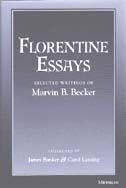
Florentine Essays
Selected Writings of Marvin B. BeckerMarvin B. Becker
University of Michigan Press, 2002
James Banker and Carol Lansing have shaped a collection of the works of Marvin B. Becker, a respected scholar in Florentine and Renaissance history. Becker began his work in 1953 when he arrived in Florence as a Fulbright Scholar, only eight years after the end of World War II. Italy was still struggling with the turbulent wake of the war's end. In those chaotic circumstances, Becker commenced his study of the tumultuous past of Florentine society, producing a rich amount of scholarly work to enhance the field.
In the capital of humanism, he initiated what was to be a lifelong examination of the Western civil tradition. In Florence he could study the interplay of ideas and action in what he was to call the "public world." The rise of this world out of the private, feudal and corporate structures of the medieval commune, its functioning and its eventual subversion by the authoritarian structures of the early modern state were, he thought, valuable information for modern political cultures. In the 1950s and 1960s, Becker produced approximately twenty papers dealing with a wide variety of themes and issues raised by the work of other scholars such as Davidson, Salvemini, Ottokar, Panella, Rodolico, Barbadoro, Baron, and others. He also introduced his own formulations on a range of subjects including the political role of Florence's minor guilds, usury, taxation, public debt, popular heresy, church-state relations, the city's chroniclers, the influence of "new men" upon Florentine government and changing mentalities.
These papers, in their originality, their richness of documentation and their suggestiveness, are still relevant for current scholarship. The editors of this volume have chosen the papers for the convenience of readers who may know Becker only through his books, or from the myriad of footnotes of other scholars who have drawn so much from his work. This volume will be of interest to scholars, students, and others interested in Renaissance history, whether it be social or political.
Marvin B. Becker is Professor Emeritus in the Department of History, University of Michigan. James Banker is Professor of History, North Carolina State University. Carol Lansing is Professor of History, University of California, Santa Barbara.
[more]
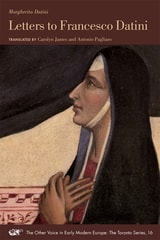
Letters to Francesco Datini
Margherita Datini
Iter Press, 2012
The letters of Margherita Datini to her husband, “the merchant of Prato,” are virtually impossible to put down. Margherita is never obsequious, and never holds her tongue as she chastises Francesco for staying up too late, asks about a case before the Eight of Florence, beseeches him to help friends in prison, worries over financial transactions, and updates him on his business, the harvests, and his illegitimate child (whom she cares for) when he is away. Rich in emotional life and historical particulars, the letters are a unique window into late medieval Tuscany and women’s “work.” Thanks to Carolyn James and Antonio Pagliaro for their illuminating introduction and equally luminous translation.
—Jane Tylus
Professor of Italian Studies and vice provost for academic affairs, New York University
—Jane Tylus
Professor of Italian Studies and vice provost for academic affairs, New York University
[more]
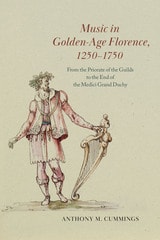
Music in Golden-Age Florence, 1250–1750
From the Priorate of the Guilds to the End of the Medici Grand DuchyAnthony M. Cummings
University of Chicago Press, 2023
A comprehensive account of music in Florence from the late Middle Ages until the end of the Medici dynasty in the mid-eighteenth century.
Florence is justly celebrated as one of the world’s most important cities. It enjoys mythic status and occupies an enviable place in the historical imagination. But its musico-historical importance is not as well understood as it should be. If Florence was the city of Dante, Michelangelo, and Galileo, it was also the birthplace of the madrigal, opera, and the piano. Music in Golden-Age Florence, 1250–1750 recounts Florence’s principal contributions to music and the history of how music was heard and cultivated in the city, from civic and religious institutions to private patronage and the academies. This book is an invaluable complement to studies of the art, literature, and political thought of the late-medieval and early-modern eras and the quasi-legendary figures in the Florentine cultural pantheon.
Florence is justly celebrated as one of the world’s most important cities. It enjoys mythic status and occupies an enviable place in the historical imagination. But its musico-historical importance is not as well understood as it should be. If Florence was the city of Dante, Michelangelo, and Galileo, it was also the birthplace of the madrigal, opera, and the piano. Music in Golden-Age Florence, 1250–1750 recounts Florence’s principal contributions to music and the history of how music was heard and cultivated in the city, from civic and religious institutions to private patronage and the academies. This book is an invaluable complement to studies of the art, literature, and political thought of the late-medieval and early-modern eras and the quasi-legendary figures in the Florentine cultural pantheon.
[more]
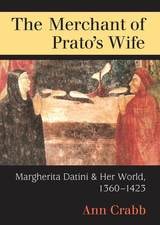
The Merchant of Prato's Wife
Margherita Datini and Her World, 1360-1423Ann Crabb
University of Michigan Press, 2015
Although the fourteenth-century Italian merchant Francesco Datini has received attention from business historians, there has previously been no full study of his wife, Margherita Datini. Drawing on a sizable trove of Margherita’s correspondence held in the Archivio di Stato di Prato, including hundreds of letters she exchanged with Francesco, Ann Crabb investigates the social and economic importance of women’s roles as wives and mothers, early modern European views on honor, and the practice of letter writing in Margherita’s world.
Margherita’s often colorful comments demonstrate her attitudes toward her rather unhappy marriage and her inability to have children, along with other aspects of her life. Her letters reveal the pride she felt in carrying out her many responsibilities as a wife and, later, a widow: in scribal letter writing, in business, in household management, and in farming. Crabb emphasizes that the role of a wife was a recognized social position, beyond her individual relations with her husband, and provided opportunities beyond what restrictive laws or restrictive views of female honor would suggest. Further, Crabb considers Margherita’s successful efforts, on her own initiative and in her late thirties, to learn to read and write at a literate level.
This book will be of interest to both scholars and general readers of women’s history. In addition, historians of early modern Italy and, more generally, of early modern Europe will find this book valuable.
[more]