Results by title
5 books match the query 'To 1519'
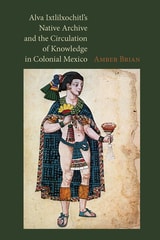
Alva Ixtlilxochitl's Native Archive and the Circulation of Knowledge in Colonial Mexico
Amber Brian
Vanderbilt University Press, 2016
Born between 1568 and 1580, Alva Ixtlilxochitl was a direct descendant of Ixtlilxochitl I and Ixtlilxochitl II, who had been rulers of Texcoco, one of the major city-states in pre-Conquest Mesoamerica. After a distinguished education and introduction into the life of the empire of New Spain in Mexico, Ixtlilxochitl was employed by the viceroy to write histories of the indigenous peoples in Mexico. Engaging with this history and delving deep into the resultant archives of this life's work, Amber Brian addresses the question of how knowledge and history came to be crafted in this era.
Brian takes the reader through not only the history of the archives itself, but explores how its inheritors played as crucial a role in shaping this indigenous history as the author. The archive helped inspire an emerging nationalism at a crucial juncture in Latin American history, as Creoles and indigenous peoples appropriated the history to give rise to a belief in Mexican exceptionalism. This belief, ultimately, shaped the modern state and impacted the course of history in the Americas. Without the work of Ixtlilxochitl, that history would look very different today.
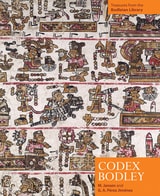
Codex Bodley
A Painted Chronicle from the Mixtec Highlands, MexicoMaarten Jansen and Gabina Aurora Pérez Jiménez
Bodleian Library Publishing, 2005
Codex Bodley explores the enormous wealth of information contained in the manuscript, which documents precolonial Mixtec genealogical relationships and historical events spanning from 900 AD to 1521. Maarten Jansen and Gabina Aurora Pérez Jiménez provide insightful and expert commentary on the manuscript, explaining its history as they consider key characteristics of Mixtec pictography. They then provide an engaging and masterful interpretation of the manuscript's narrative, with a detailed explanatory reading of its pictograms and their significance. Accompanied by vivid and colorful illustrations, Codex Bodley is an invaluable text for scholars of precolonial Mexican history, art, and culture.
Codex Chimalpopoca
The Text in Nahuatl with a Glossary and Grammatical NotesJohn Bierhorst
University of Arizona Press, 2011
History and Mythology of the Aztecs
The Codex ChimalpopocaJohn Bierhorst
University of Arizona Press, 1992
Of particular interest are the stories of the hero-god Quetzalcoatl, for which the Chimalpopoca is the premier source. John Bierhorst's work is the first major scholarship on the Codex Chimalpopoca in more than forty years. His is the first edition in English and the first in any language to include the complete text of the Legend of the Suns. The precise, readable translation not only contributes to the study of Aztec history and literature but also makes the codex an indispensable reference for Aztec cultural topics, including land tenure, statecraft, the role of women, the tribute system, warfare, and human sacrifice.
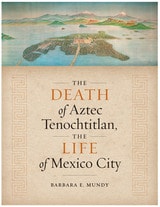
The Death of Aztec Tenochtitlan, the Life of Mexico City
By Barbara E. Mundy
University of Texas Press, 2015
Winner, Book Prize in Latin American Studies, Colonial Section of Latin American Studies Association (LASA), 2016
ALAA Book Award, Association for Latin American Art/Arvey Foundation, 2016
The capital of the Aztec empire, Tenochtitlan, was, in its era, one of the largest cities in the world. Built on an island in the middle of a shallow lake, its population numbered perhaps 150,000, with another 350,000 people in the urban network clustered around the lake shores. In 1521, at the height of Tenochtitlan’s power, which extended over much of Central Mexico, Hernando Cortés and his followers conquered the city. Cortés boasted to King Charles V of Spain that Tenochtitlan was “destroyed and razed to the ground.” But was it?
Drawing on period representations of the city in sculptures, texts, and maps, The Death of Aztec Tenochtitlan, the Life of Mexico City builds a convincing case that this global capital remained, through the sixteenth century, very much an Amerindian city. Barbara E. Mundy foregrounds the role the city’s indigenous peoples, the Nahua, played in shaping Mexico City through the construction of permanent architecture and engagement in ceremonial actions. She demonstrates that the Aztec ruling elites, who retained power even after the conquest, were instrumental in building and then rebuilding the city. Mundy shows how the Nahua entered into mutually advantageous alliances with the Franciscans to maintain the city's sacred nodes. She also focuses on the practical and symbolic role of the city’s extraordinary waterworks—the product of a massive ecological manipulation begun in the fifteenth century—to reveal how the Nahua struggled to maintain control of water resources in early Mexico City.