Results by title
12 books match the query 'To 1775'
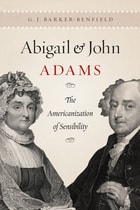
Abigail and John Adams
The Americanization of SensibilityG. J. Barker-Benfield
University of Chicago Press, 2010
During the many years that they were separated by the perils of the American Revolution, John and Abigail Adams exchanged hundreds of letters. Writing to each other of public events and private feelings, loyalty and love, revolution and parenting, they wove a tapestry of correspondence that has become a cherished part of American history and literature.
With Abigail and John Adams, historian G. J. Barker-Benfield mines those familiar letters to a new purpose: teasing out the ways in which they reflected—and helped transform—a language of sensibility, inherited from Britain but, amid the revolutionary fervor, becoming Americanized. Sensibility—a heightened moral consciousness of feeling, rooted in the theories of such thinkers as Descartes, Locke, and Adam Smith and including a “moral sense” akin to the physical senses—threads throughout these letters. As Barker-Benfield makes clear, sensibility was the fertile, humanizing ground on which the Adamses not only founded their marriage, but also the “abhorrence of injustice and inhumanity” they and their contemporaries hoped to plant at the heart of the new nation. Bringing together their correspondence with a wealth of fascinating detail about life and thought, courtship and sex, gender and parenting, and class and politics in the revolutionary generation and beyond, Abigail and John Adams draws a lively, convincing portrait of a marriage endangered by separation, yet surviving by the same ideas and idealism that drove the revolution itself.
A feast of ideas that never neglects the real lives of the man and woman at its center, Abigail and John Adams takes readers into the heart of an unforgettable union in order to illuminate the first days of our nation—and explore our earliest understandings of what it might mean to be an American.
Alice Morse Earle and the Domestic History of Early America
Susan Reynolds Williams
University of Massachusetts Press, 2013
Author, collector, and historian Alice Morse Earle (1851–1911) was among the most important and prolific writers of her day. Between 1890 and 1904, she produced seventeen books as well as numerous articles, pamphlets, and speeches about the life, manners, customs, and material culture of colonial New England. Earle's work coincided with a surge of interest in early American history, genealogy, and antique collecting, and more than a century after the publication of her first book, her contributions still resonate with readers interested in the nation's colonial past.
An intensely private woman, Earle lived in Brooklyn, New York, with her husband and four children and conducted much of her research either by mail or at the newly established Long Island Historical Society. She began writing on the eve of her fortieth birthday, and the impressive body of scholarship she generated over the next fifteen years stimulated new interest in early American social customs, domestic routines, foodways, clothing, and childrearing patterns.
Written in a style calculated to appeal to a wide readership, Earle's richly illustrated books recorded the intimate details of what she described as colonial “home life.” These works reflected her belief that women had played a key historical role, helping to nurture communities by constructing households that both served and shaped their families. It was a vision that spoke eloquently to her contemporaries, who were busily creating exhibitions of early American life in museums, staging historical pageants and other forms of patriotic celebration, and furnishing their own domestic interiors.
Errands into the Metropolis
New England Dissidents in Revolutionary LondonJonathan Beecher Field
Dartmouth College Press, 2012
Founding Fictions
Jennifer R. Mercieca
University of Alabama Press, 2010
Founding Fictions develops the concept of a “political fiction,” or a narrative that people tell about their own political theories, and analyzes how republican and democratic fictions positioned American citizens as either romantic heroes, tragic victims, or ironic partisans. By re-telling the stories that Americans have told themselves about citizenship, Mercieca highlights an important contradiction in American political theory and practice: that national stability and active citizen participation are perceived as fundamentally at odds.
Rhetoric, Independence, and Nationhood, 1760–1800, Volume II
Stephen E Lucas
Michigan State University Press, 2022
The Complete Writings and Selected Correspondence of John Dickinson
Volume 1Jane E. Calvert
University of Delaware Press, 2011
The Complete Writings and Selected Correspondence of John Dickinson
Volume 2Jane E. Calvert
University of Delaware Press, 2021
Dickinson’s hard work on behalf of his clients brought him success in other areas of his public life. In October 1759, he was elected to his first public position as a representative for Kent County, Del., the following year he was elevated to the position of speaker, and in 1762, he became a representative for Philadelphia County, Pa. As a legislator in two colonies, learning his craft as a global war unfolded, he contributed to bills on military and defense, Indian relations, infrastructure improvements and city management, and served on various committees. The death of George II occasioned debates over laws and judges, in which Dickinson participated. This era concludes with Dickinson playing a central role in managing the unfolding Paxton Riots, in which frontiersmen massacred peaceful Indians and threatened the Quaker leadership of Pennsylvania.
In private, Dickinson lost the two most prominent male figures in his life in 1760, his father, Samuel, and soon thereafter, his mentor, colleague, and friend, John Moland. In honor of Moland, Dickinson published a poem and became a proxy head to Moland’s large family. Though his extant correspondence during this period is small, he exchanged letters with Mary Cadwalader Dickinson, Israel Pemberton, William Allason, George Read, Thomas McKean, and others. Perhaps most significant, he wrote a lengthy, unpublished essay on the flag-of-truce trade and also maintained commonplace books as he considered his place within the British Empire, opening up the next phase in Dickinson’s life as a leader of the resistance against Britain.
Published by the University of Delaware Press. Distributed worldwide by Rutgers University Press.
The Complete Writings and Selected Correspondence of John Dickinson
Volume 3Jane E. Calvert
University of Delaware Press, 2024
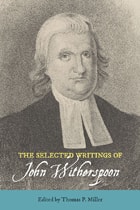
The Selected Writings of John Witherspoon
Edited by Thomas P. Miller
Southern Illinois University Press, 1990

The Southern Debate over Slavery
Volume 1: Petitions to Southern Legislatures, 1778-1864Edited by Loren Schweninger
University of Illinois Press, 2001
These petitions, filed by slaveholders and nonslaveholders, slaves and free blacks, women and men, abolitionists and staunch defenders of slavery, constitute a uniquely important primary source. Petitioners were compelled to present the most accurate and fully documented case they could, since their claims would be subject to public scrutiny and legal verification. Unlike the many reminiscences and autobiographies of the period, these petitions record with great immediacy and minute detail the dynamics, common understandings, and legal restrictions and parameters that shaped southern society during this period.
Arranged chronologically, with their original spelling and idiosyncratic phraseology intact, these documents reveal the grim and brutal nature of human bondage, the fears of whites who lived among large concentrations of blacks, and the workings of the complicated legal system designed to control blacks. They tell about the yearning of bondspeople to gain their freedom, the attitudes of freed blacks who were forced to leave the South, and the efforts of African Americans to overcome harsh and restrictive laws. They also underscore the unique situation of free women of color and the reliance of manumitted (formally freed) blacks on their former owners for protection, travel passes, guardianship papers, and reference letters.
Astonishingly intimate and frank,The Southern Debate over Slavery illuminates how slavery penetrated nearly every aspect of southern life and how various groups of southerners responded to the difficulties they confronted as a result of living in a slave society.
The Southern Debate over Slavery
Volume 2: Petitions to Southern County Courts, 1775-1867Edited by Loren Schweninger
University of Illinois Press, 2007
An incomparably rich source of period information, the second volume of The Southern Debate over Slavery offers a representative and extraordinary sampling of the thousands of petitions about issues of race and slavery that southerners submitted to county courts between the American Revolution and Civil War. These petitions, filed by slaveholders and nonslaveholders, slaves and free blacks, women and men, abolitionists and staunch defenders of slavery, constitute a uniquely important primary source. The collection records with great immediacy and minute detail the dynamics and legal restrictions that shaped southern society.
Witch-Hunting in Seventeenth-Century New England
A Documentary History 1638-1693, Second EditionDavid D. Hall
Duke University Press, 2007
Primary sources include court depositions as well as excerpts from the diaries and letters of contemporaries. They cover trials for witchcraft, reports of diabolical possessions, suits of defamation, and reports of preternatural events. Each section is preceded by headnotes that describe the case and its background and refer the reader to important secondary interpretations. In his incisive introduction, David D. Hall addresses a wide range of important issues: witchcraft lore, antagonistic social relationships, the vulnerability of women, religious ideologies, popular and learned understandings of witchcraft and the devil, and the role of the legal system. This volume is an extraordinarily significant resource for the study of gender, village politics, religion, and popular culture in seventeenth-century New England.