Results by title
3 books match the query 'To 1791'
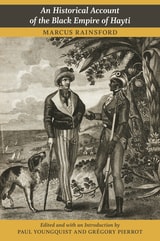
An Historical Account of the Black Empire of Hayti
Marcus Rainsford
Duke University Press, 2013
Cul de Sac
Patrimony, Capitalism, and Slavery in French Saint-DominguePaul Cheney
University of Chicago Press, 2017
Focusing on correspondence between the Ferronnayses and their plantation managers, Cul de Sac proposes that the Caribbean plantation system, with its reliance on factory-like production processes and highly integrated markets, was a particularly modern expression of eighteenth-century capitalism. But it rested on a foundation of economic and political traditionalism that stymied growth and adaptation. The result was a system heading toward collapse as planters, facing a series of larger crises in the French empire, vainly attempted to rein in the inherent violence and instability of the slave society they had built. In recovering the lost world of the French Antillean plantation, Cul de Sac ultimately reveals how the capitalism of the plantation complex persisted not as a dynamic source of progress, but from the inertia of a degenerate system headed down an economic and ideological dead end.
From Spaniard to Creole
The Archaeology of Cultural Formation at Puerto Real, HaitiCharles Robin Ewen
University of Alabama Press, 1991
Tracing the archaeological origins of Creole identity in the early colonial Caribbean.
While most studies of intercultural contact focus on the impact of the intrusive power on the native culture, this book examines the effects of the colonization process on the Spaniards in the New World during the 16th century. The site of Puerto Real on the north coast of Haiti serves as a case study. Based on the results of excavations at both Puerto Real and St. Augustine, Florida, this study suggests that the introduction of New World and African cultural elements into Spanish colonial culture began almost at contact. The model of acculturative processes, developed in St. Augustine and tested at Puerto Real, can serve to guide future Spanish colonial research. It can also be applied to non-Hispanic colonial sites in the New World. Did the French and British adapt to their new environments in a manner similar to the Spanish? Work done at Puerto Real demonstrates the utility of archaeology in the study of the effects of culture contact.