Results by title

12 books match the query 'To 1803'

cover of A French Aristocrat in the American West: The Shattered Dreams of De Lassus De Luzières

A French Aristocrat in the American West

The Shattered Dreams of De Lassus De Luzières

Carl J. Ekberg & Foreword by Marie-Sol de La Tour d'Auvergne

University of Missouri Press, 2010
In 1790, Pierre-Charles de Lassus de Luzières gathered his wife and children and fled Revolutionary France. His trek to America was prompted by his “purchase” of two thousand acres situated on the bank of the Ohio River from the Scioto Land Company—the institution that infamously swindled French buyers and sold them worthless titles to property. When de Luzières arrived and realized he had been defrauded, he chose, in a momentous decision, not to return home to France. Instead, he committed to a life in North America and began planning a move to the Mississippi River valley.
De Luzières dreamed of creating a vast commercial empire that would stretch across the frontier, extending the entire length of the Ohio River and also down the Mississippi from Ste. Genevieve to New Orleans. Though his grandiose goal was never realized, de Luzières energetically pursued other important initiatives. He founded the city of New Bourbon in what is now Missouri and recruited American settlers to move westward across the Mississippi River. The highlight of his career was being appointed Spanish commandant of the New Bourbon District, and his 1797 census of that community is an invaluable historical document. De Luzières was a significant political player during the final years of the Spanish regime in Louisiana, but likely his greatest contributions to American history are his extensive commentaries on the Mississippi frontier at the close of the colonial era.
A French Aristocrat in the American West: The Shattered Dreams of De Lassus de Luzières is both a narrative of this remarkable man’s life and a compilation of his extensive writings. In Part I of the book, author Carl Ekberg offers a thorough account of de Luzières, from his life in Pre-Revolutionary France to his death in 1806 in his house in New Bourbon. Part II is a compilation, in translation, of de Luzières’s most compelling correspondence. Until now very little of his writing has been published, despite the fact that his letters constitute one of the largest bodies of writing ever produced by a French émigré in North America.
Though de Luzières’s presence in early American history has been largely overlooked by scholars, the work left behind by this unlikely frontiersman merits closer inspection. A French Aristocrat in the American West brings the words and deeds of this fascinating man to the public for the first time.
[more]
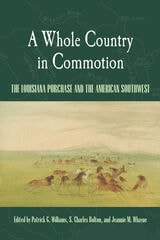
cover of A Whole Country in Commotion: The Louisiana Purchase and the American Southwest

A Whole Country in Commotion

The Louisiana Purchase and the American Southwest

Patrick G. Williams

University of Arkansas Press, 2005

Bringing together the work of prominent scholars and rising stars in southern, western, and Indian history, A Whole Country in Commotion explores lesser-known aspects of one of the better-known episodes in U.S. history. While the purchase has been seen as a great boon for the United States, doubling the size of the new nation and securing American navigation on the Mississippi River, it also brought turmoil to many. Looking past the triumphal aspects of the purchase, this book examines the “negotiations among peoples, nations and empires that preceded and followed the actual transfer of territory.” Its nine essays highlight the “commotion” the purchase stirred up—among nations, among Louisiana residents and newcomers, even among those who remained east of the Mississippi. Many of these essays look at the portion of the Louisiana territory that would become Arkansas to illustrate the profound impact of the purchase on the diverse populations of the American Southwest. Others explore the woeful commotion brought to many thousands of lives as Jefferson’s “noble bargain” set the stage for the forced migration of native and African Americans from the east to the west of the Mississippi.
[more]
cover of Bounded Lives, Bounded Places: Free Black Society in Colonial New Orleans, 1769–1803

Bounded Lives, Bounded Places

Free Black Society in Colonial New Orleans, 1769–1803

Kimberly S. Hanger

Duke University Press, 1997

During Louisiana’s Spanish colonial period, economic, political, and military conditions combined with local cultural and legal traditions to favor the growth and development of a substantial group of free blacks. In Bounded Lives, Bounded Places, Kimberly S. Hanger explores the origin of antebellum New Orleans’ large, influential, and propertied free black—or libre—population, one that was unique in the South. Hanger examines the issues libres confronted as they individually and collectively contested their ambiguous status in a complexly stratified society.
Drawing on rare archives in Louisiana and Spain, Hanger reconstructs the world of late-eighteenth-century New Orleans from the perspective of its free black residents, and documents the common experiences and enterprises that helped solidify libres’ sense of group identity. Over the course of three and a half decades of Spanish rule, free people of African descent in New Orleans made their greatest advances in terms of legal rights and privileges, demographic expansion, vocational responsibilities, and social standing. Although not all blacks in Spanish New Orleans yearned for expanded opportunity, Hanger shows that those who did were more likely to succeed under Spain’s dominion than under the governance of France, Great Britain, or the United States.
The advent of U.S. rule brought restrictions to both manumission and free black activities in New Orleans. Nonetheless, the colonial libre population became the foundation for the city’s prosperous and much acclaimed Creoles of Color during the antebellum era.
[more]
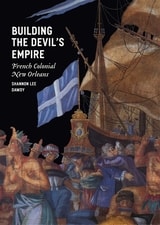
cover of Building the Devil's Empire: French Colonial New Orleans

Building the Devil's Empire

French Colonial New Orleans

Shannon Lee Dawdy

University of Chicago Press, 2008

Building the Devil’s Empire is the first comprehensive history of New Orleans’s early years, tracing the town’s development from its origins in 1718 to its revolt against Spanish rule in 1768. Shannon Lee Dawdy’s picaresque account of New Orleans’s wild youth features a cast of strong-willed captives, thin-skinned nobles, sharp-tongued women, and carousing travelers. But she also widens her lens to reveal the port city’s global significance, examining its role in the French Empire and the Caribbean, and she concludes that by exemplifying a kind of rogue colonialism—where governments, outlaws, and capitalism become entwined—New Orleans should prompt us to reconsider our notions of how colonialism works.

"[A] penetrating study of the colony's founding."—Nation


“A brilliant and spirited reinterpretation of the emergence of French New Orleans. Dawdy leads us deep into the daily life of the city, and along the many paths that connected it to France, the North American interior, and the Greater Caribbean. A major contribution to our understanding of the history of the Americas and of the French Atlantic, the work is also a model of interdisciplinary research and analysis, skillfully bringing together archival research, archaeology, and literary analysis.”—Laurent Dubois, Duke University
[more]
cover of Essays in French Colonial History: Proceedings of the 21st Annual Meeting of the French Colonial Historical Society

Essays in French Colonial History

Proceedings of the 21st Annual Meeting of the French Colonial Historical Society

A.J.B. Johnston

Michigan State University Press, 1997

On 31 May - 3 June 1995, more than 200 participants gathered in Sydney and at Fortress Louisbourg, Nova Scotia, for the 21st annual conference of the French Colonial Historical Society. Essays in French Colonial History contains seventeen of the best articles presented at this meeting. It is a wide-ranging collection that explores many new and innovative facets of the French experience outre mer. The contributors, a mix of established experts and younger scholars, examine French activity in North America, the West Indies, Africa, and South America and focus on issues military, social, cultural, native, and political history. 
     Among the subject areas explored are: the 16th century French colonies in Brazil and Florida; Victor Hugues and the Reign of Terror on Guadeloupe; commerce and the distinctiveness of Louisbourg; the importance of letter-writing and compagnonnage; unresolved territory of the Creek Nation; case studies in the area of transition patrimonial; French colonial interests and policies in Atlantic Canada, Africa, and South America; attitudes among African Americans in post-French St. Louis; and a research report on the Historical Atlas of Quebec.
[more]
cover of European Metals in Native Hands: Rethinking Technological Change 1640-1683

European Metals in Native Hands

Rethinking Technological Change 1640-1683

Kathleen L. Ehrhardt

University of Alabama Press, 2005

The first detailed analysis of Native metalworking in the Protohistoric/Contact Period

From the time of their earliest encounters with European explorers and missionaries, Native peoples of eastern North America acquired metal trinkets and utilitarian items and traded them to other aboriginal communities. As Native consumption of European products increased, their material culture repertoires shifted from ones made up exclusively of items produced from their own craft industries to ones substantially reconstituted by active appropriation, manipulation, and use of foreign goods. These material transformations took place during the same time that escalating historical, political, economic, and demographic influences (such as epidemics, new types of living arrangements, intergroup hostilities, new political alliances, missionization and conversion, changes in subsistence modes, etc.) disrupted Native systems.

Ehrhardt's research addresses the early technological responses of one particular group, the Late Protohistoric Illinois Indians, to the availability of European-introduced metal objects. To do so, she applied a complementary suite of archaeometric methods to a sample of 806 copper-based metal artifacts excavated from securely dated domestic contexts at the Illiniwek Village Historic Site in Clark County, Missouri.

Ehrhardt's scientific findings are integrated with observations from historical, archaeological, and archival research to place metal use by this group in a broad social context and to critique the acculturation perspective at other Contact Period sites. In revealing actual Native practice, from material selection and procurement to ultimate discard, the author challenges technocentric explanations for Native material and cultural change at contact.

[more]
cover of Fleur de Lys and Calumet: Being the Penicaut Narrative of French Adventure in Louisiana

Fleur de Lys and Calumet

Being the Penicaut Narrative of French Adventure in Louisiana

Edited by Richebourg McWilliams

University of Alabama Press, 1988

Andre Penicaut, a carpenter, sailed with Iberville to the French province of Louisiana in 1699 and did not return to France until 1721. The book he began in the province and finished upon his return to France is an eyewitness account of the first years of the French colony, which stretched along the Gulf Coast from Florida to Texas and in the Mississippi Valley from the Balize to the Illinois country. As a ship carpenter, Penicaut was chosen as a member of several important expeditions: he accompanied Le Sueur up the Mississippi River in 1700 to present-day Minnesota, and he went with Juchereau de St. Denis on the first journey from Mobile to the Red River and overland to the Rio Grande, to open trade with the Spaniards in Mexico. Penicaut helped to build the first post in Louisiana, at Old Biloxi, and the second post on the Mobile River.

Penicaut was at his best when describing the lives and social customs of the Indians of the region. He saw them in realistic terms, showing no prejudice toward their native habits. Neither were his French colleagues cast in heroic or villainous molds—though their accomplishments must strike modern readers as truly epic.

When first published, Fleur de Lys and Calumet was a major stimulus to scholarship in the field. This new edition will be welcomed by a new generation of scholars and readers interested in the colonial history of the Deep South and the Mississippi Valley.

[more]
cover of Francois Vallé and His World: Upper Louisiana before Lewis and Clark

Francois Vallé and His World

Upper Louisiana before Lewis and Clark

Carl J. Ekberg

University of Missouri Press, 2002

Winner of the Kemper & Leila Williams Prize in Louisiana History for excellence in historical scholarship for the year 2002, awarded by The Historic New Orleans Collection, The Louisiana Historical Association.

In François Vallé and His World, Carl Ekberg provides a fascinating biography of François Vallé (1716–1783), placing him within the context of his place and time. Vallé, who was born in Beauport, Canada, immigrated to Upper Louisiana (the Illinois Country) as a penniless common laborer sometime during the early 1740s. Engaged in agriculture, lead mining, and the Indian trade, he ultimately became the wealthiest and most powerful individual in Upper Louisiana, although he never learned to read or write.
 
Ekberg focuses on Upper Louisiana in colonial times, long before Lewis and Clark arrived in the Mississippi River valley and before American sovereignty had reached the eastern bank of the Mississippi. He vividly captures the ambience of life in the eighteenth-century frontier agricultural society that Vallé inhabited, shedding new light on the French and Spanish colonial regimes in Louisiana and on the Mississippi River frontier before the Americans arrived.
 
Based entirely on primary source documents—wills and testaments, parish registers of baptisms, marriages, and burials, and Spanish administrative correspondence—found in archives ranging from St. Louis and Ste. Genevieve to New Orleans and Seville, François Vallé and His World traces not only the life of François Vallé and the lives of his immediate family members, but also the lives of his slaves. In doing so, it provides a portrait of Missouri’s very first black families, something that has never before been attempted. Ekberg also analyzes how the illiterate Vallé became the richest person in all of Upper Louisiana, and how he rose in the sociopolitical hierarchy to become an important servant of the Spanish monarchy.
 
François Vallé and His World provides a useful corrective to the fallacious notion that Missouri’s history began with the arrival of Lewis and Clark at the turn of the nineteenth century. Anyone with an interest in colonial history or the history of the Mississippi River valley will find this book of great value.
[more]
cover of French Roots in the Illinois Country: The Mississippi Frontier in Colonial Times

French Roots in the Illinois Country

The Mississippi Frontier in Colonial Times

Carl J. Ekberg

University of Illinois Press, 1998

Winner of the Kemper and Leila Williams Book Prize for the Best Book on Louisiana History, French Roots in the Illinois Country creates an entirely new picture of the Illinois country as a single ethnic, economic, and cultural entity. Focusing on the French Creole communities along the Mississippi River, Carl J. Ekberg shows how land use practices such as medieval-style open-field agriculture intersected with economic and social issues ranging from the flour trade between Illinois and New Orleans to the significance of the different mentalities of French Creoles and Anglo-Americans.
 
[more]
cover of French and Indians in the Heart of North America, 1630-1815

French and Indians in the Heart of North America, 1630-1815

Robert Englebert

Michigan State University Press, 2013
In the past thirty years, the study of French-Indian relations in the center of North America has emerged as an important field for examining the complex relationships that defined a vast geographical area, including the Great Lakes region, the Illinois Country, the Missouri River Valley, and Upper and Lower Louisiana. For years, no one better represented this emerging area of study than Jacqueline Peterson and Richard White, scholars who identified a world defined by miscegenation between French colonists and the native population, or métissage, and the unique process of cultural accommodation that led to a “middle ground” between French and Algonquians. Building on the research of Peterson, White, and Jay Gitlin, this collection of essays brings together new and established scholars from the United States, Canada, and France, to move beyond the paradigms of the middle ground and métissage. At the same time it seeks to demonstrate the rich variety of encounters that defined French and Indians in the heart of North America from 1630 to 1815. Capturing the complexity and nuance of these relations, the authors examine a number of thematic areas that provide a broader assessment of the historical bridge-building process, including ritual interactions, transatlantic connections, diplomatic relations, and post-New France French-Indian relations.
[more]
cover of Iberville's Gulf Journals

Iberville's Gulf Journals

Pierre Le Moyne d'Iberville, translated by Richebourg Gaillard McWilliams

University of Alabama Press, 1991

Europe's expansion into the New World during the 16th, 17th, and 18th centuries was a story of power alignment and cultural transmission as well as dramatic individual effort. Spain had her conquistadores, France her coureurs de bois, and England her sea dogs. Isolated from the authority of home governments, tempted by the abundance of gold, fur, and fish in the New World, these adventurers so vital to national policies of expansion developed their own personal creeds of conquest and colonization. Their individual exploits not only represent a humanistic theme essential in Europe's movement westward but heighten the analyses of cultural institutions of the era. It is within such a multidisciplinary light that one can experience the Gulf Coast adventures of Pierre LeMoyne d'Iberville.

[more]
cover of Jolliet and Marquette: A New History of the 1673 Expedition

Jolliet and Marquette

A New History of the 1673 Expedition

Mark Walczynski

University of Illinois Press, 2023

Often viewed in isolation, the Jolliet and Marquette expedition in fact took place against a sprawling backdrop that encompassed everything from ancient Native American cities to French colonial machinations. Mark Walczynski draws on a wealth of original research to place the explorers and their journey within seventeenth-century North America. His account takes readers among the region’s diverse Native American peoples and into a vanished natural world of treacherous waterways and native flora and fauna. Walczynski also charts the little-known exploits of the French-Canadian officials, explorers, traders, soldiers, and missionaries who created the political and religious environment that formed Jolliet and Marquette and shaped European colonization of the heartland.

A multifaceted voyage into the past, Jolliet and Marquette expands and updates the oft-told story of a pivotal event in American history.

[more]