Results by title
26 books match the query 'To 1865'
A Fire Bell in the Past
The Missouri Crisis at 200, Volume I, Western Slavery, National ImpasseJeffrey L. Pasley
University of Missouri Press, 2021
Drawing on the participants in two landmark conferences held at the University of Missouri and the City University of New York, this first of two volumes finds myriad new perspectives on the Missouri Crisis. Celebrating Missouri’s bicentennial the scholarly way, with fresh research and unsparing analysis, this eloquent collection of essays from distinguished historians gives the epochal struggle over Missouri statehood its due as a major turning point in American history.
Contributors include the editors, Christa Dierksheide, David N. Gellman, Sarah L. H. Gronningsater, Robert Lee, Donald Ratcliffe, Andrew Shankman, Anne Twitty, John R. Van Atta, and David Waldstreicher.
A Fire Bell in the Past
The Missouri Crisis at 200, Volume II: “The Missouri Question” and Its AnswersJeffrey L. Pasley
University of Missouri Press, 2021
Drawn from the of participants in two landmark conferences held at the University of Missouri and the City University of New York, those who contributed original essays to this second of two volumes—a group that includes young scholars and foremost authorities in the field—answer the Missouri “Question,” in bold fashion, challenging assumptions both old and new in the long historiography by approaching the event on its own terms, rather than as the inevitable sequel of the flawed founding of the republic or a prequel to its near destruction.
This second volume of A Fire Bell in the Past features a foreword by Daive Dunkley. Contributors include Dianne Mutti Burke, Christopher Childers, Edward P. Green, Zachary Dowdle, David J. Gary, Peter Kastor, Miriam Liebman, Matthew Mason, Kate Masur, Mike McManus, Richard Newman, and Nicholas Wood.

A Lydia Maria Child Reader
Carolyn L. Karcher, ed.
Duke University Press, 1997
This rich collection is the first to represent the full range of Child’s contributions as a literary innovator, social reformer, and progressive thinker over a career spanning six decades. It features stories, editorials, articles, and letters to politicians culled from rare newspapers and periodicals and never before published in book form; extracts from her trailblazing childrearing manual, history of women, and primer for the emancipated slaves; and a generous sampling of her best-known writings on slavery, the Indian question, poverty, and women’s rights. Witty, incisive, and often daringly unconventional, Child’s writings open a panoramic window on nineteenth-century American culture while addressing issues still relevant to our own time. In this anthology, the editor of Harriet Jacobs’s Incidents in the Life of a Slave Girl reemerges in her own right as one of the nation’s greatest prophets.
American Economic Growth and Standards of Living before the Civil War
Edited by Robert E. Gallman and John Joseph Wallis
University of Chicago Press, 1992
Despite the dramatic economic growth and rise in income levels, questions remain as to the general quality of life during this era. Was the improvement in income widely shared? How did economic growth affect the nature of work? Did higher levels of income lead to improved health and longevity? The authors address these questions by analyzing new estimates of labor force participation, real wages, and productivity, as well as of the distribution of income, height, and nutrition.
Contesting the Constitution
Congress Debates the Missouri Crisis, 1819-1821William S. Belko
University of Missouri Press, 2021
The larger question with which the legislators grappled were the limits of the Constitution’s provisions granting Congress the authority to affect the institution of slavery—both where it already existed and where it could expand. The issue—what would come to be known as the Missouri Crisis—severely tested the still young republic and, some four decades later, would all but rend it asunder. This timely collection of original essays thoughtfully engages the intersections of history and constitutional law, and is certain to find eager readers among historians, legal scholars, political scientists, as well as many who call Missouri home.
Contributing Authors:
William S. Belko
Christopher Childers
John Eastman
Brook Poston
John R. Van Atta
Crusade Against Slavery
Edward Coles, Pioneer of FreedomKurt E. Leichtle and Bruce G. Carveth
Southern Illinois University Press, 2011
Rejecting slavery from a young age, Coles's early wishes to free his family's slaves initially were stymied by legal, practical, and family barriers. Instead he went to Washington, D.C., where his work in the White House was a life-changing blend of social glitter, secretarial drudge, and distasteful political patronage. Returning home, he researched places where he could live out his ideals. After considerable planning and preparation, he left his family's Virginia tobacco plantation in 1819 and started the long trip west to Edwardsville, Illinois, pausing along the Ohio River on an emotional April morning to free his slaves and offer each family 160 acres of Illinois land of their own. Some continued to work for Coles, while others were left to find work for themselves. This book revisits the lives of the slaves Coles freed, including a noted preacher and contributor to the founding of what is now the second-oldest black Baptist organization in America.
Crusade Against Slavery details Coles's struggles with frontier life and his surprise run and election to the office of Illinois governor as well as his continuing antislavery activities. At great personal cost, he led the effort to block a constitutional convention that would have legalized slavery in the state, which resulted in an acrimonious civil suit brought on by his political enemies, who claimed he violated the law by not issuing a bond of emancipation for his slaves. Although initially convicted by a partisan jury, Coles was vindicated when the Illinois Supreme Court overturned the decisions of the lower courts. Through the story of Coles's moral and legal battles against slavery, Leichtle and Carveth unearth new perspectives on an institution that was on unsure footing yet strongly ingrained in the business interests at the economic base of the fledgling state.
In 1831, after less than a decade in Illinois-and after losing a bid for Congress-Coles left for Philadelphia, where he remained in correspondence with Madison about the issue of slavery. Drawing on previous incomplete treatments of Coles's life, including his own short memoir, Crusade Against Slavery includes the first published analysis of Madison's failure to free his slaves despite his plans to do so through his will and a fascinating exploration of Coles's struggle to understand Madison's inability to live up to the ideals both men shared.
Democracy in America
Alexis de Tocqueville
University of Chicago Press, 2000
Alexis de Tocqueville (1805-59) came to America in 1831 to see what a great republic was like. What struck him most was the country's equality of conditions, its democracy. The book he wrote on his return to France, Democracy in America, is both the best ever written on democracy and the best ever written on America. It remains the most often quoted book about the United States, not only because it has something to interest and please everyone, but also because it has something to teach everyone.
Fanatics and Fire-eaters
Newspapers and the Coming of the Civil WarLorman A. Ratner and Dwight L. Teeter Jr.
University of Illinois Press, 2003
In the troubled years leading up to the Civil War, newspapers in the North and South presented the arguments for and against slavery, debated the right to secede, and in general denounced opposing viewpoints with imagination and vigor. At the same time, new technologies like railroads and the telegraph lent the debates an immediacy that both enflamed emotions and brought the slavery issue into every home.
Lorman A. Ratner and Dwight L. Teeter Jr. look at the power of America's fast-growing media to influence perception and the course of events prior to the Civil War. Drawing on newspaper accounts from across the United States, the authors look at how the media covered—and the public reacted to—major events like the Dred Scott decision, John Brown's raid on Harper's Ferry, and the election of 1860. They find not only North-South disputes about the institution of slavery but differing visions of the republic itself—and which region was the true heir to the legacy of the American Revolution.
Frank Blair
Lincoln's ConservativeWilliam E. Parrish
University of Missouri Press, 1998
Known for his fearlessness in both the political arena and the battlefield, Frank Blair is a Missouri legend. As a member of one of the most prominent and powerful political families in America during the nineteenth century, possibly the equivalent of the twentieth-century Kennedys, Frank was steeped in politics at an early age. The youngest son of Francis Preston Blair, editor of Andrew Jackson's Washington Globe and adviser to Presidents Andrew Jackson through Andrew Johnson, Frank Blair was greatly influenced by his father, who had high political expectations of him.
Volatile and combative, Blair was either strongly admired or hated by the public figures of his day. He held adamantly to his opinions and fought hard for his political causes. He was an ardent supporter of Abraham Lincoln and championed the president's program in Congress and in Missouri against the frequent assaults of the Radicals. Credited with being the principal leader in saving Missouri for the Union in 1861, Blair later served with great distinction at Vicksburg, Chattanooga, and in the Sherman campaigns throughout Georgia and the Carolinas. He is one of only two Missourians ever honored by his state in Statuary Hall in the U.S. Capitol.
Frank Blair: Lincoln's Conservative reveals the full extent of Blair's importance as a national political figure. Specialists in nineteenth-century America, students of Missouri history, and Civil War buffs will welcome this study, which will long stand as the definitive work on this influential and colorful character.
Inequality in Early America
Carla Gardina Pestana
Dartmouth College Press, 2015
Junius And Joseph
Presidential Politics and the Assassination of the First Mormon ProphetRobert S. Wicks & Fred R. Foister
Utah State University Press, 2005
Law and the Conditions of Freedom in the Nineteenth-Century United States
James Willard Hurst
University of Wisconsin Press, 1964
In these essays J. Willard Hurst shows the correlation between the conception of individual freedom and the application of law in the nineteenth-century United States—how individuals sought to use law to increase both their personal freedom and their opportunities for personal growth. These essays in jurisprudence and legal history are also a contribution to the study of social and intellectual history in the United States, to political science, and to economics as it concerns the role of public policy in our economy. The nonlawyer will find in them demonstration of how "technicalities" express deep issues of social values.
Lincoln and the Economics of the American Dream
Gabor S. Boritt
University of Illinois Press, 1994
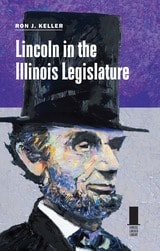
Lincoln in the Illinois Legislature
Ron J Keller
Southern Illinois University Press, 2019
Due partly to Lincoln’s own reserve and partly to an unimpressive legislative tally, Lincoln’s time in the state legislature has been largely neglected by historians more drawn to other early hallmarks of his life, including his law career, his personal life, and his single term as a U.S. congressman in the 1840s. Of about sixteen hundred bills, resolutions, and petitions passed from 1834 to 1842, Lincoln introduced only about thirty of them. The issue he most ardently championed and shepherded through the legislature—the internal improvements system—left the state in debt for more than a generation.
Despite that spotty record, Keller argues, it was during these early years that Lincoln displayed and honed the traits that would allow him to excel in politics and ultimately define his legacy: honesty, equality, empathy, and leadership. Keller reanimates Lincoln’s time in the Illinois legislature to reveal the formation of Lincoln’s strong character and political philosophy in those early years, which allowed him to rise to prominence as the Whig party’s floor leader regardless of setbacks and to build a framework for his future.
Lincoln in the Illinois Legislature details Lincoln’s early political platform and the grassroots campaigning that put him in office. Drawing on legislative records, newspaper accounts, speeches, letters, and other sources, Keller describes Lincoln’s positions on key bills, highlights his colleagues’ perceptions of him, and depicts the relationships that grew out of his statehouse interactions. Keller’s research delves into Lincoln’s popularity as a citizen of New Salem, his political alliances and victories, his antislavery stirrings, and his personal joys and struggles as he sharpened his political shrewdness.
Keller argues Lincoln’s definitive political philosophies—economic opportunity and the right to rise, democratic equality, and to a lesser extent his hatred of slavery—took root during his legislative tenure in Illinois. Situating Lincoln’s tenure and viewpoints within the context of national trends, Keller demonstrates that understanding Lincoln’s four terms as a state legislator is vital to understanding him as a whole.
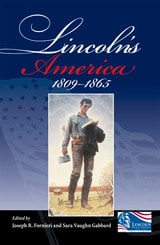
Lincoln's America
1809 - 1865Edited by Joseph R. Fornieri and Sara Vaughn Gabbard
Southern Illinois University Press, 2008
To fully understand and appreciate Abraham Lincoln’s legacy, it is important to examine the society that influenced the life, character, and leadership of the man who would become the Great Emancipator. Editors Joseph R. Fornieri and Sara Vaughn Gabbard have done just that in Lincoln’s America: 1809–1865, a collection of original essays by ten eminent historians that place Lincoln within his nineteenth-century cultural context.
Among the topics explored in Lincoln’s America are religion, education, middle-class family life, the antislavery movement, politics, and law. Of particular interest are the transition of American intellectual and philosophical thought from the Enlightenment to Romanticism and the influence of this evolution on Lincoln's own ideas.
By examining aspects of Lincoln’s life—his personal piety in comparison with the beliefs of his contemporaries, his success in self-schooling when frontier youths had limited opportunities for a formal education, his marriage and home life in Springfield, and his legal career—in light of broader cultural contexts such as the development of democracy, the growth of visual arts, the question of slaves as property, and French visitor Alexis de Tocqueville’s observations on America, the contributors delve into the mythical Lincoln of folklore and discover a developing political mind and a changing nation.
As Lincoln’s America shows, the sociopolitical culture of nineteenth-century America was instrumental in shaping Lincoln’s character and leadership. The essays in this volume paint a vivid picture of a young nation and its sixteenth president, arguably its greatest leader.
Lincoln's Preparation for Greatness
THE ILLINOIS LEGISLATIVE YEARSPaul Simon
University of Illinois Press, 1971
"Abraham Lincoln was a member of the Illinois Legislature from
1834 to 1842 -- one of the Long Nine, as the Sangamon County delegation
was known, all its members being more than six feet tall. It was during
these eight years that he came as close to scandal as he was ever to come
in his public or private life. Did he, or did he not, engage in shameless
logrolling to get the state capital moved to Springfield? This and other
aspects of Lincoln's apprenticeship in the legislator . . . are thoroughly
investigated."
-- Chicago Sun-Times
"The wealth of detail it contains makes it a worthwhile addition
to the study of Lincoln's legislative career."
-- Los Angeles Times
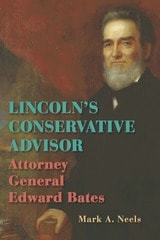
Lincoln’s Conservative Advisor
Attorney General Edward BatesMark A. Neels
Southern Illinois University Press, 2025
How a traditionalist became part of Lincoln's volatile team of rivals
Edward Bates, a founding father of Missouri and leader of the Missouri Whig Party, served as Abraham Lincoln’s attorney general during the American Civil War. The first full biography of Bates in nearly sixty years, Lincoln’s Conservative Advisor reveals a striking portrait of this complex figure in Lincoln’s cabinet.
Author Mark A. Neels begins with Bates’s youth in Virginia and follows him through his political and judicial career, his candidacy as a Republican presidential nominee in 1860, and his appointment to Abraham Lincoln’s cabinet as attorney general. Bates became an essential advisor to the president on key legal, military, and political matters from emancipation to civil liberties and equal rights, and his official opinion on Habeas Corpus would have a permanent effect on presidential authority and separation of powers. When Lincoln drafted the Emancipation Proclamation, Bates found himself at odds with the president and the radical anti-slavery members of the cabinet. But more than simply highlighting the conflict within Lincoln’s administration, Bates’s example lays bare the strong philosophical divisions within the Republican Party during the Civil War era. These divisions were present at the party’s inception, crystallized during the war, and ultimately sparked a political realignment during Reconstruction. Bates was at the center of this divide for most of its existence, and in some cases assisted in its promulgation.
Bates, a fierce opponent of radical Republicanism, embodies the conflict among Republicans over issues of slavery and citizenship. In both judicial and elective office, he was compelled by a sense of duty to defy the populism of President Andrew Jackson and Senator Thomas Hart Benton, and, later, the proslavery forces that threatened to tear the nation apart. Though he had owned slaves, Bates represented at least one enslaved woman’s suit for freedom, released from bondage the people he had enslaved, and aided Lincoln in his efforts to end slavery nationwide. Bates’s opinion on citizenship as attorney general helped pave the way for equal rights. His opinions were not always popular with either his colleagues or the greater populace, but Bates remained true to his conservative principles—a set of values shared by a large swath of Lincoln’s Republican Party—which positioned him as a leading opponent of radical Republicanism during the Reconstruction Era.
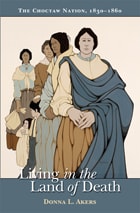
Living in the Land of Death
The Choctaw Nation, 1830-1860Donna L. Akers
Michigan State University Press, 2004
With the Indian Removal Act of 1830, the Choctaw people began their journey over the Trail of Tears from their homelands in Mississippi to the new lands of the Choctaw Nation. Suffering a death rate of nearly 20 percent due to exposure, disease, mismanagement, and fraud, they limped into Indian Territory, or, as they knew it, the Land of the Dead (the route taken by the souls of Choctaw people after death on their way to the Choctaw afterlife). Their first few years in the new nation affirmed their name for the land, as hundreds more died from whooping cough, floods, starvation, cholera, and smallpox.
Living in the Land of the Dead depicts the story of Choctaw survival, and the evolution of the Choctaw people in their new environment. Culturally, over time, their adaptation was one of homesteads and agriculture, eventually making them self-sufficient in the rich new lands of Indian Territory. Along the Red River and other major waterways several Choctaw families of mixed heritage built plantations, and imported large crews of slave labor to work cotton fields. They developed a sub-economy based on interaction with the world market. However, the vast majority of Choctaws continued with their traditional subsistence economy that was easily adapted to their new environment.
The immigrant Choctaws did not, however, move into land that was vacant. The U.S. government, through many questionable and some outright corrupt extralegal maneuvers, chose to believe it had gained title through negotiations with some of the peoples whose homelands and hunting grounds formed Indian Territory. Many of these indigenous peoples reacted furiously to the incursion of the Choctaws onto their rightful lands. They threatened and attacked the Choctaws and other immigrant Indian Nations for years. Intruding on others’ rightful homelands, the farming-based Choctaws, through occupation and economics, disrupted the traditional hunting economy practiced by the Southern Plains Indians, and contributed to the demise of the Plains ways of life.
Messy Beginnings
Postcoloniality and Early American StudiesEdited by Malini Johar Schueller and Edward Watts
Rutgers University Press, 2003
When exploring the links between America and postcolonialism, scholars tend to think either in terms of contemporary multiculturalism, or of imperialism since 1898. This narrow view has left more than the two prior centuries of colonizing literary and political culture unexamined.
Messy Beginnings challenges the idea of early America’s immunity from issues of imperialism, that its history is not as “clean” as European colonialism. By addressing the literature ranging from the diaries of American women missionaries in the Middle East to the work of Benjamin Franklin and Nathaniel Hawthorne, and through appraisals of key postcolonial theorists such as Edward Said, Gayatri Spivak, and Homi Bhabha, the contributors to this volume explore the applicability of their models to early American culture.
Messy Beginnings argues against the simple concept that the colonization of what became the United States was a confrontation between European culture and the “other.” Contributors examine the formation of America through the messy or unstable negotiations of the idea of “nation.”
The essays forcefully show that the development of “Americanness” was a raced and classed phenomenon, achieved through a complex series of violent encounters, legal maneuvers, and political compromises. The complexity of early American colonization, where there was not one coherent “nation” to conquer, contradicts the simple label of imperialism used in other lands. The unique approach of Messy Beginnings will reshape both pre-conceived notions of postcolonialism, and how postcolonialists think about the development of the American nation.
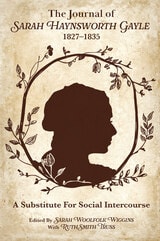
The Journal of Sarah Haynsworth Gayle, 1827–1835
A Substitute for Social IntercourseEdited by Sarah Woolfolk Wiggins with Ruth Smith Truss
University of Alabama Press, 2013
The remarkable journal of the young wife of early Alabama governor John Gayle and a primary source of our knowledge about early Alabama and the antebellum American South
Astonishing, tragic, and remarkable, the journal of Sarah Haynsworth Gayle, wife of early Alabama governor John Gayle, is among the most widely studied and seminal accounts of antebellum life in the American South. This is the first complete edition of the journal in print.
Bereft of the companionship of her often-absent husband, Sarah considered her journal “a substitute for social intercourse” during the period from 1827 to 1835. It became the social and intellectual companion to which she confided stories that reflected her personal life and the world of early Alabama. Sarah speaks directly to us of her loneliness, the challenges of child rearing, her fear of and frustration with the management of slaves, and the difficulty of balancing the responsibilities of a socially prominent woman with her family’s slender finances.
The poor condition of the journal and its transcripts, sometimes disintegrated or reassembled in the wrong order, has led historians to misinterpret Gayle’s words. Gayle’s descendants, Alabama’s famed Gorgases, deliberately obscured or defaced many passages. Using archival techniques to recover the text and restore the correct order, Sarah Wiggins and Ruth Truss reveal the unknown story of Sarah’s economic hardships, the question of her husband’s “temperance,” and her opium use.
The only reliable and unexpurgated edition of Sarah Gayle’s journal, now enhanced with a fascinating introduction and inset notes, The Journal of Sarah Haynsworth Gayle, 1827–1835, is a robust and gripping account and will be of inestimable value to our understanding of antebellum society, religion, intellectual culture, and slavery.
Published in cooperation with the University Libraries, The University of Alabama, with further financial support from the Library Leadership Board, the University Libraries, The University of Alabama.
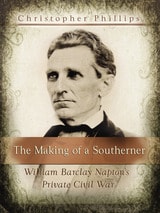
The Making of a Southerner
William Barclay Napton's Private Civil WarChristopher Phillips
University of Missouri Press, 2008

The Panic of 1819
The First Great DepressionAndrew H. Browning
University of Missouri Press, 2024
The Panic introduced Americans to the new phenomenon of boom and bust, changed the country's attitudes towards wealth and poverty, spurred the political movement that became Jacksonian Democracy, and helped create the sectional divide that would lead to the Civil War. Although it stands as one of the turning points of American history, few Americans today have heard of the Panic of 1819, with the result that we continue to ignore its lessons—and repeat its mistakes.
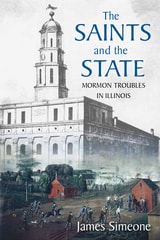
The Saints and the State
The Mormon Troubles in IllinoisJames Simeone
Ohio University Press, 2021
A compelling history of the 1846 Mormon expulsion from Illinois that exemplifies the limits of American democracy and religious tolerance.
When members of the Church of Jesus Christ of Latter-day Saints (known as Mormons) settled in Illinois in 1839, they had been persecuted for their beliefs from Ohio to Missouri. Illinoisans viewed themselves as religiously tolerant egalitarians and initially welcomed the Mormons to their state. However, non-Mormon locals who valued competitive individualism perceived the saints‘ western Illinois settlement, Nauvoo, as a theocracy with too much political power. Amid escalating tensions in 1844, anti-Mormon vigilantes assassinated church founder Joseph Smith and his brother Hyrum. Two years later, the state expelled the saints. Illinois rejected the Mormons not for their religion, but rather for their effort to create a self-governing state in Nauvoo.
Mormons put the essential aspirations of American liberal democracy to the test in Illinois. The saints’ inward group focus and their decision to live together in Nauvoo highlight the challenges strong group consciousness and attachment pose to democratic governance. The Saints and the State narrates this tragic story as an epic failure of governance and shows how the conflicting demands of fairness to the Mormons and accountability to Illinois’s majority became incompatible.
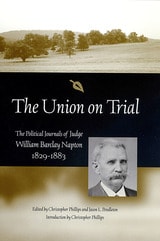
The Union on Trial
The Political Journals of Judge William Barclay Napton, 1829-1883Edited by Christopher Phillips & Jason L. Pendleton. Introduction by Christopher Phillips
University of Missouri Press, 2005
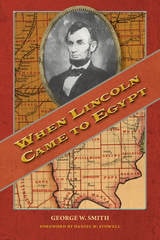
When Lincoln Came to Egypt
George W. Smith, with a Foreword by Daniel W. Stowell
Southern Illinois University Press, 2017
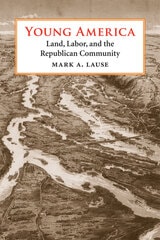
Young America
Land, Labor, and the Republican CommunityMark A. Lause
University of Illinois Press, 2005
Rooting the movement in contemporary economic structures and social ideology, Young America examines this urban and working-class "agrarianism," demonstrating how the political preoccupations of this movement transformed socialism by drawing its adherents from communitarian preoccupations into political action. The alliance of the NRA's land reformers and radical abolitionists led unprecedented numbers to petition Congress and established the foundations of what became the new Republican Party, promising "Free Soil, Free Labor, Free Men."