Results by title

7 books match the query 'To 1960'
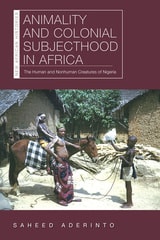
cover of Animality and Colonial Subjecthood in Africa: The Human and Nonhuman Creatures of Nigeria

Animality and Colonial Subjecthood in Africa

The Human and Nonhuman Creatures of Nigeria

Saheed Aderinto

Ohio University Press, 2022
With this multispecies study of animals as instrumentalities of the colonial state in Nigeria, Saheed Aderinto argues that animals, like humans, were colonial subjects in Africa. Animality and Colonial Subjecthood in Africa broadens the historiography of animal studies by putting a diverse array of species (dogs, horses, livestock, and wildlife) into a single analytical framework for understanding colonialism in Nigeria and Africa as a whole. From his study of animals with unequal political, economic, social, and intellectual capabilities, Aderinto establishes that the core dichotomies of human colonial subjecthood—indispensable yet disposable, good and bad, violent but peaceful, saintly and lawless—were also embedded in the identities of Nigeria’s animal inhabitants. If class, religion, ethnicity, location, and attitude toward imperialism determined the pattern of relations between human Nigerians and the colonial government, then species, habitat, material value, threat, and biological and psychological characteristics (among other traits) shaped imperial perspectives on animal Nigerians. Conceptually sophisticated and intellectually engaging, Aderinto’s thesis challenges readers to rethink what constitutes history and to recognize that human agency and narrative are not the only makers of the past.
[more]
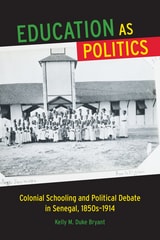
cover of Education as Politics: Colonial Schooling and Political Debate in Senegal, 1850s–1914

Education as Politics

Colonial Schooling and Political Debate in Senegal, 1850s–1914

Kelly M. Duke Bryant

University of Wisconsin Press, 2015

In 1914, Blaise Diagne was elected as Senegal’s first black African representative to the National Assembly in France. Education as Politics reinterprets the origins and significance of this momentous election, showing how colonial schools had helped reshape African power and politics during the preceding decades and how they prepared the way for Diagne’s victory.
            Kelly M. Duke Bryant demonstrates the critical impact of colonial schooling on Senegalese politics by examining the response to it by Africans from a variety of backgrounds and statuses—including rural chiefs, Islamic teachers, and educated young urbanites. For those Africans who chose to engage with them, the French schools in Senegal provided a new source of patronage, a potentially beneficial connection to the bureaucratizing colonial state, a basis for claims to authority or power, or an arena in which to debate pressing issues like the future of Qur’anic schooling and the increasing racism of urban society under colonial rule.
            Based on evidence from archives in Senegal and France, and on interviews Duke Bryant conducted in Senegal, she demonstrates that colonial schooling remade African politics during this period of transition to French rule, creating political spaces that were at once African and colonial, and ultimately allowing Diagne to claim election victory.
[more]
cover of Moral Economies of Corruption: State Formation and Political Culture in Nigeria

Moral Economies of Corruption

State Formation and Political Culture in Nigeria

Steven Pierce

Duke University Press, 2016
Nigeria is famous for "419" e-mails asking recipients for bank account information and for scandals involving the disappearance of billions of dollars from government coffers. Corruption permeates even minor official interactions, from traffic control to university admissions. In Moral Economies of Corruption Steven Pierce provides a cultural history of the last 150 years of corruption in Nigeria as a case study for considering how corruption plays an important role in the processes of political change in all states. He suggests that corruption is best understood in Nigeria, as well as in all other nations, as a culturally contingent set of political discourses and historically embedded practices. The best solution to combatting Nigerian government corruption, Pierce contends, is not through attempts to prevent officials from diverting public revenue to self-interested ends, but to ask how public ends can be served by accommodating Nigeria's history of patronage as a fundamental political principle.
 
 
[more]
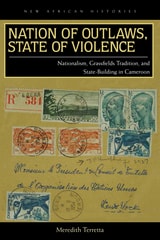
cover of Nation of Outlaws, State of Violence: Nationalism, Grassfields Tradition, and State Building in Cameroon

Nation of Outlaws, State of Violence

Nationalism, Grassfields Tradition, and State Building in Cameroon

Meredith Terretta

Ohio University Press, 2014

Nation of Outlaws, State of Violence is the first extensive history of Cameroonian nationalism to consider the global and local influences that shaped the movement within the French and British Cameroons and beyond. Drawing on the archives of the United Nations, France, Great Britain, Ghana, and Cameroon, as well as oral sources, Nation of Outlaws, State of Violence chronicles the spread of the Union des populations du Cameroun (UPC) nationalist movement from the late 1940s into the first postcolonial decade. It shows how, in the French and British Cameroon territories administered as UN Trusteeships after the Second World War, notions of international human rights, the promise of Third World independence, Pan-African federation, and national citizenship blended with local political and spiritual practices that resurfaced as the period of European rule came to a close. After French and British administrators banned the party in the mid-1950s, UPC nationalists adopted violence as a revolutionary strategy. In the 1960s, the nationalist vision disintegrated. The postcolonial regime labeled UPC nationalists “outlaws” and rounded them up for imprisonment or execution as the state shifted to single-party rule in 1966.

Nation of Outlaws, State of Violence traces the connection between local and transregional politics in the age of Africa’s decolonization and the early decades of the Cold War. Rather than stop at official independence as most conventional histories of African nationalist movements do, this book considers postindependence events as crucial to the history of Cameroonian nationalism and to an understanding of the postcolonial government that came to power on 1 January 1960. While the history of the UPC is a story that ends with the party’s failure to gain access to political power with independence, it is also a story of the postcolonial state’s failure to become a nation.
[more]
cover of The Doctor Who Would Be King

The Doctor Who Would Be King

Guillaume Lachenal

Duke University Press, 2022
In The Doctor Who Would Be King Guillaume Lachenal tells the extraordinary story of Dr. Jean Joseph David, a French colonial army doctor who governed an entire region of French Cameroon during World War II. Dr. David—whom locals called “emperor”—dreamed of establishing a medical utopia. Through unchecked power, he imagined realizing the colonialist fantasy of emancipating colonized subjects from misery, ignorance, and sickness. Drawing on archives, oral histories, and ethnographic fieldwork, Lachenal traces Dr. David’s earlier attempts at a similar project on a Polynesian island and the ongoing legacies of his failed experiment in Cameroon. Lachenal does not merely recount a Conradian tale of imperial hubris, he brings the past into the present, exploring the memories and remains of Dr. David’s rule to reveal a global history of violence, desire, and failure in which hope for the future gets lost in the tragic comedy of power.
[more]
cover of The Great Upheaval: Women and Nation in Postwar Nigeria

The Great Upheaval

Women and Nation in Postwar Nigeria

Judith A. Byfield

Ohio University Press, 2021
This social and intellectual history of women’s political activism in postwar Nigeria reveals the importance of gender to the study of nationalism and poses new questions about Nigeria’s colonial past and independent future. In the years following World War II, the women of Abeokuta, Nigeria, staged a successful tax revolt that led to the formation first of the Abeokuta Women’s Union and then of Nigeria’s first national women’s organization, the Nigerian Women’s Union, in 1949. These organizations became central to a new political vision, a way for women across Nigeria to define their interests, desires, and needs while fulfilling the obligations and responsibilities of citizenship. In The Great Upheaval, Judith A. Byfield has crafted a finely textured social and intellectual history of gender and nation making that not only tells a story of women’s postwar activism but also grounds it in a nuanced account of the complex tax system that generated the “upheaval.” Byfield captures the dynamism of women’s political engagement in Nigeria’s postwar period and illuminates the centrality of gender to the study of nationalism. She thus offers new lines of inquiry into the late colonial era and its consequences for the future Nigerian state. Ultimately, she challenges readers to problematize the collapse of her female subjects' greatest aspiration, universal franchise, when the country achieved independence in 1960.
[more]
cover of When Sex Threatened the State: Illicit Sexuality, Nationalism, and Politics in Colonial Nigeria, 1900-1958

When Sex Threatened the State

Illicit Sexuality, Nationalism, and Politics in Colonial Nigeria, 1900-1958

Saheed Aderinto

University of Illinois Press, 2015

Breaking new ground in the understanding of sexuality's complex relationship to colonialism, When Sex Threatened the State illuminates the attempts at regulating prostitution in colonial Nigeria.
 
As Saheed Aderinto shows, British colonizers saw prostitution as an African form of sexual primitivity and a problem to be solved as part of imperialism's "civilizing mission". He details the Nigerian response to imported sexuality laws and the contradictory ways both African and British reformers advocated for prohibition or regulation of prostitution. Tracing the tensions within diverse groups of colonizers and the colonized, he reveals how wrangling over prostitution camouflaged the negotiating of separate issues that threatened the social, political, and sexual ideologies of Africans and Europeans alike.
 
The first book-length project on sexuality in early twentieth century Nigeria, When Sex Threatened the State combines the study of a colonial demimonde with an urban history of Lagos and a look at government policy to reappraise the history of Nigerian public life.
[more]