Results by title
3 books match the query 'To 1975'
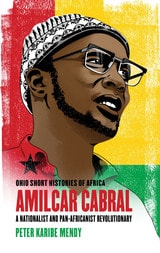
Amílcar Cabral
A Nationalist and Pan-Africanist RevolutionaryPeter Karibe Mendy
Ohio University Press, 2019
Amílcar Cabral was an agronomist who led an armed struggle that ended Portuguese colonialism in Guinea-Bissau and Cabo Verde. The uprising contributed significantly to the collapse of a fascist regime in Lisbon and the dismantlement of Portugal’s empire in Africa. Assassinated by a close associate with the deep complicity of the Portuguese colonial authorities, Cabral not only led one of Africa’s most successful liberation movements, but was the voice and face of the anticolonial wars against Portugal.
A brilliant military strategist and astute diplomat, Cabral was an original thinker who wrote innovative and inspirational essays that still resonate today. His charismatic and visionary leadership, his active pan-Africanist solidarity and internationalist commitment to “every just cause in the world,” remain relevant to contemporary struggles for emancipation and self-determination. Peter Karibe Mendy’s compact and accessible biography is an ideal introduction to his life and legacy.
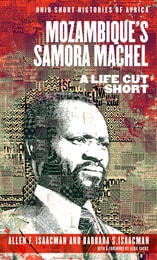
Mozambique’s Samora Machel
A Life Cut ShortAllen F. Isaacman
Ohio University Press, 2020
The precipitous rise and controversial fall of a formidable African leader.
Samora Machel (1933–1986), the son of small-town farmers, led his people through a war against their Portuguese colonists and became the first president of the People’s Republic of Mozambique.
Machel’s military successes against a colonial regime backed by South Africa, Rhodesia, the United States, and its NATO allies enhanced his reputation as a revolutionary hero to the oppressed people of Southern Africa. In 1986, during the country’s civil war, Machel died in a plane crash under circumstances that remain uncertain.
Allen and Barbara Isaacman lived through many of these changes in Mozambique and bring personal recollections together with archival research and interviews with others who knew Machel or participated in events of the revolutionary or post-revolutionary years.
The Phenomenology of Pain
Saulius Geniusas
Ohio University Press, 2020
The Phenomenology of Pain is the first book-length investigation of its topic to appear in English. Groundbreaking, systematic, and illuminating, it opens a dialogue between phenomenology and such disciplines as cognitive science and cultural anthropology to argue that science alone cannot clarify the nature of pain experience without incorporating a phenomenological approach. Building on this premise, Saulius Geniusas develops a novel conception of pain grounded in phenomenological principles: pain is an aversive bodily feeling with a distinct experiential quality, which can only be given in original first-hand experience, either as a feeling-sensation or as an emotion.
Geniusas crystallizes the fundamental methodological principles that underlie phenomenological research. On the basis of those principles, he offers a phenomenological clarification of the fundamental structures of pain experience and contests the common conflation of phenomenology with introspectionism. Geniusas analyzes numerous pain dissociation syndromes, brings into focus the de-personalizing and re-personalizing nature of chronic pain experience, and demonstrates what role somatization and psychologization play in pain experience. In the process, he advances Husserlian phenomenology in a direction that is not explicitly worked out in Husserl’s own writings.