Results by title
3 books match the query 'Toil'
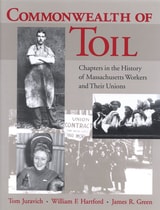
Commonwealth of Toil
Chapters in the History of Massachusetts Workers and Their UnionsThomas Juravich
University of Massachusetts Press, 1996
Over the past two centuries, Massachusetts workers have fought for many important advances that would later be enjoyed by other Americans. The right to organize, restrictions on work hours and child labor, and workers' compensation were all pioneered in the Commonwealth. From the 1825 strike of Boston carpenters for a ten-hour day to recent victories in hospitals and universities, Massachusetts workers and their unions have been in the forefront of the battle for dignity and justice.
This book tells their story. In eighteen chapters, beginning with the first industrial workers in the nation—the Lowell “mill girls”—the authors describe the struggles of working men and women to improve their lives. In the process, the book provides a valuable perspective on the development of the American labor movement.

The Voice of Toil
Nineteenth-Century British Writings about WorkDavid J. Bradshaw
Ohio University Press, 1999
One of the most recurrent and controversial subjects of nineteenth–century discourse was work. Many thinkers associated work with honest pursuit of doing good, not the curse accompanying exile from Eden but rather “a great gift of God.” Sincerely undertaken work comprised a mission entailing a commitment to serve others and promote a better future for all.
Satisfaction with what work could do for individuals had its counterbalance in the anger and dismay expressed at the conditions of those whom Robert Owen, in 1817, first called the “working class.” What working–class people confronted both at the labor site and at their lodgings was construed as oppressive, and the misery of their lives became the subject of sentimental poetry, government report, popular fiction, and journalistic expose. Perhaps as heated as the discussion about conditions of lower–class workers was the conversation about separate spheres of work for men and women. This conversation, too, found its way into the literature and public discourse of the day.
In The Voice of Toil, the editors have collected the central writings from a pivotal place and time, including poems, stories, essays, and a play that reflect four prominent ways in which the subject of work was addressed: Work as Mission, Work as Opportunity, Work as Oppression, and (Separate) Spheres of Work. The resulting anthology offers a provocative text for students of nineteenth-century British literature and history and a valuable resource for scholars.
The text includes readings from John Wesley, William Blake, Elizabeth Gaskell, William Wordsworth, Charles Dickens, Florence Nightingale, William Morris, Joanna Baillie, Friedrich Engels, Matthew Arnold, Angela Burdett–Coutts, John Stuart Mill, Elizabeth Barrett Browning, Bernard Shaw and many others.
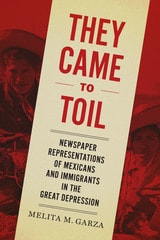
They Came to Toil
Newspaper Representations of Mexicans and Immigrants in the Great DepressionBy Melita M. Garza
University of Texas Press, 2018
As the Great Depression gripped the United States in the early 1930s, the Hoover administration sought to preserve jobs for Anglo-Americans by targeting Mexicans, including long-time residents and even US citizens, for deportation. Mexicans comprised more than 46 percent of all people deported between 1930 and 1939, despite being only 1 percent of the US population. In all, about half a million people of Mexican descent were deported to Mexico, a “homeland” many of them had never seen, or returned voluntarily in fear of deportation.
They Came to Toil investigates how the news reporting of this episode in immigration history created frames for representing Mexicans and immigrants that persist to the present. Melita M. Garza sets the story in San Antonio, a city central to the formation of Mexican American identity, and contrasts how the city’s three daily newspapers covered the forced deportations of Mexicans. She shows that the Spanish-language La Prensa not surprisingly provided the fullest and most sympathetic coverage of immigration issues, while the locally owned San Antonio Express and the Hearst chain-owned San Antonio Light varied between supporting Mexican labor and demonizing it. Garza analyzes how these media narratives, particularly in the English-language press, contributed to the racial “othering” of Mexicans and Mexican Americans. Adding an important new chapter to the history of the Long Civil Rights Movement, They Came to Toil brings needed historical context to immigration issues that dominate today’s headlines.