Results by title
5 books match the query 'Tokugawa period, 1600-1868'
Education in Tokugawa Japan
R. P. Dore
University of Michigan Press, 1992
“This careful and important study of the development of the varied types of education in the last two and a half centuries of feudalism in Japan under the Tokugawa dictatorship (1600–1868) is more than a history of premodern education. It is also an intellectual history and a history of the educational philosophy of the writers of that period. Basing his work on extensive Japanese primary sources, the author has selected and organized his material well; thus his study fills an important gap in our knowledge of Japanese history.” —Hugh Borton, Haverford College, American Historical Review 71, no. 4 (July 1966): 1410–11.
“There is no other book like it. . . . Readers already familiar with earlier books by Ronald Dore will rightly have guessed that we have been given yet another tour de force. Utilizing a remarkable amount of primary source material and discussing its implications with his customary grace and clarity, the author deals with the educational institutions for both samurai and commoner and the curricula of the bewildering variety of schools of Japan from the beginning of the 17th century through the Meiji Restoration in 1868. Yet this is in no sense a book of restricted interest, for it has as much to say to the student of sociocultural change as to the Japan specialist.” —R. J. Smith, Cornell University, American Anthropologist 68, no. 4 (August 1966), 1086–87.
[more]
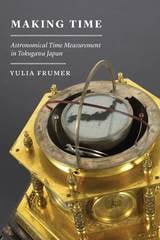
Making Time
Astronomical Time Measurement in Tokugawa JapanYulia Frumer
University of Chicago Press, 2017
What is time made of? We might balk at such a question, and reply that time is not made of anything—it is an abstract and universal phenomenon. In Making Time, Yulia Frumer upends this assumption, using changes in the conceptualization of time in Japan to show that humans perceive time as constructed and concrete.
In the mid-sixteenth century, when the first mechanical clocks arrived in Japan from Europe, the Japanese found them interesting but useless, because they failed to display time in units that changed their length with the seasons, as was customary in Japan at the time. In 1873, however, the Japanese government adopted the Western equal-hour system as well as Western clocks. Given that Japan carried out this reform during a period of rapid industrial development, it would be easy to assume that time consciousness is inherent to the equal-hour system and a modern lifestyle, but Making Time suggests that punctuality and time-consciousness are equally possible in a society regulated by a variable-hour system, arguing that this reform occurred because the equal-hour system better reflected a new conception of time — as abstract and universal—which had been developed in Japan by a narrow circle of astronomers, who began seeing time differently as a result of their measurement and calculation practices. Over the course of a few short decades this new way of conceptualizing time spread, gradually becoming the only recognized way of treating time.
In the mid-sixteenth century, when the first mechanical clocks arrived in Japan from Europe, the Japanese found them interesting but useless, because they failed to display time in units that changed their length with the seasons, as was customary in Japan at the time. In 1873, however, the Japanese government adopted the Western equal-hour system as well as Western clocks. Given that Japan carried out this reform during a period of rapid industrial development, it would be easy to assume that time consciousness is inherent to the equal-hour system and a modern lifestyle, but Making Time suggests that punctuality and time-consciousness are equally possible in a society regulated by a variable-hour system, arguing that this reform occurred because the equal-hour system better reflected a new conception of time — as abstract and universal—which had been developed in Japan by a narrow circle of astronomers, who began seeing time differently as a result of their measurement and calculation practices. Over the course of a few short decades this new way of conceptualizing time spread, gradually becoming the only recognized way of treating time.
[more]
Peasant Uprisings in Japan
A Critical Anthology of Peasant HistoriesEdited by Anne Walthall
University of Chicago Press, 1991
Combining translations of five peasant narratives with critical commentary on their provenance and implications for historical study, this book illuminates the life of the peasantry in Tokugawa Japan.
[more]
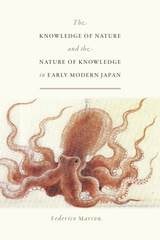
The Knowledge of Nature and the Nature of Knowledge in Early Modern Japan
Federico Marcon
University of Chicago Press, 2015
Between the early seventeenth and the mid-nineteenth century, the field of natural history in Japan separated itself from the discipline of medicine, produced knowledge that questioned the traditional religious and philosophical understandings of the world, developed into a system (called honzogaku) that rivaled Western science in complexity—and then seemingly disappeared. Or did it? In The Knowledge of Nature and the Nature of Knowledge in Early Modern Japan, Federico Marcon recounts how Japanese scholars developed a sophisticated discipline of natural history analogous to Europe’s but created independently, without direct influence, and argues convincingly that Japanese natural history succumbed to Western science not because of suppression and substitution, as scholars traditionally have contended, but by adaptation and transformation.
The first book-length English-language study devoted to the important field of honzogaku, The Knowledge of Nature and the Nature of Knowledge in Early Modern Japan will be an essential text for historians of Japanese and East Asian science, and a fascinating read for anyone interested in the development of science in the early modern era.
The first book-length English-language study devoted to the important field of honzogaku, The Knowledge of Nature and the Nature of Knowledge in Early Modern Japan will be an essential text for historians of Japanese and East Asian science, and a fascinating read for anyone interested in the development of science in the early modern era.
[more]
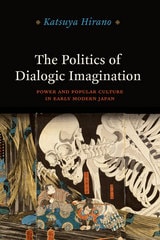
The Politics of Dialogic Imagination
Power and Popular Culture in Early Modern JapanKatsuya Hirano
University of Chicago Press, 2013
In The Politics of Dialogic Imagination, Katsuya Hirano seeks to understand why, with its seemingly unrivaled power, the Tokugawa shogunate of early modern Japan tried so hard to regulate the ostensibly unimportant popular culture of Edo (present-day Tokyo)—including fashion, leisure activities, prints, and theater. He does so by examining the works of writers and artists who depicted and celebrated the culture of play and pleasure associated with Edo’s street entertainers, vagrants, actors, and prostitutes, whom Tokugawa authorities condemned to be detrimental to public mores, social order, and political economy.
Hirano uncovers a logic of politics within Edo’s cultural works that was extremely potent in exposing contradictions between the formal structure of the Tokugawa world and its rapidly changing realities. He goes on to look at the effects of this logic, examining policies enacted during the next era—the Meiji period—that mark a drastic reconfiguration of power and a new politics toward ordinary people under modernizing Japan. Deftly navigating Japan’s history and culture, The Politics of Dialogic Imaginationprovides a sophisticated account of a country in the process of radical transformation—and of the intensely creative culture that came out of it.
[more]