Results by title
3 books match the query 'Tokyo (Japan)'
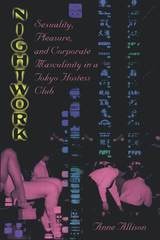
Nightwork
Sexuality, Pleasure, and Corporate Masculinity in a Tokyo Hostess ClubAnne Allison
University of Chicago Press, 1994
In Nightwork, Anne Allison opens a window onto Japanese corporate culture and gender identities. Allison performed the ritualized tasks of a hostess in one of Tokyo's many "hostess clubs": pouring drinks, lighting cigarettes, and making flattering or titillating conversation with the businessmen who came there on company expense accounts. Her book critically examines how such establishments create bonds among white-collar men and forge a masculine identity that suits the needs of their corporations.
Allison describes in detail a typical company outing to such a club—what the men do, how they interact with the hostesses, the role the hostess is expected to play, and the extent to which all of this involves "play" rather than "work." Unlike previous books on Japanese nightlife, Allison's ethnography of one specific hostess club (here referred to as Bijo) views the general phenomenon from the eyes of a woman, hostess, and feminist anthropologist.
Observing that clubs like Bijo further a kind of masculinity dependent on the gestures and labors of women, Allison seeks to uncover connections between such behavior and other social, economic, sexual, and gendered relations. She argues that Japanese corporate nightlife enables and institutionalizes a particular form of ritualized male dominance: in paying for this entertainment, Japanese corporations not only give their male workers a self-image as phallic man, but also develop relationships to work that are unconditional and unbreakable. This is a book that will appeal to anyone interested in gender roles or in contemporary Japanese society.
[more]
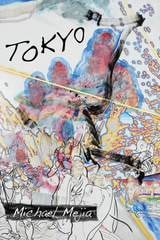
TOKYO
Michael Mejia
University of Alabama Press, 2018
A novel in three parts, linked by a single narrative of disaster, loss, and longing.
TOKYO is an incisive, shape-shifting tour de force, a genre-bending mix of lyric prose, science fiction, horror, and visual collage exploring the erotic undercurrents of American perceptions of Japanese culture and identity.
By turns noir, surreal, and clinical in its language and style, TOKYO employs metaphors of consumption, disease, theater, gender fluidity, monstrousness, and ecological disaster in intertwined accounts touching on matters of cultural appropriation, fiction's powerful capacity to produce immersive realities, and the culturally corrupting late capitalist excesses that entangle both the United States and Japan.
The novel opens with a fantastic, slyly comic report written by a Japanese executive, describing the anomalous bluefin tuna his company purchased at Tokyo’s iconic fish market, as well as the dissolution of the executive’s marriage to his Japanese-American, or Sansei, wife. But when an American writer—whose own Sansei wife was previously married to a Japanese executive—begins investigating the report’s author and his claims, assisted by a mysterious Japanese correspondent the American suspects may once have been his wife’s lover, identities begin to scramble until it’s uncertain who is imagining who, and who is and isn’t Japanese. Meanwhile, a secret plot to establish pure Japaneseness through the global distribution of genetically engineered bluefin tuna seems to be rushing toward its conclusion like a great wave.
[more]
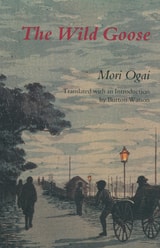
The Wild Goose
Mori Ogai; Translated with an Introduction by Burton Watson
University of Michigan Press, 1995
Mori Ōgai (1862–1922), one of the giants of modern Japanese literature, wrote The Wild Goose at the turn of the century. Set in the early 1880s, it was, for contemporary readers, a nostalgic return to a time when the nation was embarking on an era of dramatic change. Ōgai’s narrator is a middle-aged man reminiscing about an unconsummated affair, dating to his student days, between his classmate and a young woman kept by a moneylender. At a time when writers tended to depict modern, alienated male intellectuals, the characters of The Wild Goose are diverse, including not only students preparing for a privileged intellectual life and members of the plebeian classes who provide services to them, but also a pair of highly developed female characters. The author’s sympathetic and penetrating portrayal of the dilemmas and frustrations faced by women in this early period of Japan’s modernization makes the story of particular interest to readers today.
Ōgai was not only a prolific and popular writer, but also a protean figure in early modern Japan: critic, translator, physician, military officer, and eventually Japan’s Surgeon General. His rigorous and broad education included the Chinese classics as well as Dutch and German; he gained admittance to the Medical School of Tokyo Imperial University at the age of only fifteen. Once established as a military physician, he was sent to Germany for four years to study aspects of European medicine still unfamiliar to the Japanese. Upon his return, he produced his first works of fiction and translations of English and European literature. Ōgai’s writing is extolled for its unparalleled style and psychological insight, nowhere better demonstrated than in The Wild Goose.
[more]