Results by title
5 books match the query 'Tollison, Robert D.'
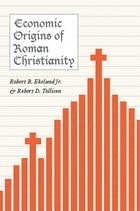
Economic Origins of Roman Christianity
Robert B. Ekelund Jr. and Robert D. Tollison
University of Chicago Press, 2011
In the global marketplace of ideas, few realms spark as much conflict as religion. For millions of people, it is an integral part of everyday life, reflected by a widely divergent supply of practices and philosophical perspectives. Yet, historically, the marketplace has not always been competitive. While the early Common Era saw competition between Christianity, Judaism, and the many pagan cults, Roman Christianity came eventually to dominate Western Europe.
Using basic concepts of economic theory, Robert B. Ekelund Jr. and Robert D. Tollison explain the origin and subsequent spread of Roman Christianity, showing first how the standard concepts of risk, cost, and benefit can account for the demand for religion. Then, drawing on the economics of networking, entrepreneurship, and industrial organization, the book explains Christianity's rapid ascent. Like a business, the church developed sound business strategies that increased its market share to a near monopoly in the medieval period. This book offers a fascinating look at the dynamics of Christianity’s rise, as well as how aspects the church’s structure—developed over the first millennium—illuminate a number of critical problems faced by the church today.
[more]
Predicting Politics
Essays in Empirical Public ChoiceW. Mark Crain and Robert D. Tollison, Editors
University of Michigan Press, 1990
Predicting Politics: Essays in Empirical Public Choice explores politics in an empirical spirit. The topics covered are novel and important, including the impact of campaign finance on the size of government, the economics of gerrymandering, constitutional change, and budgetary politics. The approach is to formulate and to test interesting hypotheses about political behavior. The essential idea is to illustrate the power of public choice theory in explaining actual politics.The volume brings together the work of Crain and Tollison and other scholars who have worked in this public choice tradition, and shows the power of empirical approaches in explaining the origin and inner working of political institutions and processes.
[more]

The National Collegiate Athletic Association
A Study in Cartel BehaviorArthur A. Fleisher III, Brian L. Goff, and Robert D. Tollison
University of Chicago Press, 1992
Intercollegiate sports is an enterprise that annually grosses over $1 billion in income. Some schools receive more than $20 million from athletic programs, perhaps as much as $10 million simply from the sale of football tickets.
Probing the history and business practices of the most powerful sports organization of colleges and universities in the United States, the authors present a persuasive case that the NCAA is in fact a cartel, its members engaged in classically defined restrictive practices for the sole purpose of jointly maximizing their profits.
This fresh perspective on the NCAA's institutional structure helps to explain why illicit payments to athletes persist, why non-NCAA organizations have not flourished, and why members have readily agreed on certain suspect rules.
Offering a valuable case study for sports analysts and students of economics and cartel behavior, this book is a revealing glimpse inside the embattled NCAA program.
[more]
The Theory of Public Choice-II
James M. Buchanan and Robert D. Tollison, Editors
University of Michigan Press, 1984
The Theory of Public Choice is a landmark volume that brings together key essays and articles charting the rapid evolution of public choice theory during its most formative decade. Edited by James M. Buchanan and Robert D. Tollison—leading figures in the “Virginian School” of political economy—this collection synthesizes the major advances of public choice as it applies the tools of economic analysis to the workings of democratic and political institutions.The volume begins with overviews of the field’s development, highlighting public choice’s foundational challenge to “romantic” notions of government and its turn toward a more realistic, empirical understanding of collective decision-making. Renowned contributors—including Buchanan, Dennis Mueller, Gordon Tullock, and many others—explore subjects from voting theory and constitutional economics to rent-seeking, bureaucracy, and the political economy of welfare and regulation.Organized into topical sections covering theoretical advances, applications, empirical studies, and philosophical issues, The Theory of Public Choice illuminates how economics, political science, and policy analysis intersect. Whether addressing topics like political resource allocation, the logic of majority rule, or the emergence of tax and spending limitations, these essays demonstrate how public choice theory has reshaped the way scholars, policymakers, and citizens think about government.Accessible yet rigorous, this collection is essential for anyone seeking insight into the mechanisms of collective action, constitutional design, and the ongoing challenge of ensuring accountability and efficiency in public institutions. It stands as a vital resource for students and scholars in economics, political science, public policy, and related fields.
[more]

Theory of Public Choice
Political Applications of EconomicsJames M. Buchanan and Robert D. Tollison, Editors
University of Michigan Press, 1981
The Theory of Public Choice, edited by Nobel Laureate James M. Buchanan and Robert D. Tollison, serves as a landmark volume synthesizing the foundational principles of the "Virginia School" of political economy. The collection famously strips away the "romantic" assumption that politicians and bureaucrats act solely as benevolent public servants, analyzing political behavior instead through the lens of economic self-interest and utility maximization. Across its collected essays, the book demonstrates how the analytical tools of marketplace economics can be systematically applied to collective decision-making, exploring critical concepts such as voting rules, bureaucracy, special interest groups, and the mechanics of rent-seeking. Ultimately, this essential text provides a realistic, empirical framework for understanding institutional design and government limitations, making it a foundational resource for students and scholars of political science, public policy, and constitutional economics
[more]