Results by title
6 books match the query 'Toulmin, Stephen'
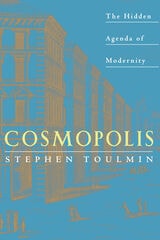
Cosmopolis
The Hidden Agenda of ModernityStephen Toulmin
University of Chicago Press, 1992
A daring account of the philosophical development of the idea of a rational society and its consequences for the present
In the seventeenth century, a vision arose which was to captivate the Western imagination for the next three hundred years: the vision of Cosmopolis, a society as rationally ordered as the Newtonian view of nature. While fueling extraordinary advances in all fields of human endeavor, this vision perpetuated a hidden yet persistent agenda: the delusion that human nature and society could be fitted into precise and manageable rational categories. Stephen Toulmin confronts that agenda—its illusions and its consequences for our present and future world.
In the seventeenth century, a vision arose which was to captivate the Western imagination for the next three hundred years: the vision of Cosmopolis, a society as rationally ordered as the Newtonian view of nature. While fueling extraordinary advances in all fields of human endeavor, this vision perpetuated a hidden yet persistent agenda: the delusion that human nature and society could be fitted into precise and manageable rational categories. Stephen Toulmin confronts that agenda—its illusions and its consequences for our present and future world.
[more]

The Architecture of Matter
Stephen Toulmin and June Goodfield
University of Chicago Press, 1982
"Warmly recommended. It is that rare achievement, a lively book which at the same time takes the fullest possible advantage of scholarly knowledge."—Charles C. Gillespie, New York Times Book Review
[more]

The Discovery of Time
Stephen Toulmin and June Goodfield
University of Chicago Press, 1982
"A discussion of the historical development of our ideas of time as they relate to nature, human nature and society. . . . The excellence of The Discovery of Time is unquestionable."—Martin Lebowitz, The Kenyon Review
[more]
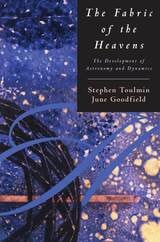
The Fabric of the Heavens
The Development of Astronomy and DynamicsStephen Toulmin and June Goodfield
University of Chicago Press, 1999
Conceived as three companion volumes that form an introduction to the central ideas of the modern natural sciences, these books—intelligent, informative, and accessible—are an excellent source for those who have no technical knowledge of the subject.
Praise for The Fabric of the Heavens:
"I cannot remember when I last went through a book, any book, with such all-devouring zest. What is more, even the most complex technicalities are reduced to a positively crystalline clarity: If I can understand them, anyone can. The Fabric of the Heavens is, in every sense of the word, an eye-opener."—Peter Green, The Yorkshire Post
"Not until the last chapter of the book is [the reader] allowed to think again wholly as a modern man has become accustomed, by common sense, to think. The discipline is admirably suited to the authors' task, and cunningly devised for the reader's edification—and, indeed, for his delight."—Physics Today
Praise for The Architecture of Matter:
"The Architecture of Matter is to be warmly recommended. It is that rare achievement, a lively book which at the same time takes the fullest possible advantage of scholarly knowledge."—Charles C. Gillespie, New York Times Book Review
"One is impressed by the felicity of the examples and by the lively clarity with which significant experiments and ideas are explained. . . . No other history of science is so consistently challenging."—Scientific American
Praise for The Discovery of Time:
"A subject of absorbing interest . . . is presented not as a history of science, but as a chapter in the history of ideas from the ancient Greeks to our own time."—Times Literary Supplement
[more]
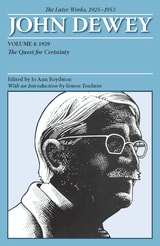
The Later Works of John Dewey, Volume 4, 1925 - 1953
1929: The Quest for CertaintyJohn Dewey. Edited by Jo Ann Boydston
Southern Illinois University Press, 2008
This volume provides an authoritative edition of Dewey’s The Quest for Certainty: A Study of the Relation Between Knowledge and Action. The book is made up of the Gifford Lectures delivered April–May 1929 at the University of Edinburgh. Writing to Sidney Hook, Dewey described this work as “a criticism of philosophy as attempting to attain theoretical certainty.” In the Philosophical Review Max C. Otto later elaborated: “Mr. Dewey wanted, so far as lay in his power, to crumble into dust, once and for all, ‘the chief fortress of the classic philosophical tradition.”
[more]

The Structure of Scientific Theories
Edited by Frederick Suppe
University of Illinois Press, 1977
[more]