Results by title
82 books match the query 'Tourism' and 7 start with a
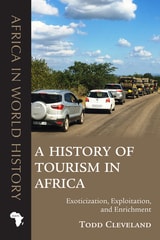
A History of Tourism in Africa
Exoticization, Exploitation, and EnrichmentTodd Cleveland
Ohio University Press, 2021
An engaging social history of foreign tourists’ dreams, the African tourism industry’s efforts to fulfill them, and how both sides affect each other.
Since the nineteenth century, foreign tourists and resident tourism workers in Africa have mutually relied upon notions of exoticism, but from vastly different perspectives. Many of the countless tourists who have traveled to the African continent fail to acknowledge or even realize that skilled African artists in the tourist industry repeatedly manufacture “authentic” experiences in order to fulfill foreigners’ often delusional, or at least uninformed, expectations. These carefully nurtured and controlled performances typically reinforce tourists’ reductive impressions—formed over centuries—of the continent, its peoples, and even its wildlife. In turn, once back in their respective homelands, tourists’ accounts of their travels often substantiate, and thereby reinforce, prevailing stereotypes of “exotic” Africa. Meanwhile, Africans’ staged performances not only impact their own lives, primarily by generating remunerative opportunities, but also subject the continent’s residents to objectification, exoticization, and myriad forms of exploitation.
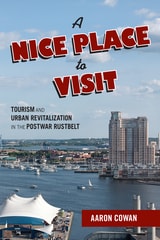
A Nice Place to Visit
Tourism and Urban Revitalization in the Postwar RustbeltAaron Cowan
Temple University Press, 2016
How did tourism gain a central role in the postwar American Rustbelt city? And how did tourism development reshape the meaning and function of these cities? These are the questions at the heart of Aaron Cowan’s groundbreaking book, A Nice Place to Visit.
Cowan provides an insightful, comparative look at the historical development of Cincinnati, St. Louis, Pittsburgh, and Baltimore in the post–World War II period to show how urban tourism provided a potential solution to the economic woes of deindustrialization. A Nice Place to Visit chronicles the visions of urban leaders who planned hotels, convention centers, stadiums, and festival marketplaces to remake these cities as tourist destinations. Cowan also addresses the ever-present tensions between tourist development and the needs and demands of residents in urban communities.
A Nice Place to Visit charts how these Rustbelt cities adapted to urban decline and struggled to meet the challenge of becoming an appealing place to visit, as well as good and just communities in which to live.

A Return to Servitude
Maya Migration and the Tourist Trade in CancúnM. Bianet Castellanos
University of Minnesota Press, 2010
A Return to Servitude is an ethnography of Maya migration within Mexico that analyzes the foundational role indigenous peoples play in the development of the modern nation-state. Focusing on tourism in the Yucatán Peninsula, M. Bianet Castellanos examines how Cancún came to be equated with modernity, how this city has shaped the political economy of the peninsula, and how indigenous communities engage with this vision of contemporary life. More broadly, she demonstrates how indigenous communities experience, resist, and accommodate themselves to transnational capitalism.
Tourism and the social stratification that results from migration have created conflict among the Maya. At the same time, this work asserts, it is through engagement with modernity and its resources that they are able to maintain their sense of indigeneity and community.
After The Boom In Tombstone And Jerome, Arizona
Decline In Western Resource TownsEric L. Clements
University of Nevada Press, 2014
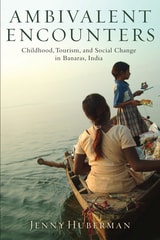
Ambivalent Encounters
Childhood, Tourism, and Social Change in Banaras, IndiaHuberman, Jenny
Rutgers University Press, 2012
Jenny Huberman provides an ethnographic study of encounters between western tourists and the children who work as unlicensed peddlers and guides along the riverfront city of Banaras, India. She examines how and why these children elicit such powerful reactions from western tourists and locals in their community as well as how the children themselves experience their work and render it meaningful.
Ambivalent Encounters brings together scholarship on the anthropology of childhood, tourism, consumption, and exchange to ask why children emerge as objects of the international tourist gaze; what role they play in representing socio-economic change; how children are valued and devalued; why they elicit anxieties, fantasies, and debates; and what these tourist encounters teach us more generally about the nature of human interaction. It examines the role of gender in mediating experiences of social change—girls are praised by locals for participating constructively in the informal tourist economy while boys are accused of deviant behavior. Huberman is interested equally in the children’s and adults’ perspectives; her own experiences as a western visitor and researcher provide an intriguing entry into her interpretations.
Download the open access ebook here.
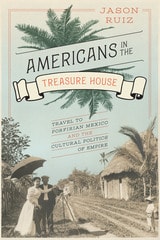
Americans in the Treasure House
Travel to Porfirian Mexico and the Cultural Politics of EmpireBy Jason Ruiz
University of Texas Press, 2014
When railroads connected the United States and Mexico in 1884 and overland travel between the two countries became easier and cheaper, Americans developed an intense curiosity about Mexico, its people, and its opportunities for business and pleasure. Indeed, so many Americans visited Mexico during the Porfiriato (the long dictatorship of Porfirio Díaz, 1876–1911) that observers on both sides of the border called the hordes of tourists and business speculators a “foreign invasion,” an apt phrase for a historical moment when the United States was expanding its territory and influence.
Americans in the Treasure House examines travel to Mexico during the Porfiriato, concentrating on the role of travelers in shaping ideas of Mexico as a logical place for Americans to extend their economic and cultural influence in the hemisphere. Analyzing a wealth of evidence ranging from travelogues and literary representations to picture postcards and snapshots, Jason Ruiz demonstrates that American travelers constructed Mexico as a nation at the cusp of modernity, but one requiring foreign intervention to reach its full potential. He shows how they rationalized this supposed need for intervention in a variety of ways, including by representing Mexico as a nation that deviated too dramatically from American ideals of progress, whiteness, and sexual self-control to become a modern “sister republic” on its own. Most importantly, Ruiz relates the rapid rise in travel and travel discourse to complex questions about national identity, state power, and economic relations across the U.S.–Mexico border.
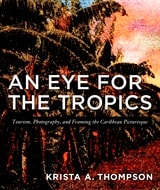
An Eye for the Tropics
Tourism, Photography, and Framing the Caribbean PicturesqueKrista A. Thompson
Duke University Press, 2006
Illustrated with more than one hundred images, including many in color, An Eye for the Tropics is a nuanced evaluation of the aesthetics of the “tropicalizing images” and their effects on Jamaica and the Bahamas. Thompson describes how representations created to project an image to the outside world altered everyday life on the islands. Hoteliers imported tropical plants to make the islands look more like the images. Many prominent tourist-oriented spaces, including hotels and famous beaches, became off-limits to the islands’ black populations, who were encouraged to act like the disciplined, loyal colonial subjects depicted in the pictures.
Analyzing the work of specific photographers and artists who created tropical representations of Jamaica and the Bahamas between the 1880s and the 1930s, Thompson shows how their images differ from the English picturesque landscape tradition. Turning to the present, she examines how tropicalizing images are deconstructed in works by contemporary artists—including Christopher Cozier, David Bailey, and Irénée Shaw—at the same time that they remain a staple of postcolonial governments’ vigorous efforts to attract tourists.