Results by title
4 books match the query 'Trace'
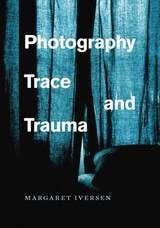
Photography, Trace, and Trauma
Margaret Iversen
University of Chicago Press, 2017
Examining photography and film, molds, rubbings, and more, Margaret Iversen considers how these artistic processes can be understood as presenting or simulating a residue, trace, or “index” of a traumatic event. These approaches, which involve close physical contact or the short-circuiting of artistic agency, are favored by artists who wish to convey the disorienting effect and elusive character of trauma. Informing the work of a number of contemporary artists—including Tacita Dean, Jasper Johns, Mary Kelly, Gabriel Orozco, and Gerhard Richter—the concept of the trace is shown to be vital for any account of the aesthetics of trauma; it has left an indelible mark on the history of photography and art as a whole.
The Trace of Judaism
Dostoevsky, Babel, Mandelstam, LevinasVal Vinokur
Northwestern University Press, 2009
The defining quality of Russian literature, for most critics, is its ethical seriousness expressed through formal originality. The Trace of Judaism addresses this characteristic through the thought of the Lithuanian-born Franco-Jewish philosopher Emmanuel Levinas. Steeped in the Russian classics from an early age, Levinas drew significantly from Dostoevsky in his ethical thought. One can profitably read Russian literature through Levinas, and vice versa.
Toward a Sociology of the Trace
Herman Gray
University of Minnesota Press, 2010
The contributors utilize empirically based studies of social policy, political economy, and social institutions to offer a new way of looking at the creation of meaning, representation, and memory. They scrutinize subjects such as narratives in the U.S. coal industry's change from digging mines to removing mountaintops; war-related redress policies in post-World War II Japan; views of masculinity linked to tequila, Pancho Villa, and the Mexican Revolution; and the politics of subjectivity in 1970s political violence in Thailand.
Contributors: Sarah Banet-Weiser, U of Southern California; Barbara A. Barnes, U of California, Berkeley; Marie Sarita Gaytán; Avery F. Gordon, U of California, Santa Barbara; Tanya McNeill, U of California, Santa Cruz; Sudarat Musikawong, Willamette U; Akiko Naono, U of Kyushu; Rebecca R. Scott, U of Missouri.
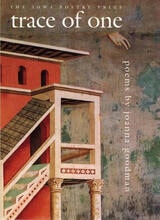
Trace of One
Joanna Goodman
University of Iowa Press, 2002
In Trace of One,real geographies merge with spiritual ones, just as details of the speaker’s physical and emotional worlds intertwine with the transcendent realms of science, religion, and myth. Joanna Goodman’s poems share a sense of spatial and temporal displacement—they are love poems to a place, whether it be a field, a room, or a paradise—they celebrate their subjects, but they are also poems of grief and solitude. The poems resonate with ethereal echoes paradoxically emitted by an increasingly demystified world in which mechanical explanations for the workings of the human mind and body bump up against the mystery and obliqueness of the soul.