Results by title

8 books match the query 'Traffic'
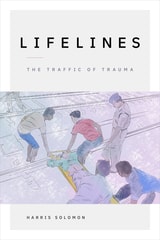
cover of Lifelines: The Traffic of Trauma

Lifelines

The Traffic of Trauma

Harris Solomon

Duke University Press, 2022
In Lifelines Harris Solomon takes readers into the trauma ward of one of Mumbai’s busiest public hospitals, narrating the stories of the patients, providers, and families who experience and care for traumatic injuries due to widespread traffic accidents. He traces trauma’s moves after the accident: from scenes of road and railway injuries to ambulance interiors; through emergency triage, surgery, and intensive care; and from the morgue for patients who do not survive into the homes of those who do. These pathways reveal how trauma shifts inequalities, infrastructures, and institutions through the lives and labors of clinical spaces. Solomon contends that medicine itself must be understood in terms of lifelines: patterns of embodied movement that determine survival. In reflecting on the centrality of traffic to life, Lifelines explores a fundamental question: How does medicine move us?
[more]
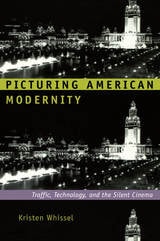
cover of Picturing American Modernity: Traffic, Technology, and the Silent Cinema

Picturing American Modernity

Traffic, Technology, and the Silent Cinema

Kristen Whissel

Duke University Press, 2008

In Picturing American Modernity, Kristen Whissel investigates the relationship between early American cinema and the experience of technological modernity. She demonstrates how between the late 1890s and the eve of the First World War moving pictures helped the U.S. public understand the possibilities and perils of new forms of “traffic” produced by industrialization and urbanization. As more efficient ways to move people, goods, and information transformed work and leisure at home and contributed to the expansion of the U.S. empire abroad, silent films presented compelling visual representations of the spaces, bodies, machines, and forms of mobility that increasingly defined modern life in the United States and its new territories.

Whissel shows that by portraying key events, achievements, and anxieties, the cinema invited American audiences to participate in the rapidly changing world around them. Moving pictures provided astonishing visual dispatches from military camps prior to the outbreak of fighting in the Spanish-American War. They allowed audiences to delight in images of the Pan-American Exposition, and also to mourn the assassination of President McKinley there. One early film genre, the reenactment, presented spectators with renditions of bloody battles fought overseas during the Philippine-American War. Early features offered sensational dramatizations of the scandalous “white slave trade,” which was often linked to immigration and new forms of urban work and leisure. By bringing these frequently distant events and anxieties “near” to audiences in cities and towns across the country, the cinema helped construct an American national identity for the machine age.
[more]
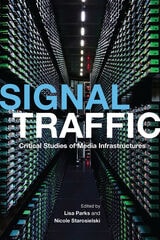
cover of Signal Traffic: Critical Studies of Media Infrastructures

Signal Traffic

Critical Studies of Media Infrastructures

Edited by Lisa Parks and Nicole Starosielski

University of Illinois Press, 2015

The contributors to Signal Traffic investigate how the material artifacts of media infrastructure--transoceanic cables, mobile telephone towers, Internet data centers, and the like--intersect with everyday life. Essayists confront the multiple and hybrid forms networks take, the different ways networks are imagined and engaged with by publics around the world, their local effects, and what human beings experience when a network fails.

Some contributors explore the physical objects and industrial relations that make up an infrastructure. Others venture into the marginalized communities orphaned from the knowledge economies, technological literacies, and epistemological questions linked to infrastructural formation and use. The wide-ranging insights delineate the oft-ignored contrasts between industrialized and developing regions, rich and poor areas, and urban and rural settings, bringing technological differences into focus.

Contributors include Charles R. Acland, Paul Dourish, Sarah Harris, Jennifer Holt and Patrick Vonderau, Shannon Mattern, Toby Miller, Lisa Parks, Christian Sandvig, Nicole Starosielski, Jonathan Sterne, and Helga Tawil-Souri.

[more]
cover of Telecommunications Traffic, Tariffs and Costs: An Introduction for Managers

Telecommunications Traffic, Tariffs and Costs

An Introduction for Managers

R.E. Farr

The Institution of Engineering and Technology, 1988
This book has been written with the intention of helping those who ore concerned with planning, ordering, managing and using telecommunications facilities in connection with their business activities, and who do not wish to obtain a detailed technical and mathematical knowledge of the subject. The various types of telecommunications traffic are analysed without recourse to the underlying theory, and the reader is introduced to the terminology and operation of modern telecommunications systems and networks. Particular attention is paid to the relationship between traffic-carrying capacity and cost, and to the importance of traffic measurement and forecasting as a means of matching equipment provision to demand. The role of performance targets is discussed and the book explains how a comparison between public-network tariff options and the cost of private system and network alternatives can ensure a cost-effective solution to any communications problem. The principles are demonstrated by simple worked examples and a detailed glossary of terms is included.
[more]
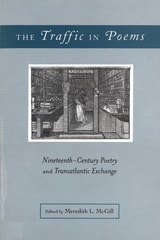
cover of The Traffic In Poems: Nineteenth-Century Poetry and Transatlantic Exchange

The Traffic In Poems

Nineteenth-Century Poetry and Transatlantic Exchange

McGill, Meredith L

Rutgers University Press, 2008

The transatlantic crossing of people and goods shaped nineteenth-century poetry in surprising ways that cannot be fully understood through the study of separate national literary traditions. American and British poetic cultures were bound by fascination, envy, influence, rivalry, recognition, and piracy, as well as by mutual fantasies about and competition over the Caribbean.

Drawing on examples such as Felicia Hemans's elaboration of the foundational American myth of Plymouth Rock, Emma Lazarus's ambivalent welcome of Europe's cast-off populations, black abolitionist Mary Webb's European performances of Hiawatha, and American reprints of Robert Browning and George Meredith, the eleven essays in this book focus on poetic depictions of exile, slavery, immigration, and citizenship and explore the often asymmetrical traffic between British and American poetic cultures.
[more]
cover of The Traffic in Women's Work: East European Migration and the Making of Europe

The Traffic in Women's Work

East European Migration and the Making of Europe

Anca Parvulescu

University of Chicago Press, 2014
“Welcome to the European family!” When East European countries joined the European Union under this banner after 1989, they agreed to the free movement of goods, services, capital, and persons. In this book, Anca Parvulescu analyzes an important niche in this imagined European kinship: the traffic in women, or the circulation of East European women in West Europe in marriage and as domestic servants, nannies, personal attendants, and entertainers. Analyzing film, national policies, and an impressive range of work by theorists from Giorgio Agamben to Judith Butler, she develops a critical lens through which to think about the transnational continuum of “women’s work.”
 
Parvulescu revisits Claude Lévi-Strauss’s concept of kinship and its rearticulation by second-wave feminists, particularly Gayle Rubin, to show that kinship has traditionally been anchored in the traffic in women. Reading recent cinematic texts that help frame this, she reveals that in contemporary Europe, East European migrant women are exchanged to engage in labor customarily performed by wives within the institution of marriage. Tracing a pattern of what she calls Americanization, Parvulescu argues that these women thereby become responsible for the labor of reproduction. A fascinating cultural study as much about the consequences of the enlargement of the European Union as women’s mobility, The Traffic in Women’s Work questions the foundations of the notion of Europe today.
[more]
cover of Traffic in Asian Women

Traffic in Asian Women

Laura Hyan Yi Kang

Duke University Press, 2020

In Traffic in Asian Women Laura Hyun Yi Kang demonstrates that the figure of "Asian women" functions as an analytic with which to understand the emergence, decline, and permutation of U.S. power/knowledge at the nexus of capitalism, state power, global governance, and knowledge production throughout the twentieth century. Kang analyzes the establishment, suppression, forgetting, and illegibility of the Japanese military "comfort system" (1932–1945) within that broader geohistorical arc. Although many have upheld the "comfort women" case as exemplary of both the past violation and the contemporary empowerment of Asian women, Kang argues that it has profoundly destabilized the imaginary unity and conceptual demarcation of the category. Kang traces how "Asian women" have been alternately distinguished and effaced as subjects of the traffic in women, sexual slavery, and violence against women. She also explores how specific modes of redress and justice were determined by several overlapping geopolitical and economic changes ranging from U.S.-guided movements of capital across Asia and the end of the Cold War to the emergence of new media technologies that facilitated the global circulation of "comfort women" stories.
[more]
cover of Traffic with Macbeth

Traffic with Macbeth

Larissa Szporluk

Tupelo Press, 2011

A buffeting sequence of dramatic monologues that provoke and disturb, Larissa Szporluk’s Traffic with Macbeth evokes a dark world linked to the black magic of Shakespeare’s tortured Scottish assassin, usurper of kings. Baroque in their sweep of high style and low slang, melody and dissonance, these poems use shifting animate and inanimate speakers and surrealist leaps to convey human brutality, the vulnerability of women and children, madness, and the struggle to escape the limitations of this world.

[more]