Results by title
3 books match the query 'Trans - Mississippi'
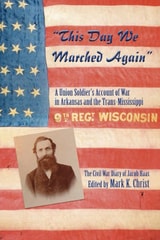
"This Day We Marched Again"
A Union Soldier's Account of War in Arkansas and the Trans-MississippiMark K. Christ
Butler Center for Arkansas Studies, 2014
A testament to the valor and determination of a common soldier On September 17, 1861, twenty-two-year-old Jacob Haas enlisted in the Sheboygan Tigers, a company of German immigrants that became Company A of the Ninth Wisconsin Infantry Regiment. Over the next three years, Haas and his comrades marched thousands of miles and saw service in Arkansas, Kansas, Missouri, and the Indian Territory, including pitched battles at Newtonia, Missouri, and Jenkins’ Ferry, Arkansas. Haas describes the war from the perspective of a private soldier and an immigrant as he marches through scorching summers and brutally cold winters to fight in some of the most savage combat in the west. His diary shows us an extraordinary story of the valor and determination of a volunteer soldier. Though his health was ruined by war, Haas voiced no regrets for the price he paid to fight for his adopted country.
[more]

I Acted from Principle
The Civil War Diary of Dr. William M. McPheeters, Confederate Surgeon in the Trans-MississippiCynthia DeHaven Pitcock
University of Arkansas Press, 2000
At the start of the Civil War, Dr. William McPheeters was a distinguished physician in St. Louis, conducting unprecedented public-health research, forging new medical standards, and organizing the state's first professional associations. But Missouri was a volatile border state. Under martial law, Union authorities kept close watch on known Confederate sympathizers. McPheeters was followed, arrested, threatened, and finally, in 1862, given an ultimatum: sign an oath of allegiance to the Union or go to federal prison. McPheeters "acted from principle" instead, fleeing by night to Confederate territory. He served as a surgeon under Gen. Sterling Price and his Missouri forces west of the Mississippi River, treating soldiers' diseases, malnutrition, and terrible battle wounds. From almost the moment of his departure, the doctor kept a diary. It was a pocket-size notebook which he made by folding sheets of pale blue writing paper in half and in which he wrote in miniature with his steel pen. It is the first known daily account by a Confederate medical officer in the Trans-Mississippi Department. It also tells his wife's story, which included harassment by Federal military officials, imprisonment in St. Louis, and banishment from Missouri with the couple's two small children. The journal appears here in its complete and original form, exactly as the doctor first wrote it, with the addition of the editors' full annotation and vivid introductions to each section.
[more]

Women in Civil War Texas
Diversity and Dissidence in the Trans-MississippiDeborah M. Liles
University of North Texas Press, 2016
[more]