Results by title
3 books match the query 'Transgender people in literature'
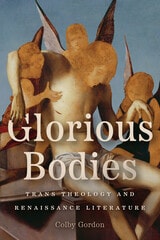
Glorious Bodies
Trans Theology and Renaissance LiteratureColby Gordon
University of Chicago Press, 2024
A prehistory of transness that recovers early modern theological resources for trans lifeworlds.
In this striking contribution to trans history, Colby Gordon challenges the prevailing assumption that trans life is a byproduct of recent medical innovation by locating a cultural imaginary of transition in the religious writing of the English Renaissance. Marking a major intervention in early modern gender studies, Glorious Bodies insists that transition happened, both socially and surgically, hundreds of years before the nineteenth-century advent of sexology. Pairing literary texts by Shakespeare, Webster, Donne, and Milton with a broad range of primary sources, Gordon examines the religious tropes available to early modern subjects for imagining how gender could change. From George Herbert’s invaginated Jesus and Milton’s gestational Adam to the ungendered “glorious body” of the resurrection, early modern theology offers a rich conceptual reservoir of trans imagery.
In uncovering early modern trans theology, Glorious Bodies mounts a critique of the broad consensus that secularism is a necessary precondition for trans life, while also combating contemporary transphobia and the right-wing Christian culture war seeking to criminalize transition. Developing a rehabilitative account of theology’s value for positing trans lifeworlds, this book leverages premodern religion to imagine a postsecular transness in the present.
[more]
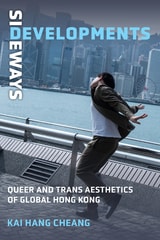
Sideways Developments
Queer and Trans Aesthetics of Global Hong KongKai Hang Cheang
University of Michigan Press, 2026
Sideways Developments examines Hong Kong Anglophone and Cantophone literature and visual culture to trace the forms of queer and trans survival and flourishing in the Asian century. Contesting the cisgender, heterosexual, linear tropes that constitute developmentalist narratives deployed by superpowers—from colonial Britain to 20th-century America to a rising China—Cheang argues that sideways aesthetics define the narratives through which the LGBTQ+ community navigates personal and socioeconomic transitions. Through formalist analyses of a range of genres, Cheang reveals the affordances of queer and trans cultures for addressing the question of Hong Kong during its period of promised transition until 2047.
In this moment of multiple crises, Sideways Developments offers a timely hermeneutic and theory of solidarity and sustainability. The book tracks how sideways aesthetics have evolved from a feature of LGBTQ+ plots, performance, and nonlinear approaches to space-time to a form of togetherness that links postcolonial Hong Kong with struggles worldwide. Using what Cheang terms intersectional formalism as an analytical tool, the book provides a multilayered examination of the alternative pathways exemplified by queer and trans resilience and regeneration.
In this moment of multiple crises, Sideways Developments offers a timely hermeneutic and theory of solidarity and sustainability. The book tracks how sideways aesthetics have evolved from a feature of LGBTQ+ plots, performance, and nonlinear approaches to space-time to a form of togetherness that links postcolonial Hong Kong with struggles worldwide. Using what Cheang terms intersectional formalism as an analytical tool, the book provides a multilayered examination of the alternative pathways exemplified by queer and trans resilience and regeneration.
[more]
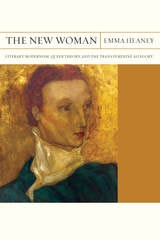
The New Woman
Literary Modernism, Queer Theory, and the Trans Feminine AllegoryEmma Heaney
Northwestern University Press, 2017
The New Woman: Literary Modernism, Queer Theory, and the Trans Feminine Allegory traces the use of the trans feminine as an allegorical figure, from the practice's origins in nineteenth-century sexology through writings in the fields of psychoanalysis, Modernist fiction, and contemporary Queer Theory.
The book is the first to identify the process by which medical sources simplified the diversity of trans feminine experience into a single diagnostic narrative. It then demonstrates that this medical figure became an archetype for the "sexual anarchy" of the Modernist period in works by Aldous Huxley, James Joyce, Djuna Barnes, T. S. Eliot, and Jean Genet.
Thus illuminating the trans feminine's Modernist provenance, the book examines foundational works of Queer Theory that resuscitated the trans feminine allegory at the end of the twentieth century. Insightful and seminal, The New Woman debunks the pervasive reflex beginning in the 1990s to connect trans experience to a late twentieth-century collapse of sexual differences by revealing the Modernist roots of that very formulation.
[more]