Results by title
10 books match the query 'Transit'
And the Monkey Learned Nothing
Dispatches from a Life in TransitTom Lutz
University of Iowa Press, 2016
In Transit
Transport Workers Union In Nyc 1933-66Joshua Freeman
Temple University Press, 2001
Isherwood in Transit
James J. Berg
University of Minnesota Press, 2020
New perspectives on Christopher Isherwood as a searching and transnational writer
“Perhaps I had traveled too much, left my heart in too many places,” muses the narrator of Christopher Isherwood’s novel Prater Violet (1945), which he wrote in his adopted home of Los Angeles after years of dislocation and desperation. In Isherwood in Transit, James J.Berg and Chris Freeman bring together diverse Isherwood scholars to understand the challenges this writer faced as a consequence of his travel.
Based on a conference at the Huntington Library, where Isherwood’s recently opened papers are held, Isherwood in Transit considers the writer not as an English, continental, or American writer but as a transnational one, whose identity, politics, and beliefs were constantly transformed by global connections and engagements arising from journeys to Germany, Japan, China, and Argentina; his migration to the United States; and his conversion to Vedanta Hinduism in the 1940s.
Approaching Isherwood’s rootlessness and restlessness from various perspectives, these essays show that long after he made a new home in California and became an American citizen, Christopher Isherwood remained unsettled, although his wanderings became spiritual and personal rather than geographic.
Contributors: Barrie Jean Borich, DePaul U; Jamie Carr, Niagara U; Robert L. Caserio, Penn State U, University Park; Lisa Colletta, American U of Rome; Lois Cucullu, U of Minnesota; Jaime Harker, U of Mississippi; Carola M. Kaplan, California State U, Pomona; Calvin W. Keogh, Central European U, Budapest; Victor Marsh; Wendy Moffat, Dickinson College; Xenobe Purvis; Bidhan Roy, California State U, Los Angeles; Katharine Stevenson, U of Texas at Austin; Edmund White.
Letters of Transit
Theodore Worozbyt
University of Massachusetts Press, 2008
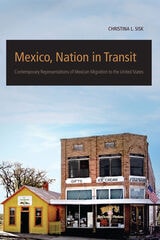
Mexico, Nation in Transit
Contemporary Representations of Mexican Migration to the United StatesChristina L. Sisk
University of Arizona Press, 2011
Sisk’s transnational investigation moves easily across the US–Mexico border, analyzing films made on both sides, literature de la frontera, Mexican rock music, migrant narratives, and texts written by second- and third-generation immigrants. Included are the perspectives of those who left Mexico, those who were left behind, and the children who travel back “home.” Sisk discovers that the loss of Mexicans to the United States through emigration has had an effect on Mexico similar to the impact of the perceived Mexican invasion of the United States.
Spanning the social sciences and the humanities, Mexico, Nation in Transit poses a new transnational alternative to the postnational view that geopolitical borders are being erased by the forces of migration and globalization, and the nationalist view that borders must be strictly enforced. It shows that borders, like identities, are not easy to locate precisely.
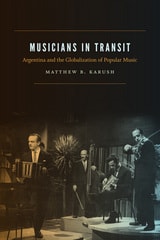
Musicians in Transit
Argentina and the Globalization of Popular MusicMatthew B. Karush
Duke University Press, 2017

Soft Weapons
Autobiography in TransitGillian Whitlock
University of Chicago Press, 2007
Azar Nafisi’s Reading Lolita in Tehran,Marjane Satrapi’s comics, and “Baghdad Blogger” Salam Pax’s Internet diary are just a few examples of the new face of autobiography in an age of migration, globalization, and terror. But while autobiography and other genres of life writing can help us attend to people whose experiences are frequently unseen and unheard, life narratives can also be easily co-opted into propaganda. In Soft Weapons, Gillian Whitlock explores the dynamism and ubiquity of contemporary life writing about the Middle East and shows how these works have been packaged, promoted, and enlisted in Western controversies.
Considering recent autoethnographies of Afghan women, refugee testimony from Middle Eastern war zones, Jean Sasson’s bestsellers about the lives of Arab women, Norma Khouri’s fraudulent memoir Honor Lost, personal accounts by journalists reporting the war in Iraq, Satrapi’s Persepolis, Nafisi’s book, and Pax’s blog, Whitlock explores the contradictions and ambiguities in the rapid commodification of life memoirs. Drawing from the fields of literary and cultural studies, Soft Weapons will be essential reading for scholars of life writing and those interested in the exchange of literary culture between Islam and the West.

The Transit of Empire
Indigenous Critiques of ColonialismJodi A. Byrd
University of Minnesota Press, 2011
In 1761 and again in 1768, European scientists raced around the world to observe the transit of Venus, a rare astronomical event in which the planet Venus passes in front of the sun. In The Transit of Empire, Jodi A. Byrd explores how indigeneity functions as transit, a trajectory of movement that serves as precedent within U.S. imperial history. Byrd argues that contemporary U.S. empire expands itself through a transferable “Indianness” that facilitates acquisitions of lands, territories, and resources.
Examining an array of literary texts, historical moments, and pending legislations—from the Cherokee Nation of Oklahoma’s vote in 2007 to expel Cherokee Freedmen to the Native Hawaiian Government Reorganization bill—Byrd demonstrates that inclusion into the multicultural cosmopole does not end colonialism as it is purported to do. Rather, that inclusion is the very site of the colonization that feeds U.S. empire.
Byrd contends that the colonization of American Indian and indigenous nations is the necessary ground from which to reimagine a future where the losses of indigenous peoples are not only visible and, in turn, grieveable, but where indigenous peoples have agency to transform life on their own lands and on their own terms.
Transit
Serpent Mound Crossing Space, Time, DiscourseChadwick Allen
University of Chicago Press, 2026
In Transit, Chadwick Allen chronicles the surprising history of how the ancient snake effigy known as Serpent Mound, located in what is now southern Ohio, traveled to Seattle, Washington in the 1970s, at the height of American Indian activism associated with the Red Power movement. Allen considers Indigenous earthworks built for thousands of years across the eastern half of the North American continent, questioning what it would mean if they were understood not as static entities fixed in space and time, but as animate forces with the ability to travel. Allen also looks at the origins of the “modern” effigy in the nineteenth century, when archaeologists reconstructed Serpent Mound’s deteriorating form to create a static icon suitable for touristic display within the confines of a settler state memorial.
Drawing from archival research, interviews, and site-specific encounters, Transit meditates on the significance of building an earthen effigy in the Pacific Northwest, as part of what became the Daybreak Star Indian Cultural Center, and on the complexity of the mound’s generative contexts. Allen’s research intersects the mid-twentieth century, when artist Robert Smithson created his iconic Spiral Jetty earth sculpture and when the Muscogee (Creek) Nation designed its innovative Mound Building. The story remains ongoing in the twenty-first century, as new mounds are rising in Oklahoma and artists, activists, and intellectuals are again asserting the power of Indigenous design.

Words in Transit
Stories of ImmigrantsIlan Stavans
University of Massachusetts Press, 2016
Gathered together in a beautifully designed book that showcases Beth Reynolds's photographic portraits of each immigrant, these oral histories illuminate the many paths leading to the Pioneer Valley and demonstrate the shared experience among those seeking a new life in a foreign land. Storytellers include a massage therapist from Ireland, a Fulbright scholar from Palestine, a health educator from Taiwan, a literature professor from Spain, and a yoga teacher from Romania. Other participants hail from far-flung places including Haiti, Jamaica, El Salvador, Côte d'Ivoire, the Dominican Republic, Bhutan, Laos, Syria, Cambodia, Sri Lanka, Nepal, Congo, Slovenia, Iraq, and Ukraine. Introduced by the renowned scholar of translation and global literature Ilan Stavans, these stories testify to the resilience, bravery, and hopefulness of western New England émigrés. Proceeds from this book go to scholarships for immigrants at Holyoke Community College.