Results by title
4 books match the query 'Translations into Russian'
Made Under Pressure
Literary Translation in the Soviet Union, 1960–1991Natalia Kamovnikova
University of Massachusetts Press, 2019
During the Cold War, determined translators and publishers based in the Soviet Union worked together to increase the number of foreign literary texts available in Russian, despite fluctuating government restrictions. Based on extensive interviews with literary translators, Made Under Pressure offers an insider's look at Soviet censorship and the role translators played in promoting foreign authors—including figures like John Fowles, George Orwell, Kurt Vonnegut, Gabriel García Márquez, and William Faulkner.
Natalia Kamovnikova chronicles the literary translation process from the selection of foreign literary works to their translation, censorship, final approval, and publication. Interviews with Soviet translators of this era provide insight into how the creative work of translating and the practical work of publishing were undertaken within a politically restricted environment, and recall the bonds of community and collaboration that they developed.
Natalia Kamovnikova chronicles the literary translation process from the selection of foreign literary works to their translation, censorship, final approval, and publication. Interviews with Soviet translators of this era provide insight into how the creative work of translating and the practical work of publishing were undertaken within a politically restricted environment, and recall the bonds of community and collaboration that they developed.
[more]
Russia Reads Rousseau, 1762-1825
Thomas Barran
Northwestern University Press, 2002
This book is the first study of the dynamics and individual character of the Russian reception of Rousseau. An earlier version of the manuscript was reviewed by the Harriman Institute in 1994, and was subsequently revised and resubmitted.
[more]
The Politics of Fantasy
Magic, Children's Literature, and Fandom in Putin's RussiaEliot Borenstein
University of Wisconsin Press, 2025
What happened when J. K. Rowling’s mega-blockbuster—born in the United Kingdom and launched to global heights by Hollywood and the full force of Western marketing—came knocking on President Putin’s door? The arrival of boy wizard and international star Harry Potter in a recently neoliberal Russia was enormously influential, but neither smooth nor uncontested. The franchise quickly became a lens that focused Russian ambitions and fears during an era characterized by both the hegemony of globalized popular culture and a nationalized conservative backlash.
With crisp, engaging prose, Eliot Borenstein leaps from Harry Potter into an exploration of the culture wars and moral panics sparked in Russia by Western-inspired children’s literature, extending back into the Soviet period and through the invasion of Ukraine. As cultural products pitched ostensibly to children, the Harry Potter books and films became the perfect objects for criticism, translation, adaptation, parody, attack, mimicry, and meme-making, allowing Russians to carve out their own space in the worldwide market of magical multiverses.
With crisp, engaging prose, Eliot Borenstein leaps from Harry Potter into an exploration of the culture wars and moral panics sparked in Russia by Western-inspired children’s literature, extending back into the Soviet period and through the invasion of Ukraine. As cultural products pitched ostensibly to children, the Harry Potter books and films became the perfect objects for criticism, translation, adaptation, parody, attack, mimicry, and meme-making, allowing Russians to carve out their own space in the worldwide market of magical multiverses.
[more]
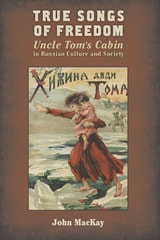
True Songs of Freedom
Uncle Tom’s Cabin in Russian Culture and SocietyJohn MacKay
University of Wisconsin Press, 2013
Harriet Beecher Stowe's 1852 antislavery novel Uncle Tom's Cabin was the nineteenth century's best-selling novel worldwide; only the Bible outsold it. It was known not only as a book but through stage productions, films, music, and commercial advertising as well. But how was Stowe's novel—one of the watershed works of world literature—actually received outside of the American context?
True Songs of Freedom explores one vital sphere of Stowe's influence: Russia and the Soviet Union, from the 1850s to the present day. Due to Russia's own tradition of rural slavery, the vexed entwining of authoritarianism and political radicalism throughout its history, and (especially after 1945) its prominence as the superpower rival of the United States, Russia developed a special relationship to Stowe's novel during this period of rapid societal change. Uncle Tom's Cabin prompted widespread reflections on the relationship of Russian serfdom to American slavery, on the issue of race in the United States and at home, on the kinds of writing appropriate for children and peasants learning to read, on the political function of writing, and on the values of Russian educated elites who promoted, discussed, and fought over the book for more than a century. By the time of the Soviet Union's collapse in 1991, Stowe's novel was probably better known by Russians than by readers in any other country.
John MacKay examines many translations and rewritings of Stowe's novel; plays, illustrations, and films based upon it; and a wide range of reactions to it by figures famous (Leo Tolstoy, Ivan Turgenev, Marina Tsvetaeva) and unknown. In tracking the reception of Uncle Tom's Cabin across 150 years, he engages with debates over serf emancipation and peasant education, early Soviet efforts to adapt Stowe's deeply religious work of protest to an atheistic revolutionary value system, the novel's exploitation during the years of Stalinist despotism, Cold War anti-Americanism and antiracism, and the postsocialist consumerist ethos.
[more]