Results by title
3 books match the query 'Transnational Imaginary'
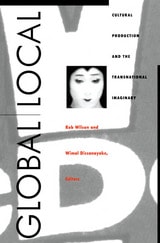
Global/Local
Cultural Production and the Transnational ImaginaryRob Wilson and Wimal Dissanayake, eds.
Duke University Press, 1996
Ranging across issues involving film, literature, and theory, as well as history, politics, economics, sociology, and anthropology, these deeply interdisciplinary essays explore the interwoven forces of globalism and localism in a variety of cultural settings, with a particular emphasis on the Asia-Pacific region. Powerful readings of the new image culture, transnational film genre, and the politics of spectacle are offered as is a critique of globalization as the latest guise of colonization. Articles that unravel the complex links between the global and local in terms of the unfolding narrative of capital are joined by work that illuminates phenomena as diverse as "yellow cab" interracial sex in Japan, machinic desire in Robocop movies, and the Pacific Rim city. An interview with Fredric Jameson by Paik Nak-Chung on globalization and Pacific Rim responses is also featured, as is a critical afterword by Paul Bové.
Positioned at the crossroads of an altered global terrain, this volume, the first of its kind, analyzes the evolving transnational imaginary—the full scope of contemporary cultural production by which national identities of political allegiance and economic regulation are being undone, and in which imagined communities are being reshaped at both the global and local levels of everyday existence.
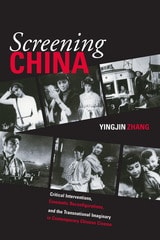
Screening China
Critical Interventions, Cinematic Reconfigurations, and the Transnational Imaginary in Contemporary Chinese CinemaZhang Yingjin
University of Michigan Press, 2001
Yingjin Zhang guides the reader through the development of Chinese film criticism, pointing out that Western critics have studied a comparatively small number of films from a much larger body of work, often with a unidirectional Eurocentric bias. The result has been that the few have influenced the many, perpetuating a cycle of production of films from China that bow to the Western notion of "Chineseness." As a corrective, the author introduces readers to a much larger canon of film and proposes a multidirectional model of film studies, one that allows for a Western reading of Chinese film yet also recognizes Chinese cinema's own voice.
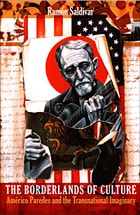
The Borderlands of Culture
Americo Paredes and the Transnational ImaginaryRamón Saldívar
Duke University Press, 2006
Saldívar demonstrates how Paredes’s poetry, prose, and journalism prefigured his later work as a folklorist and ethnographer. In song, story, and poetry, Paredes first developed the themes and issues that would be central to his celebrated later work on the “border studies” or “anthropology of the borderlands.” Saldívar describes how Paredes’s experiences as an American soldier, journalist, and humanitarian aid worker in Asia shaped his understanding of the relations between Anglos and Mexicans in the borderlands of south Texas and of national and ethnic identities more broadly. Saldívar was a friend of Paredes, and part of The Borderlands of Culture is told in Paredes’s own words. By explaining how Paredes’s work engaged with issues central to contemporary scholarship, Saldívar extends Paredes’s intellectual project and shows how it contributes to the remapping of the field of American studies from a transnational perspective.