Results by title
9 books match the query 'Transparency'
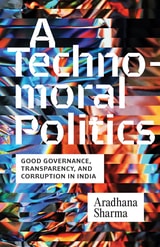
A Technomoral Politics
Good Governance, Transparency, and Corruption in IndiaAradhana Sharma
University of Minnesota Press, 2024
Examining anticorruption battles and transparency laws to ask: what makes for good governance, and can it limit liberal democratic politics as much as encourage it?
Good governance is meant to empower citizens, increase democratic participation, and make states transparent and accountable, yet this liberal democratic imperative can also promote populist authoritarian rule. Bringing together discourses on ethical goodness with the technicalities of governance as expressed in laws and policies, Aradhana Sharma develops the concept of “technomoral politics” to navigate this fraught topic. With a focus on the work of activists, citizens, and state officials, she offers an ethnographic account of the contradictions and dangers of good-governance politics in twenty-first-century India.
A Technomoral Politics follows the evolution of a group of activists in New Delhi led by Arvind Kejriwal from 2008 to 2014 as they morphed from a protransparency NGO to a mass movement against state corruption to a populist party that promised to change the political system through laws and policies. Sharma explores the technomoral framing of state opacity and corruption as well as the limits of the law in resolving these issues, probing such themes as the contradictory relationship between transparency and bureaucracy and the classed and gendered nature of democratic state institutions.
By examining scalar dimensions of good-governance politics, from the hyperlocal work of activists to global trends, A Technomoral Politics illuminates the paradoxes, limits, and risks of a system that is meant to spread liberal democratic principles but that also ends up promoting antidemocratic, populist-authoritarian forms of rule.
Retail e-book files for this title are screen-reader friendly.

Guerrilla Auditors
The Politics of Transparency in Neoliberal ParaguayKregg Hetherington
Duke University Press, 2011

Jean-Jacques Rousseau
Transparency and ObstructionJean Starobinski
University of Chicago Press, 1988
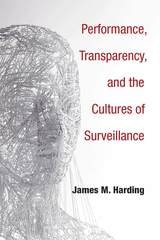
Performance, Transparency, and the Cultures of Surveillance
James M. Harding
University of Michigan Press, 2018

Radical Secrecy
The Ends of Transparency in Datafied AmericaClare Birchall
University of Minnesota Press, 2021
Reimagining transparency and secrecy in the era of digital data
When total data surveillance delimits agency and revelations of political wrongdoing fail to have consequences, is transparency the social panacea liberal democracies purport it to be? This book sets forth the provocative argument that progressive social goals would be better served by a radical form of secrecy, at least while state and corporate forces hold an asymmetrical advantage over the less powerful in data control. Clare Birchall asks: How might transparency actually serve agendas that are far from transparent? Can we imagine a secrecy that could act in the service of, rather than against, a progressive politics?
To move beyond atomizing calls for privacy and to interrupt the perennial tension between state security and the public’s right to know, Birchall adapts Édouard Glissant’s thinking to propose a digital “right to opacity.” As a crucial element of radical secrecy, she argues, this would eventually give rise to a “postsecret” society, offering an understanding and experience of the political that is free from the false choice between secrecy and transparency. She grounds her arresting story in case studies including the varied presidential styles of George W. Bush, Barack Obama, and Donald Trump; the Snowden revelations; conspiracy theories espoused or endorsed by Trump; WikiLeaks and guerrilla transparency; and the opening of the state through data portals.
Postsecrecy is the necessary condition for imagining, finally, an alternative vision of “the good,” of equality, as neither shaped by neoliberal incarnations of transparency nor undermined by secret state surveillance. Not least, postsecrecy reimagines collective resistance in the era of digital data.
Reclaiming Accountability
Transparency, Executive Power, and the U.S. ConstitutionHeidi Kitrosser
University of Chicago Press, 2014
In Reclaiming Accountability, Kitrosser traces presidentialism from its start as part of a decades-old legal movement through its appearance during the Bush and Obama administrations, demonstrating its effects on secrecy throughout. Taking readers through the key presidentialist arguments—including “supremacy” and “unitary executive theory”—she explains how these arguments misread the Constitution in a way that is profoundly at odds with democratic principles. Kitrosser’s own reading offers a powerful corrective, showing how the Constitution provides myriad tools, including the power of Congress and the courts to enforce checks on presidential power, through which we could reclaim government accountability.

Surveillance, Transparency, and Democracy
Public Administration in the Information AgeAkhlaque Haque
University of Alabama Press, 2015
Exploring the delicate balance between technological innovation, government transparency, and democratic freedom.
In this well-informed yet anxious age, public administrators have constructed vast cisterns that collect and interpret a meteoric shower of facts. Akhlaque Haque demonstrates that this pervasive use and increasing dependence on information technology (IT) enables sophisticated and well-intentioned public services that nevertheless risk deforming public policy decision-making and sees a contradiction inherent in a public that seeks services that require a level of data collection that in turn triggers fears of a tyrannical police state.
The author posits that IT’s potential as a tool for human development depends on how civil servants and citizens actively engage in identifying desired outcomes, map IT solutions to those outcomes, and routinize the applications of those solutions. This leads to his call for the development of entrepreneurs who generate innovative solutions to critical human needs and problems. In his powerful summary, he recaps possible answers to the question: What is the best way a public institution can apply technology to improving the human condition?
Engrossing, challenging, and timely, Surveillance, Transparency, and Democracy is essential reading for both policy makers as well as the great majority of readers and citizens engaged in contemporary arguments about the role of government, public health and security, individual privacy, data collection, and surveillance.

Transparency and Conspiracy
Ethnographies of Suspicion in the New World OrderHarry G. West and Todd Sanders, eds.
Duke University Press, 2003
In this collection leading anthropologists reveal the variations and commonalities in conspiratorial thinking or occult cosmologies around the globe—in Korea, Tanzania, Mozambique, New York City, Indonesia, Mongolia, Nigeria, and Orange County, California. The contributors chronicle how people express profound suspicions of the United Nations, the state, political parties, police, courts, international financial institutions, banks, traders and shopkeepers, media, churches, intellectuals, and the wealthy. Rather than focusing on the veracity of these convictions, Transparency and Conspiracy investigates who believes what and why. It makes a compelling argument against the dismissal of conspiracy theories and occult cosmologies as antimodern, irrational oversimplifications, showing how these beliefs render the world more complex by calling attention to its contradictions and proposing alternative ways of understanding it.
Contributors. Misty Bastian, Karen McCarthy Brown, Jean Comaroff, John Comaroff, Susan Harding, Daniel Hellinger, Caroline Humphrey, Laurel Kendall, Todd Sanders, Albert Schrauwers, Kathleen Stewart, Harry G. West
Transparency in Population Forecasting
Methods for Fitting and Projecting Fertility, Mortality and MigrationJoop de Beer
Amsterdam University Press, 2011