Results by title

5 books match the query 'Transport'
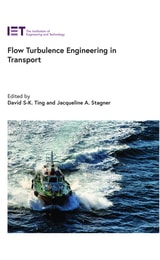
cover of Flow Turbulence Engineering in Transport

Flow Turbulence Engineering in Transport

David S-K. Ting

The Institution of Engineering and Technology, 2026
Turbulence in transportation occurs in the aerodynamics of vehicles, hydrodynamics of watercrafts, and combustion engines, amongst others. Turbulent flows can greatly affect the performance of vehicles, from air and water resistance, noise, and combustion quality - but it can also be exploited to improve the efficiency of the involved engineering operations. Understanding how turbulence effects occur within various transport modes can help engineers build better performing and safer vehicles, and overall improve transport networks.
[more]
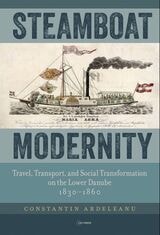
cover of Steamboat Modernity: Travel, Transport, and Social Transformation on the Lower Danube, 1830–1860

Steamboat Modernity

Travel, Transport, and Social Transformation on the Lower Danube, 1830–1860

Constantin Ardeleanu

Central European University Press, 2024

Through a skillful combination of economic and cultural history, this book describes the impact on Moldavia and Wallachia of steam navigation on the Danube. The Danube route integrated the two principalities into a dense network of European roads and waterways. From the 1830s to the 1860s, steamboat transport transformed time and space for the areas that benefited from regular services. River traffic accelerated urban development along the Lower Danube and contributed directly to institutional modernization in one of Europe’s peripheries.

Beyond technological advances and the transportation of goods on a trans-imperial waterway, steamboat travel revolutionized human interactions, too. The book offers a fascinating insight into the social and cultural milieu of the nineteenth century, drawing on first-hand accounts of Danube cruising. Describing the story of travelers who interacted, met, and visited the places they stopped, Constantin Ardeleanu creates a transnational history of travel up and down the Danube from Vienna to Constantinople. The pleasures and sometimes the travails of the travelers unfold against a backdrop of technical and economic transformation in the crucial period of modernization.

[more]
cover of Transport in Condensed Matter: Many-body theory for electronic, magnetic, and topological systems

Transport in Condensed Matter

Many-body theory for electronic, magnetic, and topological systems

Antonio Sergio Teixeira Pires

The Institution of Engineering and Technology, 2026
Transport in Condensed Matter offers a clear and comprehensive introduction to the principles that govern how charge and spin move through condensed-matter systems. The book opens with linear response theory, Green's functions, and the Boltzmann transport equation, essential tools for understanding electronic behaviour in solids. It then develops perturbation theory and diagrammatic methods, followed by a detailed treatment of impurity scattering, a crucial but often neglected ingredient in realistic transport calculations.
[more]
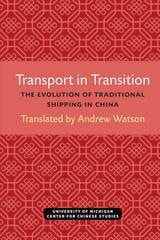
cover of Transport in Transition: The Evolution of Traditional Shipping in China

Transport in Transition

The Evolution of Traditional Shipping in China

Translated by Andrew Watson

University of Michigan Press, 1972

Water transport is a major feature of the traditional Chinese economy because of its magnitude and comparative efficiency. Yet this feature has all too often been ignored by scholars, with the notable exception of Japanese scholars. We cannot hope to gain any real conception of how the Chinese economy worked in the past, or works now, until we have a clearer picture of the circulation of men and commodities. In this circulation, water transport has been and is of crucial importance.
Transport in Transition collects and translates notable Japanese articles to throw some light on the evolution of traditional junk shipping during a key transitional phase, 1900–1940, when it was absorbing the influences of various forms of modernization and on the eve of its major organizational transformation under the direction of the Communisty Party. The articles chosen concentrate on two main themes: the institutional organization of the shipping business, and the forms of ownership and operation. They will be of value to business historians and economic sociologists generally as well as to economic historians interested in transport.
Several features of the Chinese economy are sharply illuminated. Most striking is the extent of regional variation. North and central Chinese shipping are shown to have differed both in their methods of operaiton and organization. Also noteworthy is the enduring strength of some traditional features of shipping operation and business practice. An unexpected feature of this endurance was the strength of traditional shipping in the face of steady competition from all forms of modern transport and from reputdely more efficient forms of business management.
[more]
cover of Tropes of Transport: Hegel and Emotion

Tropes of Transport

Hegel and Emotion

Katrin Pahl

Northwestern University Press, 2012

Intervening in the multidisciplinary debate on emotion, Tropes of Transport offers a fresh analysis of Hegel’s work that becomes an important resource for Pahl’s cutting-edge theory of emotionality. If it is usually assumed that the sincerity of emotions and the force of affects depend on their immediacy, Pahl explores to what extent mediation—and therefore a certain degree of manipulation but also of sympathy—is constitutive of emotionality. Hegel serves as a particularly helpful interlocutor not only because he offers a sophisticated analysis of mediation, but also because, rather than locating emotion in the heart, he introduces impersonal tropes of transport, such as trembling, release, and shattering.

[more]