Results by title
3 books match the query 'Travel in motion pictures'
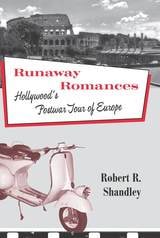
Runaway Romances
Hollywood's Postwar Tour of EuropeRobert R. Shandley
Temple University Press, 2009
In the 1950s and early 1960s, America imagined itself young and in love in Europe. And Hollywood films of the era reflected this romantic allure. From a young and naïve Audrey Hepburn falling in love with Gregory Peck inRoman Holiday to David Lean’s Summertime, featuring Katherine Hepburn’s sexual adventure in Venice, these glossy travelogue romances were shot on location, and established an exciting new genre for Hollywood.
As Robert Shandley shows in Runaway Romances, these films were not only indicative of the ideology of the American-dominated postwar world order, but they also represented a shift in Hollywood production values. Eager to capture new audiences during a period of economic crisis, Hollywood’s European output utilized the widescreen process to enhance cinematic experience. The films—To Catch a Thief, Three Coins in the Fountain, and Funny Face among them—enticed viewers to visit faraway places for romantic escapades. In the process, these runaway romances captured American fantasies for a brief, but intense, period that ended as audiences grew tired of old World splendors, and entered into a new era of sexual awakening.
The Stranger from Omaha
Travel Narratives in the Cinema of Alexander PayneJason Sperb
University of Texas Press, 2025
The first in-depth analysis of the films of Alexander Payne through the lenses of authorship, tourism, and leisure.
With the films Election, About Schmidt, Sideways, Nebraska, and The Holdovers, Alexander Payne has carved out an unusual role in American cinema as a bankable auteur. There is something about Payne’s neurotics and searchers, his working stiffs and disillusioned idealists—something funny, moving, and filled with insight.
Jason Sperb dissects Payne’s oeuvre, focusing on the director’s penchant for travel narratives. Payne’s films usually center on male protagonists discontent with the emotional and material realities of the day-to-day and seeking satisfaction in some literal or metaphorical elsewhere. But their attempts to escape wind up perpetuating, rather than alleviating, the imbalance between labor and leisure that structures modern life. In this sense, Sperb argues, Payne’s characters are akin to tourists, searching for fleeting glimpses of the fulfillment they dream about. Examining themes of masculinity, nostalgia, whiteness, and class, The Stranger from Omaha is the first auteur study devoted to Payne’s delicately balanced cinematic world. An outsider even in his own heartland, Payne proves to be an artist working at a clarifying remove—a witness to the American condition, observing from just enough distance.
Tourist Distractions
Traveling and Feeling in Transnational Hallyu CinemaYoungmin Choe
Duke University Press, 2016