90 books match the query 'Trees' and 6 start with a
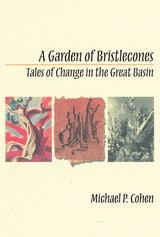
cover of A Garden Of Bristlecones: Tales Of Change In The Great Basin

A Garden Of Bristlecones

Tales Of Change In The Great Basin

Michael P. Cohen

University of Nevada Press, 1998

An engaging, well-illustrated natural and cultural history of the oldest living organism—the bristlecone pine. Since Edmund Schulman discovered in 1958 that individual bristlecones live nearly 5,000 years, the trees have been investigated primarily for the elaborate record their rings contain. The trees have been "read' closely, with major consequences for natural and human history. Historians have read local and global environmental change. Archaeologists have rewritten the history of civilization. Writers have transformed them into figures pertinent to the human dilemmas of time and eternity. A Garden of Bristlecones investigates professional and popular conceptions as a set of narratives drawn from the outside and inside of the trees. It reveals the premises of the investigators, the nature of their inquiry, and the extent of their knowledge, while also revealing the Great Basin bristlecone itself. Illustrations by Valerie Cohen.
[more]
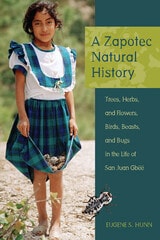
cover of A Zapotec Natural History: Trees, Herbs, and Flowers, Birds, Beasts, and Bugs in the Life of San Juan Gbëë

A Zapotec Natural History

Trees, Herbs, and Flowers, Birds, Beasts, and Bugs in the Life of San Juan Gbëë

Eugene S. Hunn

University of Arizona Press, 2008

A Zapotec Natural History is an extraordinary book (with accompanying data also available on the web here!) that describe the people of a small town in Mexico and their remarkable knowledge of the natural world in which they live. San Juan Gbëë is a Zapotec Indian community located in the state of Oaxaca, a region of surprising biological diversity. Eugene S. Hunn is a well-known anthropologist and ethnobiologist who has spent many years working in San Juan Gbëë, studying its residents and their knowledge of the local environment. Here Hunn writes sensitively and respectfully about the rich understanding of local flora and fauna that village inhabitants have acquired and transmitted over many centuries. In this village everyone, young children included, can identify and name hundreds of local plants, animals, and fungi, together with the details of their life cycles, habitat preferences, and functions in the economic, aesthetic, and spiritual lives of the town. Part 1 of this two-part work describes the community, the subsistence farming practices of its residents, the nomenclature and classification of the local biological taxonomy, the use of plants for treating illnesses, and the ritual and decorative roles of flowers. Part 2 is online and includes detailed inventories of all plant, animal, and fungal categories recognized by San Juan’s people, a series of indexes, and a library of more than 1,200 images illustrating the town’s plants, people, landscapes, and daily activities.

The contents of Part 2 are available online.
[more]
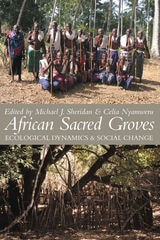
cover of African Sacred Groves: Ecological Dynamics and Social Change

African Sacred Groves

Ecological Dynamics and Social Change

Michael J. Sheridan

Ohio University Press, 2007

In western scholarship, Africa’s so-called sacred forests are often treated as the remains of primeval forests, ethnographic curiosities, or cultural relics from a static precolonial past. Their continuing importance in African societies, however, shows that this “relic theory” is inadequate for understanding current social and ecological dynamics. African Sacred Groves challenges dominant views of these landscape features by redefining the subject matter beyond the compelling yet uninformative term “sacred.” The term “ethnoforests” incorporates the environmental, social-political, and symbolic aspects of these forests without giving undue primacy to their religious values. This interdisciplinary
book by an international group of scholars and conservation practitioners provides a methodological framework for understanding these forests by examining their ecological characteristics, delineating how they relate to social dynamics and historical contexts, exploring their ideological aspects, and evaluating their strengths and weaknesses as sites for community-based resource management and the conservation of cultural and biological diversity.
[more]
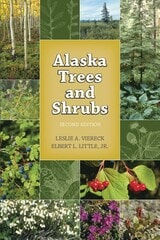
cover of Alaska Trees and Shrubs

Alaska Trees and Shrubs

Les Viereck

University of Alaska Press, 2007
Alaska Trees and Shrubs has been the definitive work on the woody plants of Alaska for more than three decades. This new, completely revised second edition provides updated information on habitat, as well as detailed descriptions of every tree or shrub species in the state. New distribution maps reflect the latest survey data, while the keys, glossary, and appendix on non-native plants make this the most useful guide to Alaska trees and shrubs ever published.
[more]
cover of Ancient Piñon-Juniper Woodlands: A Natural History of Mesa Verde Country

Ancient Piñon-Juniper Woodlands

A Natural History of Mesa Verde Country

Lisa M. Floyd

University Press of Colorado, 2003

In Ancient Piñon-Juniper Woodlands, editor Lisa Floyd gathers together noted scientists and historians to celebrate the varied and unique woodland region surrounding Mesa Verde National Park. One of the most widespread habitat types in the West, piñon-juniper woodlands have faced extensive eradication, grazing pressures, and the encroachment of human developments, and, consequently, only a few mature stands have reached their full growth potential. Mesa Verde Country, with its deep canyons and high ridgetops, is the magnificent home of many of these ancient stands.

Impressively broad in scope, Floyd's volume thoroughly explores Mesa Verde Country's important and historic ecosystem. Covering such diverse topics as geologic evolution, natural history, human history, bats, and fungi, to name but a few, this volume will appeal to scientists, resource managers, conservationists, and the lay reader with an interest in this most western of ecosystems. Technical Editors: David D. Hanna, William H. Romme and Marilyn Colyer
[more]
cover of Atlas of Nevada Conifers: A Phytogeographic Reference

Atlas of Nevada Conifers

A Phytogeographic Reference

David Alan Charlet

University of Nevada Press, 1996

Atlas of Nevada Conifers is a major scientific contribution to our understanding of the ecology of Nevada. It documents in great detail the distribution of all native conifer species in the state—critical information because of the primary ecological importance of conifers for all organisms and because of the lack of documentation of these distributions in the scientific literature before now. Charlet maps and documents the exact location of herbarium records for 1,600 individual trees. The data found in 23 tables and 22 range maps will serve as a primary reference for botanists, land managers, and conservation biologists for years to come.

[more]