Results by title

8 books match the query 'Trencsényi, Balázs'
cover of Anti-modernism: Radical Revisions of Collective Identity

Anti-modernism

Radical Revisions of Collective Identity

Ahmet Ersoy

Central European University Press, 2014
The last volume of the Discourses of Collective Identity in Central and Southeast Europe 1770–1945 series presents 46 texts under the heading of "antimodernism". In a dynamic relationship with modernism, from the 1880s to the 1940s, and especially during the interwar period, the antimodernist political discourse in the region offered complex ideological constructions of national identification. These texts rejected the linear vision of progress and instead offered alternative models of temporality, such as the cyclical one as well as various narratives of decline. This shift was closely connected to the rejection of liberal democratic institutionalism, and the preference for organicist models of social existence, emphasizing the role of the elites (and charismatic leaders) shaping the whole body politic. Along these lines, antimodernist authors also formulated alternative visions of symbolic geography: rejecting the symbolic hierarchies that focused on the normativity of Western European models, they stressed the cultural and political autarchy of their own national community, which in some cases was also coupled with the reevaluation of the Orient. At the same time, this antimodernist turn should not be confused with rightwing radicalism—in fact, the dialogue with the modernist tradition was often very subtle and the anthology also contains texts which offered a criticism of 'modern' totalitarianism in an antimodernist key.
[more]
cover of Late Enlightenment: Emergence of the Modern 'National Idea'

Late Enlightenment

Emergence of the Modern 'National Idea'

Marius Turda

Central European University Press, 2006
This volume represents the first in a four-volume series, a daring project by CEU Press which presents the most important texts that triggered and shaped the processes of nation-building in the many countries of Central and Southeast Europe. The series brings together scholars from Austria, Albania, Bosnia-Herzegovina, Bulgaria, Croatia, the Czech Republic, Greece, Hungary, the Republic of Macedonia, Poland, Romania, Serbia and Montenegro, Slovakia, Slovenia and Turkey. The editors have created a new interpretative synthesis that challenges the self-centered and "isolationist" historical narratives and educational canons prevalent in the region, in the spirit of of "coming to terms with the past." The main aim of the venture is to confront 'mainstream' and seemingly successful national discourses with each other, thus creating a space for analyzing those narratives of identity which became institutionalized as "national canons." The series will broaden the field of possible comparisons of the respective national cultures.
[more]
cover of Modernism: Representations of National Culture

Modernism

Representations of National Culture

Ahmet Ersoy

Central European University Press, 2010
Fifty-one texts illustrate the evolution of modernism in Eastern Europe. Essays, articles, poems, or excerpts from longer works offer new opportunities of possible comparisons of the respective national cultures. The volume focuses on the literary and scientific attempts at squaring the circle of individual and collective identities. Often outspokenly critical of the romantic episteme, these texts reflect a more sophisticated and critical stance than in the preceding periods. At the same time, rather than representing a complete rupture, they often continue and confirm the romantic identity narratives, albeit with "other means". The volume also presents the ways national minorities sought to legitimize their existence with reference to their cultural and institutional peculiarity.
[more]
cover of Modernism: The Creation of Nation-States

Modernism

The Creation of Nation-States

Michal Kopecek

Central European University Press, 2010
This volume presents and illustrates the development of the ideologies of nation states, the "modern" successors of former empires. They exemplify the use modernist ideological framaeworks, from liberalism to socialism, in the context of the fundamental reconfiguration of the political system in this part of Europe between the 1860s and the 1930s. It also gives a panorama of the various solutions proposed for the national question in the region.
[more]
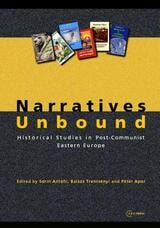
cover of Narratives Unbound: Historical studies in post-communist Eastern Europe

Narratives Unbound

Historical studies in post-communist Eastern Europe

Péter Apor

Central European University Press, 2007
The first work that covers the post-Communist development of historical studies in six Eastern European countries: Bulgaria, Czech Republic, Hungary, Poland, Romania, and Slovakia. A uniquely critical and qualitative analysis from a comparative and critical perspective, written by scholars from the region itself. Focusing on the first post-Communist decade, 1989–1999, the book offers a longer-term perspective that includes the immediate 'prehistory' of that momentous decade as well as its 'posthistoire'. The authors capture the spirit of 1989, that heady mix of elation, surprise, determination, and hope: l'ivresse du possible. This was the paradoxical beginning of Eastern European post-Communism: ushered in by 'anti-Utopian' revolutions, and slowly finding its course towards a bureaucratic, imitative, challenging, and anachronistic restoration of a capitalism that had changed almost beyond recognition when it had mutated into the negative double of Communism. Each individual chapter has numerous and detailed notes and references.
[more]
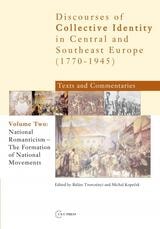
cover of National Romanticism: The Formation of National Movements

National Romanticism

The Formation of National Movements

Miroslav Hroch

Central European University Press, 2007
67 texts, including hymns, manifestos, articles or extracts from lengthy studies exemplify the relation between Romanticism and the national movements in the cultural space ranging from Poland to the Ottoman Empire. Each text is accompanied by a presentation of the author, and by an analysis of the context in which the respective work was born.The end of the 18th century and first decades of the 19th were in many respects a watershed period in European history. The ideas of the Enlightenment and the dramatic convulsions of the French Revolution had shattered the old bonds and cast doubt upon the established moral and social norms of the old corporate society. In culture a new trend, Romanticism, was successfully asserting itself against Classicism and provided a new key for a growing number of activists to 're-imagine' their national community, reaching beyond the traditional frameworks of identification (such as the 'political nation', regional patriotism, or Christian universalism). The collection focuses on the interplay of Romantic cultural discourses and the shaping of national ideology throughout the 19th century, tracing the patterns of cultural transfer with Western Europe as well as the mimetic competition of national ideologies within the region.
[more]
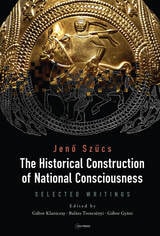
cover of The Historical Construction of National Consciousness: Selected Writings

The Historical Construction of National Consciousness

Selected Writings

Jeno Szucs

Central European University Press, 2022

A long essay entitled Three Historical Regions of Europe, appearing first in a samizdat volume in Budapest in 1980, instantly put its author into the forefront of the transnational debate on Central Europe, alongside such intellectual luminaries as Milan Kundera and Czesław Miłosz. The present volume offers English-language readers a rich selection of the depth and breadth of the legacy of Jenő Szűcs (1928–1988).

The selection documents Szűcs’s seminal contribution to many contemporary debates in historical anthropology, nationalism studies, and conceptual history. It contains his key texts on the history of national consciousness and patterns of collective identity, as well as medieval and early modern political thought. The works published here, most of them previously unavailable in English, provide a sophisticated analysis of a wide range of subjects from the myths of origins of Hungarians before Christianization to the political and religious ideology of the Dózsa peasant uprising in 1514, the medieval roots of civil society, or the revival of ethnic nationalism during the communist era. The volume, with an introduction by the editors locating Szűcs in a transnational context, offers a unique insight into the complex and sensitive debate on national identity in post-1945 East Central Europe.
[more]
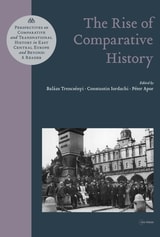
cover of The Rise of Comparative History

The Rise of Comparative History

Balázs Trencsényi

Central European University Press, 2021

This book—the first of a three-volume overview of comparative and transnational historiography in Europe—focuses on the complex engagement of various comparative methodological approaches with different transnational and supranational frameworks. It considers scales from universal history to meso-regional (i.e. Balkans, Central Europe, etc.) perspectives. In the form of a reader, it displays 18 historical studies written between 1900 and 1943. The collection starts with the French and German methodological discussions around the turn of the twentieth century, stemming from the effort to integrate history with other emerging social sciences on a comparative methodological basis. The volume then turns to the question of structural and institutional comparisons, revisiting various historiographical ventures that tried to sketch out a broader (regional or European-level) interpretative framework to assess the legal systems, patterns of agrarian production, and the common ethnographic and sociocultural features. 
  
In the third part, a number of texts are presented, which put forward a supra-national research framework as an antidote to national exclusivism. While in Western Europe the most obvious such framework was pan-European, in East Central Europe the agenda of comparison was linked usually to a meso-regional framework.

The studies are accompanied by short contextual introductions including biographical information on the respective authors.
[more]