111 books match the query 'Trials, litigation, etc' and 6 start with a
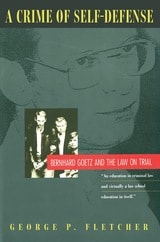
cover of A Crime of Self-Defense: Bernhard Goetz and the Law on Trial

A Crime of Self-Defense

Bernhard Goetz and the Law on Trial

George P. Fletcher

University of Chicago Press, 1990
The popular press dubbed him "the subway vigilante": Bernhard Goetz, who on December 22, 1984, shot four black youths on a New York subway train when one of them asked for five dollars. Goetz claimed to have fired in self-defense, out of fear that the young men were about to rob him.
[more]
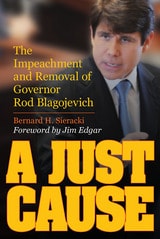
cover of A Just Cause: The Impeachment and Removal of Governor Rod Blagojevich

A Just Cause

The Impeachment and Removal of Governor Rod Blagojevich

Bernard H. Sieracki. Foreword by Jim Edgar

Southern Illinois University Press, 2016

Illinois State Historical Society Certificate of Excellence 2016

During the predawn hours of December 9, 2008, an FBI team swarmed the home of Illinois governor Rod Blagojevich and took him away in handcuffs. The shocking arrest, based on allegations of corruption and extortion, launched a chain of political events never before seen in Illinois. In A Just Cause, Bernard H. Sieracki delivers a dynamic firsthand account of this eight-week political crisis, beginning with Blagojevich’s arrest, continuing through his impeachment and trial, and culminating in his conviction and removal from office. Drawing on his own eyewitness observations of the hearings and trial, the comments of interviewees, trial transcripts, and knowledge gained from decades of work with the Illinois legislature, Sieracki tells the compelling story of the first impeachment and removal from office of an Illinois governor, while providing a close look at the people involved.

A Just Cause depicts Blagojevich as a master of political gamesmanship, a circus ringmaster driven by personal ambition and obsessed with private gain. Sieracki examines in depth the governor’s unethical behavior while in office, detailing a litany of partisan and personal hostilities that spanned years. He thoroughly covers the events leading to Blagojevich’s downfall and the reactions of the governor’s cohorts. The author discusses the numerous allegations against Blagojevich, including attempts to “sell” appointments, jobs, and contracts in exchange for financial contributions. Sieracki then exhaustively recounts Blagojevich’s senate trial and the governor’s removal from office.

This engrossing volume is both a richly detailed case study of the American checks-and-balances system and an eyewitness account of unprecedented events. It will appeal to anyone interested in the stunning, true tale of a state upholding the maxim “The welfare of the people is the supreme law.” 
[more]
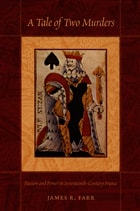
cover of A Tale of Two Murders: Passion and Power in Seventeenth-Century France

A Tale of Two Murders

Passion and Power in Seventeenth-Century France

James R. Farr

Duke University Press, 2005

As scandalous as any modern-day celebrity murder trial, the “Giroux affair” was a maelstrom of intrigue, encompassing daggers, poison, adultery, archenemies, servants, royalty, and legal proceedings that reached the pinnacle of seventeenth-century French society. In 1638 Philippe Giroux, a judge in the highest royal court of Burgundy, allegedly murdered his equally powerful cousin, Pierre Baillet, and Baillet’s valet, Philibert Neugot. The murders were all the more shocking because they were surrounded by accusations (particularly that Giroux had been carrying on a passionate affair with Baillet’s wife), conspiracy theories (including allegations that Giroux tried to poison his mother-in-law), and unexplained deaths (Giroux’s wife and her physician died under suspicious circumstances). The trial lasted from 1639 until 1643 and came to involve many of the most distinguished and influential men in France, among them the prince of Condé, Henri II Bourbon; the prime minister, Cardinal Richelieu; and King Louis XIII.

James R. Farr reveals the Giroux affair not only as a riveting murder mystery but also as an illuminating point of entry into the dynamics of power, justice, and law in seventeenth-century France. Drawing on the voluminous trial records, Farr uses Giroux’s experience in the court system to trace the mechanisms of power—both the formal power vested by law in judicial officials and the informal power exerted by the nobility through patron-client relationships. He does not take a position on Giroux’s guilt or innocence. Instead, he allows readers to draw their own conclusions about who did what to whom on that ill-fated evening in 1638.

[more]
cover of Accidental Activists: Mark Phariss, Vic Holmes, and Their Fight for Marriage Equality in Texas

Accidental Activists

Mark Phariss, Vic Holmes, and Their Fight for Marriage Equality in Texas

David Collins

University of North Texas Press, 2017
[more]
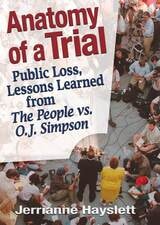
cover of Anatomy of a Trial: Public Loss, Lessons Learned from The People vs. O.J. Simpson

Anatomy of a Trial

Public Loss, Lessons Learned from The People vs. O.J. Simpson

Jerrianne Hayslett

University of Missouri Press, 2008
The People vs. O. J. Simpson ranks indisputably as the trial of the century. It featured a double murder, a celebrity defendant, a perjuring witness, and a glove that didn’t fit. The trial became a media circus of outrageous proportions that led the judge to sequester the jury, eject disruptive reporters, and fine the lawyers thousands of dollars. Now an insider at The People vs. O. J. Simpson reveals the untold story of the most widely followed trial in American history and the indelible impact it has had on the judiciary, the media, and the public.
 
            As the Los Angeles Superior Court’s media liaison, Jerrianne Hayslett had unprecedented access to the trial—and met with Judge Lance Ito daily—as she attempted, sometimes unsuccessfully, to mediate between the court and members of the media and to balance their interests. In Anatomy of a Trial, she takes readers behind the scenes to shed new light on people and proceedings and to show how the media and the trial participants changed the court-media landscape to the detriment of the public’s understanding of the judicial system.
 
            For those who think they’ve already read all there is to know about the Simpson trial, this book is an eye-opener. Hayslett kept a detailed journal during the proceedings in which she recorded anecdotes and commentary. She also shares previously undisclosed information to expose some of the myths and stereotypes perpetuated by the trial, while affirming other stories that emerged during that time. By examining this trial after more than a decade, she shows how it has produced a bunker mentality in the judicial system, shaping media and public access to courts with lasting impact on such factors as cameras in the courtroom, jury selection, admonishments from the bench, and fair-trial/free-press tensions.
 
The first account of the trial written with Judge Ito’s cooperation, Anatomy of a Trial is a page-turning narrative and features photographs that capture both the drama of the courtroom and the excesses of the media. It also includes perspectives of legal and journalism authorities and offers a blueprint for how the courts and media can better meet their responsibilities to the public.
 
Even today, judges, lawyers, and journalists across the country say the Simpson trial changed everything. This book finally tells us why.
[more]
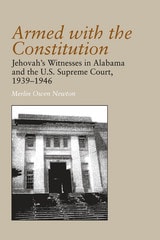
cover of Armed with the Constitution: Jehovah's Witnesses in Alabama and the U.S Supreme Court, 1939-1946

Armed with the Constitution

Jehovah's Witnesses in Alabama and the U.S Supreme Court, 1939-1946

Merlin Owen Newton

University of Alabama Press, 1995

Underscores the importance of “little people” in affecting the US government
 
Armed with the Constitution stresses the courage of a black man, Rosco Jones, and a white woman, Grace Marsh, who dared to challenge the status quo in Alabama in the early 1940s. These two Jehovah’s Witnesses helped to lay a foundation for testing the constitutionality of state and local laws, establishing precedents that the Civil Rights movement, the feminist movement, and similar forces could follow. Newton has prepared a finely woven tale of oral, legal, and social history that opens a window on the world of the Jehovah’s Witnesses in Alabama.
 
More than a legal study, this book is also a dramatic history of two powerful personalities whose total commitment to their faith enabled them to carry the Jehovah’s Witnesses’ battle from rural Alabama to the halls of the U.S. Supreme Court.
 
[more]