Results by title
6 books match the query 'Trials (Crimes against humanity)'
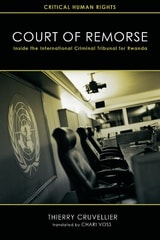
Court of Remorse
Inside the International Criminal Tribunal for RwandaThierry Cruvellier
University of Wisconsin Press, 2010
When genocidal violence gripped Rwanda in 1994, the international community recoiled, hastily withdrawing its peacekeepers. Late that year, in an effort to redeem itself, the United Nations Security Council created the International Criminal Tribunal for Rwanda to seek accountability for some of the worst atrocities since World War II: the genocide suffered by the Tutsi and crimes against humanity suffered by the Hutu. But faced with competing claims, the prosecution focused exclusively on the crimes of Hutu extremists. No charges would be brought against the Tutsi-led Rwandan Patriotic Front, which ultimately won control of the country. The UN, as if racked by guilt for its past inaction, gave in to pressure by Rwanda’s new leadership. With the Hutu effectively silenced, and the RPF constantly reminding the international community of its failure to protect the Tutsi during the war, the Tribunal pursued an unusual form of one-sided justice, born out of contrition.
Fascinated by the Tribunal’s rich complexities, journalist Thierry Cruvellier came back day after day to watch the proceedings, spending more time there than any other outside observer. Gradually he gained the confidence of the victims, defendants, lawyers, and judges. Drawing on interviews with these protagonists and his close observations of their interactions, Cruvellier takes readers inside the courtroom to witness the motivations, mechanisms, and manipulations of justice as it unfolded on the stage of high-stakes, global politics. It is this ground-level view that makes his account so valuable—and so absorbing. A must-read for those who want to understand the dynamics of international criminal tribunals, Court of Remorse reveals both the possibilities and the challenges of prosecuting human rights violations.
Fascinated by the Tribunal’s rich complexities, journalist Thierry Cruvellier came back day after day to watch the proceedings, spending more time there than any other outside observer. Gradually he gained the confidence of the victims, defendants, lawyers, and judges. Drawing on interviews with these protagonists and his close observations of their interactions, Cruvellier takes readers inside the courtroom to witness the motivations, mechanisms, and manipulations of justice as it unfolded on the stage of high-stakes, global politics. It is this ground-level view that makes his account so valuable—and so absorbing. A must-read for those who want to understand the dynamics of international criminal tribunals, Court of Remorse reveals both the possibilities and the challenges of prosecuting human rights violations.
Best Books for General Audiences, selected by the American Association for School Libraries and the Public Library Association
Best Books for High Schools, selected by the American Association for School Libraries
[more]
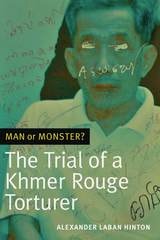
Man or Monster?
The Trial of a Khmer Rouge TorturerAlexander Laban Hinton
Duke University Press, 2016
During the Khmer Rouge's brutal reign in Cambodia during the mid-to-late 1970s, a former math teacher named Duch served as the commandant of the S-21 security center, where as many as 20,000 victims were interrogated, tortured, and executed. In 2009 Duch stood trial for these crimes against humanity. While the prosecution painted Duch as evil, his defense lawyers claimed he simply followed orders. In Man or Monster? Alexander Hinton uses creative ethnographic writing, extensive fieldwork, hundreds of interviews, and his experience attending Duch's trial to create a nuanced analysis of Duch, the tribunal, the Khmer Rouge, and the after-effects of Cambodia's genocide. Interested in how a person becomes a torturer and executioner as well as the law's ability to grapple with crimes against humanity, Hinton adapts Hannah Arendt's notion of the "banality of evil" to consider how the potential for violence is embedded in the everyday ways people articulate meaning and comprehend the world. Man or Monster? provides novel ways to consider justice, terror, genocide, memory, truth, and humanity.
[more]
Phenomenal Justice
Violence and Morality in ArgentinaEva van Roekel
Rutgers University Press, 2020
2020 Choice Outstanding Academic Title
Short-listed for the Juan E. Méndez Book Award for Human Rights in Latin America from Duke University Libraries
How do victims and perpetrators of political violence caught up in a complicated legal battle experience justice on their own terms? Phenomenal Justice is a compelling ethnography about the reopened trials for crimes against humanity committed during the brutal military dictatorship that ruled Argentina between 1976 and 1983. Grounded in phenomenological anthropology and the anthropology of emotion, this book establishes a new theoretical basis that is faithful to the uncertainties of justice and truth in the aftermath of human rights violations. The ethnographic observations and the first-person stories about torture, survival, disappearance, and death reveal the enduring trauma, heartfelt guilt, happiness, battered pride, and scratchy shame that demonstrate the unreserved complexities of truth and justice in post-conflict societies. Phenomenal Justice will be an indispensable contribution to a better understanding of the military dictatorship in Argentina and its aftermath.
[more]
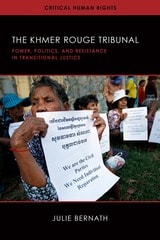
The Khmer Rouge Tribunal
Power, Politics, and Resistance in Transitional JusticeJulie Bernath
University of Wisconsin Press, 2023
From 1975 to 1979, while Cambodia was ruled by the brutal Communist Party of Kampuchea (Khmer Rouge) regime, torture, starvation, rape, and forced labor contributed to the death of at least a fifth of the country’s population. Despite the severity of these abuses, civil war and international interference prevented investigation until 2004, when protracted negotiations between the Cambodian government and the United Nations resulted in the establishment of the Extraordinary Chambers in the Courts of Cambodia (ECCC), or Khmer Rouge tribunal. The resulting trials have been well scrutinized, with many scholars seeking to weigh the results of the tribunal against the extent of the offenses.
Here, Julie Bernath takes a different tack, deliberately decentering the trials in an effort to understand the ECCC in its particular context—and, by extension, the degree to which notions of transitional justice generally must be understood in particular social, cultural, and political contexts. She focuses on “sites of resistance” to the ECCC, including not only members of the elite political class but also citizens who do not, for a variety of tangled reasons, participate in the tribunal—and even resistance from victims of the regime and participants in the trials. Bernath demonstrates that the ECCC both shapes and is shaped by long-term contestation over Cambodia’s social, economic, and political transformations, and thereby argues that transitional justice must be understood locally rather than as a homogenous good that can be implanted by international actors.
Here, Julie Bernath takes a different tack, deliberately decentering the trials in an effort to understand the ECCC in its particular context—and, by extension, the degree to which notions of transitional justice generally must be understood in particular social, cultural, and political contexts. She focuses on “sites of resistance” to the ECCC, including not only members of the elite political class but also citizens who do not, for a variety of tangled reasons, participate in the tribunal—and even resistance from victims of the regime and participants in the trials. Bernath demonstrates that the ECCC both shapes and is shaped by long-term contestation over Cambodia’s social, economic, and political transformations, and thereby argues that transitional justice must be understood locally rather than as a homogenous good that can be implanted by international actors.
[more]

Travesty
The Trial of Slobodan Milosevic and the Corruption of International JusticeJohn Laughland
Pluto Press, 2007
In 2006, Slobodan Milosevic died in prison in the Hague during a four-year marathon trial for war crimes. John Laughland was one of the last Western journalists to meet with him. Laughland had followed the trial from its beginning and wrote extensively on it in the Guardian and the Spectator, challenging the legitimacy of the Yugoslav Tribunal and the hypocrisy of "international justice."
In this short book, Laughland gives a full account of the trial---the longest trial in history---from the moment the indictment was issued at the height of NATO's attack on Yugoslavia to the day of Milosevic's mysterious death in custody. "International justice" is supposed to hold war criminals to account, but---as the trials of both Milosevic and Saddam Hussein show---the indictments are politically motivated and the judicial procedures are irredeemably corrupt. Laughland argues that international justice is an impossible dream and that such show trials are little more than propaganda exercises designed to distract attention from the war crimes committed by Western states.
"Study this story. . . . The truth is hard to find, but in John Laughland we are fortunate to have a man blessed with the desire to find the truth."
---Ramsey Clark, from the Foreword
[more]
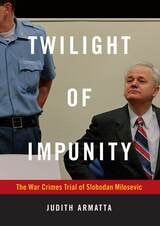
Twilight of Impunity
The War Crimes Trial of Slobodan MilosevicJudith Armatta
Duke University Press, 2010
An eyewitness account of the first major international war-crimes tribunal since the Nuremberg trials, Twilight of Impunity is a gripping guide to the prosecution of Slobodan Milosevic for war crimes, crimes against humanity, and genocide. The historic trial of the “Butcher of the Balkans” began in 2002 and ended abruptly with Milosevic’s death in 2006. Judith Armatta, a lawyer who spent three years in the former Yugoslavia during Milosevic’s reign, had a front-row seat at the trial. In Twilight of Impunity she brings the dramatic proceedings to life, explains complex legal issues, and assesses the trial’s implications for victims of the conflicts in the Balkans during the 1990s and international justice more broadly. Armatta acknowledges the trial’s flaws, particularly Milosevic’s grandstanding and attacks on the institutional legitimacy of the International Criminal Tribunal. Yet she argues that the trial provided an indispensable legal and historical narrative of events in the former Yugoslavia and a valuable forum where victims could tell their stories and seek justice. It addressed crucial legal issues, such as the responsibility of commanders for crimes committed by subordinates, and helped to create a framework for conceptualizing and organizing other large-scale international criminal tribunals. The prosecution of Slobodan Milosevic in The Hague was an important step toward ending impunity for leaders who perpetrate egregious crimes against humanity.
[more]