Results by title
6 books match the query 'Tribal government'
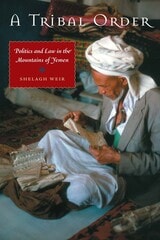
A Tribal Order
Politics and Law in the Mountains of YemenBy Shelagh Weir
University of Texas Press, 2006
2008 — British-Kuwait Friendship Prize in Middle Eastern Studies – British Society for Middle Eastern Studies
A Tribal Order describes the politico-legal system of Jabal Razih, a remote massif in northern Yemen inhabited by farmers and traders. Contrary to the popular image of Middle Eastern tribes as warlike, lawless, and invariably opposed to states, the tribes of Razih have stable structures of governance and elaborate laws and procedures for maintaining order and resolving conflicts with a minimum of physical violence. Razihi leaders also historically cooperated with states, provided the latter respected their customs, ideals, and interests. Weir considers this system in the context of the rugged environment and productive agricultural economy of Razih, and of centuries of continuous rule by Zaydi Muslim regimes and (latterly) the republican governments of Yemen.
The book is based on Weir's extended anthropological fieldwork on Jabal Razih, and on her detailed study of hundreds of handwritten contracts and treaties among and between the tribes and rulers of Razih. These documents provide a fascinating insight into tribal politics and law, as well as state-tribe relations, from the early seventeenth to the late twentieth century. A Tribal Order is also enriched by case histories that vividly illuminate tribal practices. Overall, this unusually wide-ranging work provides an accessible account of a remarkable Arabian society through time.

High Stakes
Florida Seminole Gaming and SovereigntyJessica R. Cattelino
Duke University Press, 2008
Cattelino presents a vivid ethnographic account of the history and consequences of Seminole gaming. Drawing on research conducted with tribal permission, she describes casino operations, chronicles the everyday life and history of the Seminole Tribe, and shares the insights of individual Seminoles. At the same time, she unravels the complex connections among cultural difference, economic power, and political rights. Through analyses of Seminole housing, museum and language programs, legal disputes, and everyday activities, she shows how Seminoles use gaming revenue to enact their sovereignty. They do so in part, she argues, through relations of interdependency with others. High Stakes compels rethinking of the conditions of indigeneity, the power of money, and the meaning of sovereignty.

Nkrumah & the Chiefs
The Politics of Chieftaincy in Ghana, 1951–1960Richard Rathbone
Ohio University Press, 1999
Kwame Nkrumah, who won independence for Ghana in 1957, was the first African statesman to achieve world recognition. Nkrumah and his movement also brought about the end of independent chieftaincy—one of the most fundamental changes in the history of Ghana.
Kwame Nkrumah’s Convention Peoples’ Party was committed not only to the rapid termination of British colonial rule but also to the elimination of chiefly power. This book is an account of Kwame Nkrumah and his government’s long struggle to wrest administrative control of the Ghanaian countryside from the chiefs. Based largely upon previously unstudied documentation in Ghana, this study charts the government’s frustrated attempts to democratize local government and the long and bitter campaigns mounted by many southern chiefs to resist their political marginalization.
Between 1951 and the creation of the First Republic in 1960, Ghanaian governments sought to discard the chiefly principle in local government, then to weaken chieftaincy by attrition and eventually, by altering the legal basis of chieftaincy, to incorporate and control a considerably altered chieftaincy. The book demonstrates that chieftaincy was consciously and systematically reconstructed in the decade of the 1950s with implications which can still be felt in modern Ghana.
Rebuilding Native Nations
Strategies for Governance and DevelopmentEdited by Miriam Jorgensen; Foreword by Oren Lyons; Afterword by Satsan (Herb George)
University of Arizona Press, 2007
Produced by the Native Nations Institute for Leadership, Management, and Policy at the University of Arizona and the Harvard Project on American Indian Economic Development, this book traces the contours of that revolution as Native nations turn the dream of self-determination into a practical reality. Part report, part analysis, part how-to manual for Native leaders, it discusses strategies for governance and community and economic development being employed by American Indian nations and First Nations in Canada as they move to assert greater control over their own affairs.
Rebuilding Native Nations provides guidelines for creating new governance structures, rewriting constitutions, building justice systems, launching nation-owned enterprises, encouraging citizen entrepreneurs, developing new relationships with non-Native governments, and confronting the crippling legacies of colonialism. For nations that wish to join that revolution or for those who simply want to understand the transformation now underway across Indigenous North America, this book is a critical resource.
CONTENTS
Foreword by Oren Lyons
Editor's Introduction
Part 1
Starting Points
1. Two Approaches to the Development of Native Nations: One Works, the Other Doesn't
Stephen Cornell and Joseph P. Kalt
2. Development, Governance, Culture: What Are They and What Do They Have to Do with Rebuilding Native Nations?
Manley A. Begay, Jr., Stephen Cornell, Miriam Jorgensen, and Joseph P. Kalt
Part 2
Rebuilding the Foundations
3. Remaking the Tools of Governance: Colonial Legacies, Indigenous Solutions
Stephen Cornell
4. The Role of Constitutions in Native Nation Building: Laying a Firm Foundation
Joseph P. Kalt
5 . Native Nation Courts: Key Players in Nation Rebuilding
Joseph Thomas Flies-Away, Carrie Garrow, and Miriam Jorgensen
6. Getting Things Done for the Nation: The Challenge of Tribal Administration
Stephen Cornell and Miriam Jorgensen
Part 3
Reconceiving Key Functions
7. Managing the Boundary between Business and Politics: Strategies for Improving the Chances for Success in Tribally Owned Enterprises
Kenneth Grant and Jonathan Taylor
8. Citizen Entrepreneurship: An Underutilized Development Resource
Stephen Cornell, Miriam Jorgensen, Ian Wilson Record, and Joan Timeche
9. Governmental Services and Programs: Meeting Citizens' Needs
Alyce S. Adams, Andrew J. Lee, and Michael Lipsky
10. Intergovernmental Relationships: Expressions of Tribal Sovereignty
Sarah L. Hicks
Part 4
Making It Happen
11. Rebuilding Native Nations: What Do Leaders Do?
Manley A. Begay, Jr., Stephen Cornell, Miriam Jorgensen, and Nathan Pryor
12. Seizing the Future: Why Some Native Nations Do and Others Don't
Stephen Cornell, Miriam Jorgensen, Joseph P. Kalt, and Katherine Spilde Contreras
Afterword by Satsan (Herb George)
References
About the Contributors
Index
Seeds of Tomorrow
Nurturing Roots of Oneida GovernanceEdited by Rebecca M. Webster and Lois Stevens
University of Wisconsin Press, 2026
This indispensable and unique volume is at once a history of and a pathfinder for the future of the Great Law, the governing principles behind the long-standing Haudenosaunee Confederacy. Focused on the Duck Creek Oneida people of Wisconsin, Seeds of Tomorrow draws together a wide range of tribal voices, from elders and community members to young people and academic experts. This collection chronicles the history of the Haudenosaunee Confederacy’s revolutionary governing principles, outlines the current state of tribal government, and proposes a vision for a political future that draws on traditional Indigenous practices and knowledge. This guide toward stronger sovereignty, revitalized community ties, and a healthier and more self-determined future based on traditional structures of governance is indigenization in practice: a model not just for Duck Creek Oneida but for Indigenous nations everywhere.
Contributors: Kenzie Allen, Marley Atkinson, Marena Bridges, Robert “Bob” Brown, Breann Clark, Julie Clark, Carol Cornelius, Margaret Cornelius, Randy Cornelius, Michele Doxtater, Richard “Lotni” Elm-Hill, Jennifer “Jen” Falck, William Gollnick, Joie Guiterrez, Gerald L. Hill, Jo Anne House, Toni M. House, Nicholas Metoxen, Paul Ninham, Saniya Ninham, John III Powless, Mark Powless, Nina Powless, Artley Skenandore, Lois Stevens, Vernon Stevens, Amelia “Mia” Webster, Grace Webster, Hunter D. Webster, Rebecca M. Webster, Arthur Wilbur, Jameson Wilson
Tribal Administration Handbook
A Guide for Native Nations in the United StatesRebecca M. Webster
Michigan State University Press, 2022