Results by title

3 books match the query 'Tribe'
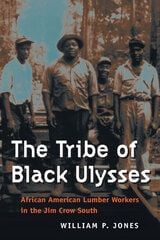
cover of The Tribe of Black Ulysses: African American Lumber Workers in the Jim Crow South

The Tribe of Black Ulysses

African American Lumber Workers in the Jim Crow South

William P. Jones

University of Illinois Press, 2005

The lumber industry employed more African American men than any southern economic sector outside agriculture. Yet little scholarship exists on these workers and their times. 

William P. Jones merges interviews with archival sources to explore black men and women's changing relationship to industrial work in the southern sawmill communities of Elizabethtown, North Carolina; Chapman, Alabama; and Bogalusa, Louisiana. By placing black lumber workers within the history of southern industrialization, Jones reveals that industrial employment was another facet of the racial segregation and political disfranchisement that defined black life in the Jim Crow South. He also examines an older tradition of southern sociology that viewed industrialization as socially disruptive and morally corrupting to African American social and cultural traditions rooted in agriculture.
[more]
cover of The Tribe of John: Ashbery and Contemporary Poetry

The Tribe of John

Ashbery and Contemporary Poetry

Susan M. Schultz

University of Alabama Press, 1995

Fourteen essayists break new ground by focusing on a new generation of postmodern poets who are clearly indebted to John Ashbery's work

This concentration on Ashbery's influence on contemporary American poetry provides new methods for interpreting and understanding his poetic achievement.
[more]
cover of The Tribe of Pyn: Literary Generations in the Postmodern Period

The Tribe of Pyn

Literary Generations in the Postmodern Period

David Cowart

University of Michigan Press, 2015

In The Tribe of Pyn, Cowart offers illuminating readings of several important novelists now at the height of their powers, whose work has received fairly limited scholarly attention thus far. Jonathan Franzen, Alice Walker, David Foster Wallace, Gloria Naylor, Richard Powers, and a raft of others are examined with lapidary care. Wrestling with the challenges inherent to distinguishing generational character (especially in the postmodern context, which is often marked by its disavowal of ideas of origin, etc.), Cowart teases out interactions and entanglements that help illuminate the work of the younger writers at the center of this study and also that of the trailblazers on its ragged frontiers.

By comparing literary figures born in the 1940s, 1950s, 1960s, and later with those born in the 1920s and 1930s, Cowart seeks to map the changing terrain of contemporary letters. Hardly epigones, he argues, the younger writers add fresh inflections to the grammar of literary postmodernism. Younger writers can continue to “make it new,” Cowart establishes, without needing to dismantle the aesthetic they have inherited from a parental generation.
 
[more]