Results by title
3 books match the query 'Troublemakers'
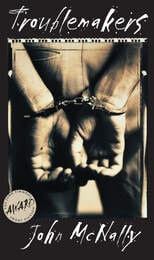
Troublemakers
John McNally
University of Iowa Press, 2000
Troublemakers is an often hilarious, sometimes frightening, occasionally off-the-wall collection of stories about men living on the edge. From the streets of Chicago's southwest side to the rural roads of Nebraska to the small towns of southern Illinois, these men tread a very fine line between right and wrong, love and hate, humor and horror.
Each story is a Pandora's box waiting to be opened: a high school boy with a new driver's license picks his brother up from jail; a UPS driver suspects his wife of having an affair but cannot find any tangible evidence of her indiscretion; an unemployed man's life begins to unravel after he discovers a dead man in a tree in his own backyard; two boys spend Halloween with an older thug; a young college teacher's patience is tested by both his annoying colleagues and the criminals who haunt his neighborhood. In story after story, McNally's troublemakers lead readers to a place no less thrilling or dangerous than the human heart itself.
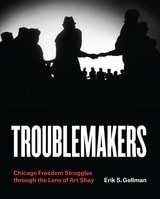
Troublemakers
Chicago Freedom Struggles through the Lens of Art ShayErik S. Gellman
University of Chicago Press, 2019
Troublemakers fuses photography and history to demonstrate how racial and economic inequality gave rise to a decades-long struggle for justice in one American city.
In dialogue with 275 of Art Shay’s photographs, Erik S. Gellman takes a new look at major developments in postwar US history: the Second Great Migration, “white flight,” and neighborhood and street conflicts, as well as shifting party politics and the growth of the carceral state. The result is a visual and written history that complicates—and even upends—the morality tales and popular memory of postwar freedom struggles.
Shay himself was a “troublemaker,” seeking to unsettle society by illuminating truths that many middle-class, white, media, political, and businesspeople pretended did not exist. Shay served as a navigator in the US Army Air Forces during World War II, then took a position as a writer for Life Magazine. But soon after his 1948 move to Chicago, he decided to become a freelance photographer. Shay wandered the city photographing whatever caught his eye—and much did. His lens captured everything from private moments of rebellion to era-defining public movements, as he sought to understand the creative and destructive energies that propelled freedom struggles in the Windy City.
Shay illuminated the pain and ecstasy that sprung up from the streets of Chicago, while Gellman reveals their collective impact on the urban fabric and on our national narrative. This collaboration offers a fresh and timely look at how social conflict can shape a city—and may even inspire us to make trouble today.
Troublemakers
Power, Representation, and the Fiction of the Mass WorkerScott, William
Rutgers University Press, 2012
William Scott’s Troublemakers explores how a major change in the nature and forms of working-class power affected novels about U.S. industrial workers in the first half of the twentieth century. With the rise of mechanization and assembly-line labor from the 1890s to the 1930s, these laborers found that they had been transformed into a class of “mass” workers who, since that time, have been seen alternately as powerless, degraded victims or heroic, empowered icons who could rise above their oppression only through the help of representative organizations located outside the workplace.
Analyzing portrayals of workers in such novels as Upton Sinclair’s The Jungle, Ruth McKenney's Industrial Valley, and Jack London’s The Iron Heel, William Scott moves beyond narrow depictions of these laborers to show their ability to resist exploitation through their direct actions—sit-down strikes, sabotage, and other spontaneous acts of rank-and-file “troublemaking” on the job—often carried out independently of union leadership. The novel of the mass industrial worker invites us to rethink our understanding of modern forms of representation through its attempts to imagine and depict workers’ agency in an environment where it appears to be completely suppressed.