Results by title
3 books match the query 'Troy'

Policing as Though People Matter
Dorothy Guyot
Temple University Press, 1991
In this work, Dorothy Guyot asks: What makes a good police department? In analyzing the transformation of the police department in Troy, New York. she explains a set of standards by which the quality of police service can be judged and illustrates a way to improve services over the long run. Throughout her case study and analysis, Guyot asks penetrating questions about the performance of police departments. She maintains that when police officers are treated as professionals by their department, they will act professionally toward citizens. This examination of fifteen years of policymaking within a single department looks at policing as a complex social service in an urban environment.
Rather than accepting the traditional "chain of command" authoritarian model of police administration, Guyot draws an analogy to hospital organization and suggests that the practitioner, whether a physician or a cop on the beat, performs the service with a tremendous amount of discretion. It follows that better management tactics at the police chief level as well as better employment policies will result in more responsible and dedicated policing by officers. The author demonstrates how, under the leadership of George W. O’Connor, the Troy P.D. changed from a backward department to one that promotes competence, as well as concern for citizens, among its individual officers.
The book is organized by issues and provides a full picture of how upgrading can be achieved through clear and specific goals. Throughout this case study, Guyot provides many examples of the behavior of police officers on the street, to illustrate the differences made by restructuring the department.

Troy, Unincorporated
Francesca Abbate
University of Chicago Press, 2012
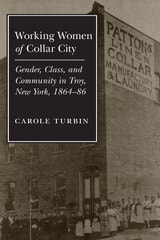
Working Women of Collar City
Gender, Class, and Community in Troy, 1864-86Carole Turbin
University of Illinois Press, 1992
Why have some working women succeeded at organizing in spite of obstacles to labor activity? Under what circumstances were they able to form alliances with male workers?
Carole Turbin explores these and other questions by examining the case of Troy, New York. In the 1860s, Troy produced nearly all the nation's detachable shirt collars and cuffs. The city's collar laundresses were largely Irish immigrants. Their union was officially the nation's first women's labor organization, and one of the best organized. Turbin provides a new perspective on gender and shows that women's family ties are not necessarily a conservative influence but may encourage women's and men's collective action.