Results by title
4 books match the query 'Trucking'

Braking the Special Interests
Trucking Deregulation and the Politics of Policy ReformDorothy Robyn
University of Chicago Press, 1987
In 1980 Congress voted to eliminate the federal system of protective regulation over the powerful trucking industry, despite fierce opposition. This upset marked a rare example in American politics of diffuse public interests winning out over powerful economic lobbies. In Braking the Special Interests Dorothy Robyn draws upon firsthand observations of formal proceedings and behind-the-scenes maneuverings to illuminate the role of political strategy in the landmark trucking battle.
Robyn focuses her analysis on four elements of strategy responsible for the deregulator's victory—elements that are essential, she argues, to any successful policy battle against entrenched special interests: the effective use of economic data and analysis to make a strong case for the merits of reform; the formation and management of a diverse lobbying coalition of firms and interest groups; presidential bargaining to gain political leverage; and transition schemes to reduce uncertainty and cushion the blow to losers.
Drawing on political and economic theory, Braking the Special Interests is an immensely rich and readable study of political strategy and skill, with general insights relevant to current political battles surrounding trade, agriculture, and tax policies. Robyn's interdisciplinary work will be of great value to scholars and practitioners of politics, economics, and public policy.
[more]
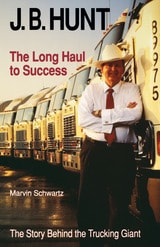
J. B. Hunt
The Long Haul to SuccessMarvin Schwartz
University of Arkansas Press, 1992
This is an enlightening and entertaining history of the Arkansas-based firm, one of America’s premier trucking companies.
[more]
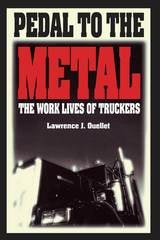
Pedal To The Metal
The Work Life of TruckersLawrence J. Ouellet
Temple University Press, 1994
From this experience, Lawrence J. Ouellet has the advantage of a rare perspective and a profound understanding of the two fundamental questions he asks in this book: Why do truck drivers work so hard even when it doesn't result in more money or other material gains? and How do truckers make sense of their behavior to themselves and to the outside world?
A vivid ethnography of trucking culture, Pedal to the Metal documents and analyzes truckers' lives and work ethic, exploring the range of identities truckers create for themselves—the renegade cowboy, the company man, the voyeur, the lone king of the road. To explain truckers' motivations, Ouellet examines the meaning of work and the motivation for excelling despite long, unsupervised hours on the road. He finds that their occupational pride results in extraordinary efforts on the job and, subsequently, a positive sense of self. Driving skill allows truckers to improve their hauling times, which they proudly track to the minute, and to increase their productivity and income.
Truckers' knowledge of the industry's structure and the idiosyncrasies of their own company allows them to improve their ability to get and carry out assignments, to maneuver around a traditional concept of rank and seniority, and to recreate to their advantage the pervasive cultural myths that the public expects should dictate a trucker's behavior. Whether capturing the pleasure and enchantment of trucking—driving under moon-lit skies across a snow-covered mountain range—or the miseries of boredom, bad weather, and exhausting schedules, Ouellet exhibits deep appreciation and passion for his subject.
[more]
Regulation, Organizations, and Politics
Motor Freight Policy at the Interstate Commerce CommissionLawrence S. Rothenberg
University of Michigan Press, 1994
Regulation, Organizations, and Politics examines the evolution of regulation at the Interstate Commerce Commission (ICC). The ICC has probably had the most profound impact on any federal agency on the way social scientists view politics. From a perspective based in modern political economy, the author develops an analysis that improves our understanding of the determinants of bureaucratic performance and clarifies the conditions under which organizations are likely to have a substantial influence. Employing a variety of techniques, Regulation, Organizations, and Politics explains how motor carriers, particularly the larger truckers who controlled the American Trucking Association, were unable to control public policy once the chief executive decided to expand substantial political resources on reforming the motor carrier system. The author shows that this failure was rooted in the carriers' inability to offer the requisite rewards and sanctions required to influence those with power over the outcome. This work thus demonstrates that an integrated approach to the intersections of rational, if often incompletely informed, actors can help us to understand phenomena that seem puzzling at first consideration.
[more]