Results by title
10 books match the query 'True'
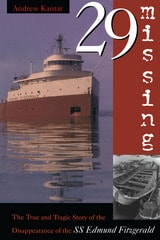
29 Missing
The True and Tragic Story of the Disappearance of the SS Edmund FitzgeraldAndrew Kantar
Michigan State University Press, 1998
On November 10, 1975, SS Edmund Fitzgerald, a giant freighter, sank with its entire crew of 29 aboard, in one of the most violent storms ever witnessed on Lake Superior. In 29 Missing, Kantar tells the "Fitz's" story from the christening in 1958 as the largest ship on the Great Lakes to the expedition in 1995 to recover the ship's bell in what proved to be a moving memorial to the lost crew. Using information from government investigative reports, the book provides a dramatic hour-by-hour account of what transpired during that terrible voyage, including dialogue from actual radio transmissions between the Fitzgerald and the Arthur Anderson, the freighter that followed behind the Fitz.
In his passionate retelling of the story, designed primarily for young adults, Kantar provides the facts leading up to the disappearance, detailing the subsequent expeditions to the wreck site as well as the leading theories about the sinking that have been debated by maritime experts.
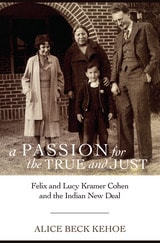
A Passion for the True and Just
Felix and Lucy Kramer Cohen and the Indian New DealAlice Beck Kehoe
University of Arizona Press, 2014
Kehoe argues that, due to anti-Semitism in 1930s America, Cohen could not speak for his legislation before Congress, and that Collier, an upper-class WASP, became the spokesman as well as the administrator. According to the author, historians of the Indian New Deal have not given due weight to Cohen’s work, nor have they recognized its foundation in his liberal secular Jewish culture. Both Felix and Lucy Cohen shared a belief in the moral duty of mitzvah, creating a commitment to the “true and the just” that was rooted in their Jewish intellectual and moral heritage, and their Social Democrat principles.
A Passion for the True and Just takes a fresh look at the Indian New Deal and the radical reversal of US Indian policies it caused, moving from ethnocide to retention of Indian homelands. Shifting attention to the Jewish tradition of moral obligation that served as a foundation for Felix and Lucy Kramer Cohen (and her professor Franz Boas), the book discusses Cohen’s landmark contributions to the principle of sovereignty that so significantly influenced American legal philosophy.
An Exemplar of the True
The Tabernacle and the Architecture of Medieval TheologyAllison Zbicz Michael
Catholic University of America Press, 2026
Fierce and True
Plays for Teen AudiencesChildren’s Theatre Children’s Theatre Company
University of Minnesota Press, 2010
In an effort to reach out to and engage these young people, the CTC began to commission and produce plays aimed at a twelve- to eighteen-year-old audience, focusing on the complexities, idiosyncrasies, and epic dilemmas in the lives of young people. Fierce and True collects four of these critically acclaimed plays: Anon(ymous) by Naomi Iizuka, The Lost Boys of Sudan by Lonnie Carter, Five Fingers of Funk by Will Power, and Prom by Whit MacLaughlin and New Paradise Laboratories.
Professional, full-length works not about teens so much as they are written for them. Ambitious, surprising, and complex, these plays speak directly to teens without pandering to them; they engage, challenge, and respect teenage minds. Diverse and utterly unique, these playwrights are bound together by the excellence of their craft and the power of their storytelling. Fierce and True both redefines the field of theater for young people and provides an invaluable resource for theater professionals, educators, and the teens they serve.
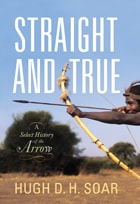
Straight and True
A Select History of the ArrowHugh D. H. Soar
Westholme Publishing, 2012
From Spears and Blowpipe Darts to the Ultimate Human-Powered Projectile
The arrow, essentially a specialized spear, is among the most ancient human inventions and can be found in cultures throughout the world. The need to launch a projectile farther and with greater accuracy than is possible with the human arm gave rise to a variety of solutions. Spearthrowers which extend the length of the user’s arm and therefore transfer greater power to the projectile were developed far back in prehistory, and both the American Indian atlatl and the Australian woomera are examples of this technology. Blowpipes, too, are recorded in various cultures and represent another ancient technology. It was soon discovered that a stringed bow could launch a small spearlike projectile we now know as the arrow, and this combination became the dominant method for shooting projectiles for tens of thousands of years. A wonderfully simple device, the arrow and bow revolutionized both hunting and warfare, not only because of the speed, force, and accuracy that could be achieved, but by the fact that the arrow makes almost no sound as it flies toward its target, providing an essential element of surprise.
In Straight and True: A Select History of the Arrow, Hugh D. H. Soar describes the transition from hand-thrown spear to bow-launched arrow and then follows the arrow’s developments in cultures around the world and across time. The book describes arrows found in Neolithic sites; those used by North and South American Indians—including a detailed discussion of poison-tipped arrows; arrows used in China, Japan, and Mongolia; and finally the arrow in Europe, where it was successfully paired with the longbow during the Middle Ages. After discussing the development of the arrow for sport and recreation, the author completes his survey with the changes in technology introduced during the twentieth century though the use of the alloy of aluminum with other lightweight metals as well as synthetic materials to construct parts of the arrow. Relying on his considerable knowledge accumulated through decades of research, the author provides the reader with an appreciation for a humble device that, coupled with the bow, changed the history of the world.

Tales Never Told Around Campfire
True Tales Of Frontier AmericaMark Dugan
Ohio University Press, 1992
The Beautiful, The True and the Good
Robert E. Wood
Catholic University of America Press, 2015
The Real, the True, and the Told
Postmodern Historical Narrative and the Ethics of RepresentationEric L. Berlatsky
The Ohio State University Press, 2011
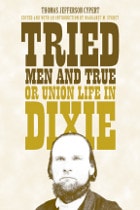
Tried Men and True, or Union Life in Dixie
Thomas J. Cypert, edited and with an introduction by Margaret M. Storey
University of Alabama Press, 2011
A gripping firsthand account of loyalty, resistance, and survival in Confederate Tennessee, this memoir reveals the untold story of Unionist courage behind enemy lines.
Tried Men and True, or Union Life in Dixie is the memoir of a Union supporter in south-central Tennessee. In it, he chronicles in vivid and emotional detail the local tensions between Unionists and Confederates during the Civil War South and offers a rare first-person account of the guerrilla war that devastated Western Tennessee.
Thomas Jefferson Cypert (1827-1918) was a staunch Union man of Wayne County, Tennessee. In 1863, he helped organize the Second Tennessee Mounted Infantry, a regiment of loyalist Southerners enlisted to combat Confederate cavalry in West Tennessee and Northern Alabama. Tried Men and True is Cypert’s memoir of his time as Captain of Company A, including his capture by Confederate cavalry and subsequent daring escape, in which he was aided by local Union sympathizers and slaves.
After the Civil War, Cypert served two terms in the Tennessee State Senate, one of them during the heated first years of Reconstruction, when Tennessee disenfranchised former rebels and attempted to establish Unionist Republican rule in the state. Cypert clearly wrote his memoir to defend Unionism, condemn secession and rebellion, and support loyalists’ claims for post-war power through an account of their wartime sacrifices. Never before published, the manuscript has been preserved in nearly perfect condition by Cypert’s descendants over the generations. This book is a remarkable and engagingly written account of resistance to the Confederacy by a group of southwestern Tennessee loyalists.
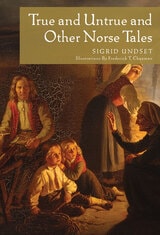
True and Untrue and Other Norse Tales
Sigrid Undset
University of Minnesota Press, 2013
A selection of Norwegian folktales chosen by Sigrid Undset, True and Untrue and Other Norse Tales is based on the classic folklore collected by Pieter Christian Asbjørnsen and Jørgen Moe. These wonderful stories tell of worlds similar to our own, worlds with love and hate, sorrow and joy, humor and pathos. Beginning with brothers named True and Untrue, the book takes readers through tales of princes and princesses, giants and trolls, husbands and wives, and a castle that is “East o’ the Sun and West o’ the Moon.” Strikingly illustrated by Frederick T. Chapman while under fire in Italy during the Second World War and with a remarkable foreword by Undset, True and Untrue and Other Norse Tales has a story for everyone.