Results by title
4 books match the query 'Truth in literature'
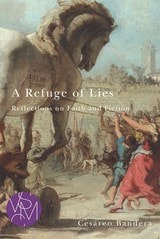
A Refuge of Lies
Reflections on Faith and FictionCesareo Bandera
Michigan State University Press, 2013
Erich Auerbach’s seminal Mimesis: The Representation of Reality in Western Literature was published more than sixty years ago and is deservedly considered a classic. The book brought into focus the fundamental difference that exists between the two basic approaches to the textual representation of reality in Western culture. These two “styles,” as Auerbach called them, were archetypically displayed in Homer’s poems and in the Old Testament, respectively. Auerbach’s differentiation is the starting point for Bandera’s insightful work, which expands and develops on this theory in several key ways. One of the more significant differences between the two styles transcends and grounds all the others. It concerns the truth of each of the two archetypal texts, or rather, the attitude exhibited in those texts with regard to the truth of what they narrate. Auerbach, Bandera notes, is amazed at the Bible’s “passionate” concern for the truth of what it says—a concern he found absent in Homer. Bandera finds that what the prophet Isaiah called “a refuge of lies” defines Homer’s work. He draws on his own research and René Girard’s theory of the sacred to develop an enhanced perspective of the relationship between these texts.
Inwardness and Theater in the English Renaissance
Katharine Eisaman Maus
University of Chicago Press, 1995
Reading works by Kyd, Marlowe, Shakespeare, Jonson, and Milton in conjuction with sectarian polemics, gynecological treatises, and accounts of criminal prosecutions, Maus delineates unexplored connections among religious, legal, sexual, and theatrical ideas of inward truth. She reveals what was at stake—ethically, politically, epistemologically, and theologically—when a writer in early modern England appealed to the difference between external show and interior authenticity. Challenging the recent tendency to see early modern selfhood as defined in wholly public terms, Maus argues that Renaissance dramatists continually payed homage to aspects of inner life they felt could never be manifested onstage.
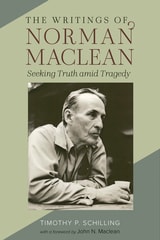
The Writings of Norman Maclean
Seeking Truth amid TragedyTimothy P. Schilling
University of Nevada Press, 2024
The Writings of Norman Maclean: Seeking Truth amid Tragedy provides the first critical reassessment of this celebrated author’s work in more than a decade. In his study, Timothy P. Schilling focuses on Maclean’s attempt, in A River Runs through It and Other Stories and Young Men and Fire, to come to grips with the tragic side of human existence. From the 1938 death of his brother Paul to the 1949 deaths of thirteen firefighters in Montana’s Mann Gulch wildfire, Maclean is driven by a desire to discover ultimate meaning—the truth—in the face of haunting tragedy. Through careful analysis of all of Maclean’s published works, Schilling highlights the audaciousness of Maclean’s quest to wrest free an answer from “the universe.”
Ever open to scientific, literary, philosophical, and theological ways of viewing reality, Maclean found ambiguity, paradoxically, to be an essential tool for probing the truth. Beyond exploring Maclean’s use of this tool, Schilling breaks new ground by considering Maclean’s invocation of the Transcendentals in “A River Runs through It,” noting the sly homage Maclean pays to Izaak Walton, examining Maclean’s often-neglected “Other Stories,” assessing Robert Redford’s film adaptation of “A River Runs through It,” and providing the most thorough exploration of Young Men and Fire yet available.
With this book, Schilling offers a current and complete analysis of Maclean—one of the most iconic figures in Western American literature.
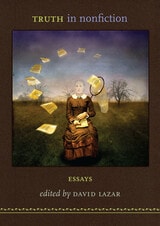
Truth in Nonfiction
EssaysDavid Lazar
University of Iowa Press, 2008
The past and the truth are slippery things, and the art of nonfiction writing requires the writer to shape as well as explore. In personal essays, meditations on the nature of memory, considerations of the genres of memoir, prose poetry, essay, fiction, and film, the contributors to this provocative collection attempt to find answers to the question of what truth in nonfiction means.
Contributors: John D’Agata, Mark Doty, Su Friedrich, Joanna Frueh, Ray González, Vivian Gornick, Barbara Hammer, Kathryn Harrison, Marianne Hirsch, Wayne Koestenbaum, Leonard Kriegel, David Lazar, Alphonso Lingis, Paul Lisicky, Nancy Mairs, Nancy K. Miller, Judith Ortiz Cofer, Phyllis Rose, Oliver Sacks, David Shields, and Leo Spitzer