Results by title
3 books match the query 'Tsing, Anna Lowenhaupt'

Multispecies Studies
Thom van Dooren, Ursula Münster, Eben Kirksey, Deborah Bird Rose, Matthew Chrulew, and Anna Tsing, special issue editors
Duke University Press, 2016
The emerging field of multispecies studies, grounded in passionate immersion in the lives of fungi, microorganisms, animals, plants, and others, is opening up novel ways of engaging with worlds around us. This issue brings together some of the leading scholars in this field to explore what is at stake—epistemologically, politically, ethically—for different forms of life caught up in diverse relationships of knowing and living together. The collection takes us into the worlds of sheep and shepherds; of stones, worms, salmon, and forest-devouring beetles; of viruses and their elephants; of seals, crows, and lava flows in Hawaii; and finally of frogs-as-pregnancy-tests and possible agents of pathogenic fungal spread. Each of the contributors explores what difference curious and careful attention to others might make in our efforts to inhabit and coconstitute flourishing worlds in these difficult times.
This issue is freely available online at environmentalhumanities.org; a print version is available for purchase.
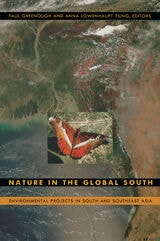
Nature in the Global South
Environmental Projects in South and Southeast AsiaPaul Greenough and Anna Lowenhaupt Tsing, eds.
Duke University Press, 2003
With contributors based in anthropology, ecology, sociology, history, and environmental and policy studies, Nature in the Global South features some of the most innovative and influential work being done in the social studies of nature. While some of the essays look at how social and natural landscapes are created, maintained, and transformed by scientists, officials, monks, and farmers, others analyze specific campaigns to eradicate smallpox and save forests, waterways, and animal habitats. In case studies centered in the Philippines, India, Pakistan, Thailand, Indonesia, and South and Southeast Asia as a whole, contributors examine how the tropics, the jungle, tribes, and peasants are understood and transformed; how shifts in colonial ideas about the landscape led to extremely deleterious changes in rural well-being; and how uneasy environmental compromises are forged in the present among rural, urban, and global allies.
Contributors:
Warwick Anderson
Amita Baviskar
Peter Brosius
Susan Darlington
Michael R. Dove
Ann Grodzins Gold
Paul Greenough
Roger Jeffery
Nancy Peluso
K. Sivaramakrishnan
Nandini Sundar
Anna Lowenhaupt Tsing
Charles Zerner

Words in Motion
Toward a Global LexiconCarol Gluck and Anna Lowenhaupt Tsing, eds.
Duke University Press, 2009
Such words as security in Brazil, responsibility in Japan, community in Thailand, and hijāb in France changed the societies in which they moved even as the words were changed by them. Some words threatened to launch wars, as injury did in imperial Britain’s relations with China in the nineteenth century. Others, such as secularism, worked in silence to agitate for political change in twentieth-century Morocco. Words imposed or imported from abroad could be transformed by those who wielded them to oppose the very powers that first introduced them, as happened in Turkey, Indonesia, and the Philippines. Taken together, this selection of fourteen essays reveals commonality as well as distinctiveness across modern societies, making the world look different from the interdisciplinary and transnational perspective of “words in motion.”
Contributors. Mona Abaza, Itty Abraham, Partha Chatterjee, Carol Gluck, Huri Islamoglu, Claudia Koonz, Lydia H. Liu, Driss Maghraoui, Vicente L. Rafael, Craig J. Reynolds, Seteney Shami, Alan Tansman, Kasian Tejapira, Anna Lowenhaupt Tsing