Results by title
4 books match the query 'Turkish literature'
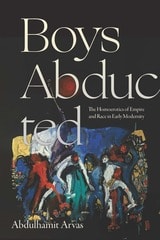
Boys Abducted
The Homoerotics of Empire and Race in Early ModernityAbdulhamit Arvas
Duke University Press, 2025
In Boys Abducted, Abdulhamit Arvas explores the history of abducted boys in English and Ottoman literary and visual culture to examine the relationships between homoeroticism, race, and empire in the early modern period. The popular literary trope of the abducted beautiful boy—often eroticized as an exotic object of desire—intersects with the historical phenomenon of vulnerable youths who were captured and exchanged within the global traffic in bodies. Arvas offers a queer-historicist analysis of a wide array of Ottoman and English texts and genres ranging from poetry, drama, and travelogue to chronicles, maps, and visual arts. He shows how the boy in these representations crosses boundaries between nations and empires, embodying the tensions and dissonances between the aestheticized eroticism of literary and cultural representations and the violent history of abductions, conversions, and enslavements. In so doing, Arvas presents complex parallels and connections between the two societies, highlighting the circulation of sexual and racial discourses in imperial imaginings to uncover discursive formations and formulations of sexuality, race, and empire.
[more]
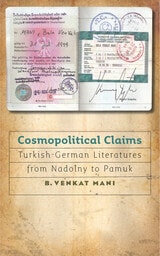
Cosmopolitical Claims
Turkish-German Literatures from Nadolny to PamukB. Venkat Mani
University of Iowa Press, 2007
When both France and Holland rejected the proposed constitution for the European Union in 2005, the votes reflected popular anxieties about the entry of Turkey into the European Union as much as they did ambivalence over ceding national sovereignty. Indeed, the votes in France and Holland echoed long standing tensions between Europe and Turkey. If there was any question that tensions were high, the explosive reaction of Europe’s Muslim population to a series of cartoons of Mohammed in a Danish newspaper put them to rest. Cosmopolitical Claims is a profoundly original study of the works of Sten Nadonly, Emine Sevgi Özdamar, Feridun Zaimoglu, and 2006 Nobel prize in literature recipient Orhan Pamuk. Rather than using the proverbial hyphen in “Turkish-German” to indicate a culture caught between two nations, Venkat Mani is interested in how Turkish-German literature engages in a scrutiny of German and Turkish national identity.
Moving deftly from the theoretical literature to the texts themselves, Mani’s groundbreaking study explores these conflicts and dialogues and the resulting cultural hybridization as they are expressed in four novels that document the complexity of Turkish-German cultural interactions in the late twentieth and early twenty-first centuries. His innovative readings will engage students of contemporary German literature as well as illuminate the discussion of minority literature in a multicultural setting.
As Salman Rushdie said in the 2002 Tanner Lecture at Yale, “The frontier is an elusive line, visible and invisible, physical and metaphorical, amoral and moral. . . . To cross a frontier is to be transformed.” It is in this vein that Mani’s dynamic and subtle work posits a still evolving discourse between Turkish and German writers.
[more]
Intersections in Turkish Literature
Essays in Honor of James Stewart-RobinsonWalter G. Andrews, Editor
University of Michigan Press, 2001
The rich but often neglected field of Turkish and Ottoman literature has long suffered from the fact that a number of traditional research boundaries have separated the studies of folk and elite literature, of Ottoman and modern literature, of the village and the city, the religious and the secular.
Intersections in Turkish Literature is a collection of essays on Turkish literature by former students of James Stewart-Robinson. The topics and methods cover a broad range--from a careful thematic analysis of a traditional Turkish folktale, which reveals its resemblance to well-known Western tales; to an analysis of the "saint tales" recounted by present-day Albanian Bektasi adepts; to a study of narrative rhythm in Nazim Hikhmet's rendition of an account of a fifteenth-century popular uprising.
Walter G. Andrews has assembled the writings of a number of scholars who bridge traditional chasms, inviting us to rethink our approaches to the study of Turkish and Ottoman literature. This collection forms a nucleus that clearly demonstrates the great potential now existing for study in this area, the essays displaying a variety of unusual approaches that bring together seemingly disparate materials: the Turkish story "The Pomegranate Seed" and Disney's "Snow White"; a fifteenth-century chronicle and the poetry of a modern socialist poet; Albanian dervishes in Detroit; a modern Turkish novel; Virginia Woolf; a Yale critic; traditional Japanese poetry; and Ottoman lyrics.
Intersections in Turkish Literature will provide an important stimulus to work that reaches beyond the limits of area studies, intersecting with the interests of scholars and students of literary theory, folklore studies, anthropology, French, Japanese, and Persian.
Walter G. Andrews is Affiliate Professor of Near Eastern Languages and Civilization, University of Washington.
[more]
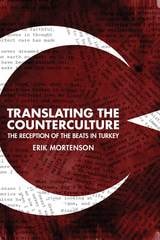
Translating the Counterculture
The Reception of the Beats in TurkeyErik Mortenson
Southern Illinois University Press, 2018
In Turkey the Beat message of dissent is being given renewed life as publishers, editors, critics, readers, and others dissatisfied with the conservative social and political trends in the country have turned to the Beats and other countercultural forebears for alternatives. Through an examination of a broad range of literary translations, media portrayals, interviews, and other related materials, this book seeks to uncover how the Beats and their texts are being circulated, discussed, and used in Turkey to rethink the possibilities they might hold for social critique today.
Mortenson examines how in Turkey the Beats have been framed by the label “underground literature”; explores the ways they are repurposed in the counterculture-inspired journal Underground Poetix; looks at the reception of Jack Kerouac’s On the Road and how that reaction provides a better understanding of the construction of “American-ness”; delves into the recent obscenity trial of William S. Burroughs’s novel The Soft Machine and the attention the book’s supporters brought to government repression and Turkish homophobia; and analyzes the various translations of Allen Ginsberg’s Howl to demonstrate the relevance Ginsberg still holds for social rebellion today.
Translating the Counterculture takes a revolutionary look at how contemporary readers in other parts of the world respond to the Beats. Challenging and unsettling an American-centric understanding of the Beats, Mortenson pushes the discipline toward a fuller consideration of their cultural legacy in a globalized twenty-first century.
[more]