Results by title
6 books match the query 'Turmoil'
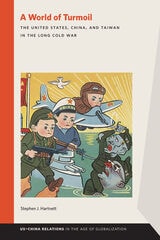
A World of Turmoil
The United States, China, and Taiwan in the Long Cold Warstephen hartnett
Michigan State University Press, 2021
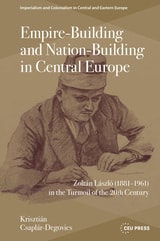
Empire-Building and Nation-Building in Central Europe
Zoltán László (1881–1961) in the Turmoil of the 20th CenturyKrisztián Csaplár-Degovics
Central European University Press, 2026
Before 1914, László established himself as a journalist, writer, academic, and willing agent of Austro-Hungarian imperial policy. In the interwar period and during the Second World War, his expertise as a propagandist found expression in racist circles.
By examining László’s life as a case study, the book offers a microhistorical perspective on how members of the educated middle classes became implicated in, and often willing participants of, imperial, racist, and totalitarian projects. It demonstrates how the lived experience of one individual illuminates the complex entanglement of ideology, identity, and power in East-Central Europe’s modern history.
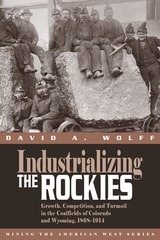
Industrializing the Rockies
Growth, Competition, and Turmoil in the Coalfields of Colorado and Wyoming, 1868-1914David A. Wolff
University Press of Colorado, 2014
In Industrializing the Rockies, David A. Wolff places these deadly conflicts and strikes in the context of the Western coal industry from its inception in 1868 to the age of maturity in the early twentieth century. The result is the first book-length study of the emergence of coalfield labor relations and a general overview of the role of coal mining in the American West.
Wolff examines the coal companies and the owners' initial motivations for investment and how these motivations changed over time. He documents the move from speculation to stability in the commodities market, and how this was reflected in the development of companies and company towns.
Industrializing the Rockies also examines the workers and their workplaces: how the miners and laborers struggled to maintain mining as a craft and how the workforce changed, ethnically and racially, eventually leading to the emergence of a strong national union. Wolff shines light on the business of coal mining detailing the market and economic forces that influenced companies and deeply affected the lives of the workers.
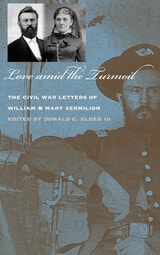
Love amid the Turmoil
The Civil War Letters of William and Mary VermilionDonald C. Elder, III
University of Iowa Press, 2003
William Vermilion (1830-1894) served as a captain in Company F of the 36th Iowa Infantry from October 1862 until September 1865. Although he was a physician in Iconium in south central Iowa at the start of the war, after it ended he became a noted lawyer in nearby Centerville; he was also a state senator from 1869 to 1872. Mary Vermilion (1831-1883) was a schoolteacher who grew up in Indiana; she and William married in 1858. In this volume historian Donald Elder provides a careful selection from the hundreds of supportive, informative, and heart-wrenching letters that they wrote each other during the war—the most complete collection of letters exchanged between a husband and a wife during the Civil War.

Still the Arena of Civil War
Violence and Turmoil in Reconstruction Texas, 1865-1874Kenneth W. Howell
University of North Texas Press, 2012
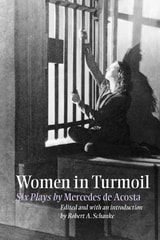
Women in Turmoil
Six Plays by Mercedes de AcostaEdited and with an introduction by Robert A. Schanke
Southern Illinois University Press, 2003
In this first publication of six plays by the flamboyantly uninhibited author, poet, and playwright Mercedes de Acosta (1893–1968), theater historian Robert A. Schanke rescues these lost theatrical writings from the dusty margins of obscurity. Often autobiographical, always rife with gender struggle, and still decidedly stageworthy, Women in Turmoil: Six Plays by Mercedes de Acosta constitutes a significant find for the canon of gay and lesbian drama.
In her 1960 autobiography Here Lies the Heart, de Acosta notes that as she was contemplating marriage to a man in 1920, she was "in a strange turmoil about world affairs, my own writing, suffrage, sex, and my inner spiritual development." The voice in these plays is that of a lesbian in turmoil, marginalized and ignored. Her same-sex desires and struggles for acceptance fueled her writings, and nowhere is that more evident than in the plays contained herein. The women characters struggle with unfulfilling marriages, divorce, unrequited sexual desire, suppressed identity, and a longing for recognition.
Of the six plays, only the first two were ever produced. Jehanne d’Arc (1922) premiered in Paris with de Acosta’s lover at the time, Eva Le Gallienne, starring and Norman Bel Geddes designing the set and lights. In 1934, de Acosta adapted it into a screenplay for Greta Garbo, then her lover, but it was never filmed. Portraying rampant anti-Semitism in a small New England town, Jacob Slovak (1923) was performed both on Broadway and in London, with the London production starring John Gielgud and Ralph Richardson.
The Mother of Christ (1924) is a long one-act play written for the internationally known actress Eleonora Duse. After Duse’s death, several other actresses including Eva Bartok, Jeanne Eagels, and Lillian Gish explored productions of the play. Igor Stravinsky wrote a score, Norman Bel Geddes designed a set, and Gladys Calthrop designed costumes. However, the play was never produced.
Her most autobiographical play, World Without End (1925), and her most sensational play, The Dark Light (1926), both unfold through plots of sibling rivalry, incest, and suicide. With overtones of Ibsen, Illusion (1928) continues the themes of de Acosta’s previous plays with her rough and seedy cast of characters, but here the playwright’s drama grows to incorporate a yearning for belonging as well as strong elements of class conflict.
What notoriety remains associated with de Acosta has less to do with her writing than with her infamous romances with the likes of Greta Garbo, Marlene Dietrich, Isadora Duncan, Alla Nazimova, Eva Le Gallienne, Tamara Karsavina, Pola Negri, and Ona Munson. Through this collection of six powerfully poignant dramas, editor Robert A. Schanke strives to correct myths about Mercedes de Acosta and to restore both her name and her literary achievements to their proper place in history.
Robert A. Schanke has authored the original biography, “That Furious Lesbian:” The Story of Mercedes de Acosta, also available from Southern Illinois University Press.