Results by title
6 books match the query 'Turpin, Zachary'
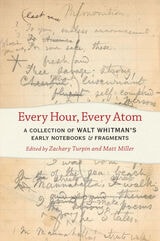
Every Hour, Every Atom
A Collection of Walt Whitman's Early Notebooks and FragmentsWalt Whitman, Zachary Turpin and Matt Miller
University of Iowa Press, 2020
Some of the dimmest years in Walt Whitman’s life precede the advent of Leaves of Grass in 1855, when he was working as a journalist and fiction writer. Starting around 1850, what he’d begun writing in his personal notebooks was far more enigmatic than anything he’d done before.
One of Whitman’s most secretive projects during this timeframe was a novel, Life and Adventures of Jack Engle; serialized anonymously in the spring of 1852, and rediscovered and properly published in 2017. The key to the novel’s later discovery were plot notes Whitman had made in one of his private notebooks.
Whitman’s invaluable notebooks have been virtually inaccessible to the public, until now. Maintaining the early notebooks’ wild, syncretic feel and sample illustrations of Whitman’s beautiful and unkempt pages, scholars Zachary Turpin and Matt Miller’s thorough transcriptions have made these notebooks available to all; sharing Whitman’s secret space for developing his poetry, his writing, his philosophy, and himself.
Life and Adventures of Jack Engle
An Auto-Biography; A Story of New York at the Present Time in which the Reader Will Find Some Familiar CharactersWalt Whitman
University of Iowa Press, 2017
Then it disappeared.
No one laid eyes on it until 2016, when literary scholar Zachary Turpin, University of Houston, followed a paper trail deep into the Library of Congress, where the sole surviving copy of Jack Engle has lain waiting for generations. Now, after more than 160 years, the University of Iowa Press is honored to reprint this lost work, restoring a missing piece of American literature by one of the world’s greatest authors, written as he verged on immortality.

Radicals, Volume 1
Fiction, Poetry, and Drama: Audacious Writings by American Women, 1830-1930Meredith Stabel and Zachary Turpin
University of Iowa Press, 2021
In Volume 1: Fiction, Poetry, and Drama, selections span from early works like Sarah Louise Forten’s anti-slavery poem “The Grave of the Slave” (1831) and Fanny Fern’s Ruth Hall (1855), a novel about her struggle to break into the male-dominated field of journalism, to Charlotte Perkins Gilman’s revenge fantasy, “When I Was a Witch” (1910) and Georgia Douglas Johnson’s poem on the fraught nature of African American motherhood, “Maternity” (1922). In between, readers will discover many vibrant and challenging lesser-known texts that are rarely collected today. Some, indeed, have been out of print for more than a century.
Unique among anthologies of American literature, Radicals undoes such silences by collecting the underrepresented, the uncategorizable, the unbowed—powerful writings by American women of genius and audacity who looked toward, and wrote toward, what Charlotte Perkins Gilman called “a lifted world.”

Radicals, Volume 2
Memoir, Essays, and Oratory: Audacious Writings by American Women, 1830-1930Merdith Stabel and Katha Pollitt
University of Iowa Press, 2021
In Volume 2: Memoir, Essays, and Oratory, selections span from early works like Sarah Mapps Douglass’s anti-slavery appeal “A Mother’s Love” (1832) and Maria W. Stewart’s “Address Delivered at the African Masonic Hall” (1833), to Zitkala-Sa’s memories in “The Land of Red Apples” (1921) and Charlotte Perkins Gilman’s moving final essay “The Right to Die” (1935). In between, readers will discover a whole host of vibrant and challenging lesser-known texts that are rarely collected today. Some, indeed, have been out of print for more than a century.
Unique among anthologies of American literature, Radicals undoes such silences by collecting the underrepresented, the uncategorizable, the unbowed—powerful writings by American women of genius and audacity who looked toward, and wrote toward, what Charlotte Perkins Gilman called “a lifted world.”

Red Business
Walt Whitman’s Notebooks and Fragments of the Civil War and the Reconstruction EraMatt Miller
University of Iowa Press, 2027
In Red Business, Walt Whitman readers can explore nearly all his notebooks and manuscript fragments from the Civil War and the Reconstruction Era. In addition to Whitman’s numerous accounts of Civil War soldiers, Red Business contains the infamous notebook in which Whitman records his feverish obsession with his young companion Peter Doyle, as well as several difficult to find, unpublished poems and essays.
Matt Miller and Zachary Turpin’s meticulous transcriptions of Whitman’s written materials allow readers to explore the often-neglected final chapter of Whitman’s life, as he battled ailments, prepared speeches, and received famous visitors, all the while continuing to write revealing new poems.
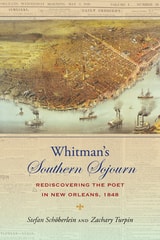
Whitman's Southern Sojourn
Rediscovering the Poet in New Orleans, 1848Stefan Schöberlein
University of Iowa Press, 2025
Far from some brief escape, New Orleans was a significant milestone in Whitman’s development as a political firebrand, as well as a major step for a professional journalist on the rise. Through a wealth of new texts, contexts, and personalities, Stefan Schöberlein and Zachary Turpin paint a vivid picture of a writer on the verge of Leaves of Grass, embracing the contradictions and the multitudes of New Orleans.