Results by title
7 books match the query 'Turtles'
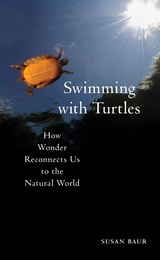
Swimming with Turtles
How Wonder Reconnects Us to the Natural WorldSusan Baur
University of Massachusetts Press, 2026
A memoir of discovery, loss, and wonder that shows us how to slow down
When psychologist and author Susan Baur first slipped into a Cape Cod pond with a snorkel, she wasn’t looking for transformation, just a swim. But beneath the surface, she discovered something extraordinary: minnows hiding among water lilies; fresh-water jellies like jewels and—most striking of all—painted, musk, and snapping turtles. Whether the turtles were buried in mud, teetering on a submerged branch, or drifting like ancient astronauts, they pulled her into a mysterious happiness she could not explain.
Learning to move slowly enough to see them became both her new discipline and her greatest joy. Each dive required patience, curiosity, and humility, and she learned to read the water, follow a subtle shadow, and anticipate the turtles’ rhythms without disturbing their world. As she mastered the art of swimming with turtles, Baur also fell in love with an older man whose companionship deepened her connection to the natural world. When he passed away, grief drove her deeper into the water. There, among the turtles, she found solace and purpose: a reason to keep diving, looking, and learning.
Over nearly two decades, Baur became a self-taught naturalist, children’s author (of The Turtle Sisters series), and unlikely environmental advocate, founding Old Ladies Against Underwater Garbage to protect the ponds she had grown to love. With humor, heart, and vivid observation, Baur shows that wonder isn’t reserved for the young or the lucky—it waits beneath the surface for anyone willing to slow down, look closely, and stay a while.
Swimming with Turtles
How Wonder Reconnects Us to the Natural WorldWritten by Susan Baur. Narrated by Moe Egan
University of Massachusetts Press, 2026
A memoir of discovery, loss, and wonder that shows us how to slow down
When psychologist and author Susan Baur first slipped into a Cape Cod pond with a snorkel, she wasn’t looking for transformation, just a swim. But beneath the surface, she discovered something extraordinary: minnows hiding among water lilies; fresh-water jellies like jewels and—most striking of all—painted, musk, and snapping turtles. Whether the turtles were buried in mud, teetering on a submerged branch, or drifting like ancient astronauts, they pulled her into a mysterious happiness she could not explain.
Learning to move slowly enough to see them became both her new discipline and her greatest joy. Each dive required patience, curiosity, and humility, and she learned to read the water, follow a subtle shadow, and anticipate the turtles’ rhythms without disturbing their world. As she mastered the art of swimming with turtles, Baur also fell in love with an older man whose companionship deepened her connection to the natural world. When he passed away, grief drove her deeper into the water. There, among the turtles, she found solace and purpose: a reason to keep diving, looking, and learning.
Over nearly two decades, Baur became a self-taught naturalist, children’s author (of The Turtle Sisters series), and unlikely environmental advocate, founding Old Ladies Against Underwater Garbage to protect the ponds she had grown to love. With humor, heart, and vivid observation, Baur shows that wonder isn’t reserved for the young or the lucky—it waits beneath the surface for anyone willing to slow down, look closely, and stay a while.
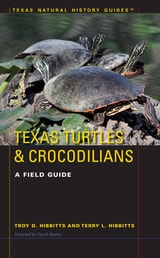
Texas Turtles & Crocodilians
A Field GuideBy Troy D. Hibbitts and Terry L. Hibbitts
University of Texas Press, 2016
Texas has a large and diverse turtle population, with forms that are found nowhere else (Cagle’s Map Turtle and the Texas Map Turtle) and wide-ranging species that barely touch the state, including the Painted Turtles and the Rough-footed Mud Turtle. From the Sabine River to El Paso, and from the Rio Grande to the Panhandle, thirty-one native and established exotic turtle species are definitely known in Texas, along with one crocodilian, the American Alligator.
Texas Turtles & Crocodilians is the first complete identification guide to all the state’s turtles and to its single alligator. It offers detailed species accounts, range maps, and excellent color photographs to aid in field identification. The authors, two of the state’s most knowledgeable herpetologists, open the book with a broad overview of turtle natural history, conservation biology, observation, and captive maintenance before providing a key to Texas turtles and accounts of the various turtle families and species. Appendices provide brief accounts of species that occurred prehistorically in Texas and non-established exotic species, as well as a table of Texas’ major watersheds and the turtle diversity in each one. Informational resources on Texas turtles and alligators, a map of Texas counties, a glossary, a bibliography, and indexes of common and scientific names complete the volume.
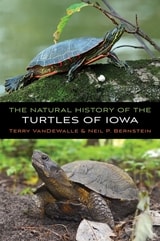
The Natural History of the Turtles of Iowa
Terry VanDeWalle
University of Iowa Press, 2024
While readers will be able to identify Iowa’s turtles through its species accounts, identification keys, and beautiful photographs and illustrations, this book is intended to be more than a field guide. What makes it truly unique is the comparison of historic data collected by Iowa herpetologists in the 1930s and 1940s with data collected by the authors, along with James L. Christiansen and others, since 1960. Custom maps show the reader how species’ distributions have changed over time. This book contains Iowa-specific data found nowhere else and is essential to all who study turtles in the Midwest.
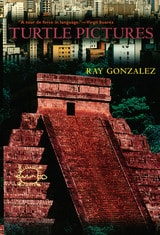
Turtle Pictures
Ray Gonzalez
University of Arizona Press, 2000
Gonzalez has forged a new Chicano manifesto, a cultural memoir that traces both his personal journey and the communal journey that Mexican Americans have traveled throughout this century, across this land. He interweaves lyrical poetry, prose poems, short fiction, and nonfiction commentary into a lush cacophony that traces the evolution of today's politically charged Chicano voices from the deafening silence of their ancestors. Adopting the turtle as a metaphor for the Native American origins of border culture, Gonzalez frames this multitextured individual vision until it becomes a universal portrait of American life: a slow, ancient creature morphing into one of voracious rapidity. In wild and challenging surrealistic images, he hammers out a political statement from language that takes on a special urgency. Walking a fine line between lyricism and polemic, and succeeding where others have stumbled, he calls on Mexican Americans to return to their roots in order to avoid being swept up in American material culture.
Turtle Pictures is a complex body of work by a poet totally in tune with the spirit and nuances of language, imbued with a deep sense of craft and literary tradition. It invites readers to revel in its richness and vitality, to be caught up in its chantlike spirit, to luxuriate in its hauntingly beautiful passages. It is a work to devour, to savor, to return to, for it speaks with all the rhythms of the soul.
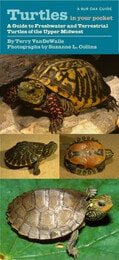
Turtles in Your Pocket
A Guide to Freshwater and Terrestrial Turtles of the Upper MidwestTerry VanDeWalle
University of Iowa Press, 2011
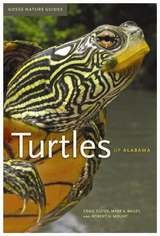
Turtles of Alabama
Craig Guyer, Mark A. Bailey, and Robert H. Mount
University of Alabama Press, 2015
From Riverbeds to Coastlines: The Ultimate Guide to Alabama’s Turtles.
For nearly 200 million years, Earth has been occupied by reptiles—a lineage of terrestrial vertebrates that includes some, like birds, that have invaded the aerial environment, and others, like turtles, that have invaded aquatic environments. With thirty-nine known species, Alabama harbors more turtle species than any other state in the nation, and its Mobile River basin is the center of the world's greatest biodiversity in turtles, surpassing all other river systems around the globe, including the Amazon and the Nile. Turtles of Alabama documents that extraordinary wealth and presents each species in full, describing its physical appearance, habitat and range, behavior, conservation and management, and taxonomy.
In addition to providing sixty-five full-color photographs of juveniles and adults along with forty-two colorfully detailed distribution maps, this volume features an introductory section explaining the physiography, climate, and habitats of the state, and offers illustrated taxonomic keys for all the species considered, including the oceanic behemoths that lay their eggs on Alabama's gulf beaches and the lumbering gopher tortoise that provides safe haven for countless other animals and arthropods in its underground burrows of the Coastal Plain. With fine line drawings to highlight various distinguishing attributes of the animals, this volume is the definitive guide to the state’s fascinating and diverse turtle populations—freshwater, marine, and terrestrial.
Although they are notoriously slow-moving, turtles still survive on Earth because of their remarkable adaptations—an exterior shell for body protection, long lives, high reproductive output, stamina, and a capacity for doing without. Turtles are cold-blooded reptiles that were here long before mammals, and they're still around, continuing to adapt to many different habitats and ecological niches, still interbreeding, evolving, and speciating. Turtles of Alabama is a fitting celebration of that phenomenal variety and strength.