Results by title
2 books match the query 'Tuskegee Institute'

Chronicles Of Faith
The Autobiography of Frederick D. PattersonFrederick D. Patterson, edited by Martia Graham Goodson
University of Alabama Press, 1991
From Tuskegee to the United Negro College Fund, one man's legacy changed American education.
Chronicles of Faith: The Autobiography of Frederick D. Patterson, edited by Martia Graham Goodson, presents the remarkable life story of one of the most influential educators and institutional leaders in twentieth-century America. Based on Patterson's personal recollections, the autobiography traces his journey from a childhood marked by adversity to a distinguished career as a veterinarian, educator, college president, and visionary advocate for higher education.
Best known as president of Tuskegee Institute and founder of the United Negro College Fund, Patterson played a pivotal role in expanding educational opportunities for African Americans during an era of segregation and limited resources. The narrative chronicles his leadership in strengthening historically Black colleges and universities, promoting professional education, and developing innovative fundraising models that transformed the future of Black higher education.
Interwoven with accounts of personal determination, faith, and public service, the book offers valuable insight into the challenges and achievements that shaped American educational history. Patterson's story is both an inspiring autobiography and an important historical document, revealing the vision and perseverance required to create lasting institutional change. Essential for understanding the evolution of higher education in the United States, this volume will be especially valuable to students, scholars, educators, historians, and readers interested in African American leadership, HBCUs, philanthropy, and social progress.
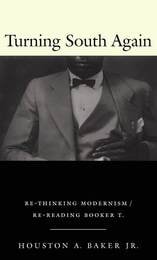
Turning South Again
Re-Thinking Modernism/Re-Reading Booker T.Houston A. Baker Jr.
Duke University Press, 2001
From the holds of slave ships to the peonage of Reconstruction to the contemporary prison system, incarceration has largely defined black life in the United States. Even Washington’s school at Tuskegee, Baker explains, housed and regulated black bodies no longer directly controlled by slave owners. He further implicates Washington by claiming that in enacting his ideas about racial “uplift,” Washington engaged in “mulatto modernism,” a compromised attempt at full citizenship. Combining autobiographical prose, literary criticism, psychoanalytic writing, and, occasionally, blues lyrics and poetry, Baker meditates on the consequences of mulatto modernism for the project of black modernism, which he defines as the achievement of mobile, life-enhancing participation in the public sphere and economic solvency for the majority of African Americans. By including a section about growing up in the South, as well as his recent return to assume a professorship at Duke, Baker contributes further to one of the book’s central concerns: a call to centralize the South in American cultural studies.