Results by title
5 books match the query 'Twentieth - Century China'

Education, Culture, and Identity in Twentieth-Century China
Glen Peterson, Ruth Hayhoe, and Yongling Lu, Editors
University of Michigan Press, 2001
Educational pursuits run like a rich thread through the fabric of China's turbulent twentieth century. From the founding of China's first modern school system in the late Qing dynasty through the republican era to the latest educational developments in the People's Republic of China, this book seeks to understand how developments in education contributed to, and were in turn influenced by, cultural patterns and the ongoing search for identity by individuals, collectivities, and states. Its sixteen contributors explore three themes that have enlivened China studies in recent years: sino-foreign interactions, state-society relations, and gender representation and identification.
Unlike most studies of modern Chinese education that focus exclusively on the post-1949 era, Education, Culture, and Identity in Twentieth-Century China represents a deliberate attempt to break through the 1949 barrier and embrace the entire century. Culture emerges in this study as a deeper level factor that underlay the development of education in each period and shaped certain recurrent patterns, while identity involves a search for individual and collective meaning that went on under different regimes.
The product of a genuinely multidisciplinary effort to promote cross-fertilization among an international team of scholars in a wide range of disciplines, Education, Culture, and Identity in Twentieth-Century China will interest students and scholars of modern China, comparative and international education, educational policy, and international relations. It will also appeal to policy makers and professionals associated with international organizations.
Glen Peterson is Associate Professor of History, University of British Columbia. Ruth Hayhoe is Director, Hong Kong Institute of Education. Yongling Lu is a graduate student in the History Department, Stanford University.
[more]
Science and Medicine in Twentieth-Century China
Research and EducationJohn Z. Bowers, J. William Hess, and Nathan Sivin, Editors
University of Michigan Press, 1988
The first part of this volume is devoted is devoted to synoptical and analytical examinations by historians of attempts to root modern science in China during the Republican period. The second contains reports by scientists who have been involved in China’s recent efforts to modernize. Topics include genetic research, taxonomy, contraception, food policy, and schistosomiasis. With an introduction by Nathan Sivin.
[more]
The Imperial Style of Inquiry in Twentieth-Century China
The Emergence of New ApproachesDonald J. Munro
University of Michigan Press, 1996
How have traditional Chinese ways of thinking affected problem solving in this century? The traditional, imperial style of inquiry is associated with the belief that the universe is a coherent, internally structured unity understandable through the similarly structured human mind. It involves a reliance on antecedent and authoritarian models, coupled with an introspective focus in investigations, at some cost to objective fact gathering.
In contrast, emergent forms of inquiry are guided by the values of individual autonomy and new perspectives on objectivity. In the 1930s and 1940s, some liberal educators held the model of Western science in great esteem, and some scientists practicing objective inquiry helped to create an awareness in the urban areas of inquiry not directed by political values.
Drawing on philosophical, social science, and popular culture materials, Donald Munro shows that the two strains coexisted in twentieth century China as mixed motives. Many important figures were motivated by a desire to act consistently with the social values associated with the premodern or received view of knowledge and inquiry. At the same time, these people often had other motives, such as utilitarian values, efficiency, and entrepreneurship. Munro argues that while many competing positions can coexist in the same person, the seeds of the positive, instrumental value of individual autonomy in Chinese inquiry are beginning to compete in both scholarly and popular culture with other, older approaches.
[more]
The Magic of Concepts
History and the Economic in Twentieth-Century ChinaRebecca E. Karl
Duke University Press, 2017
In The Magic of Concepts Rebecca E. Karl interrogates "the economic" as concept and practice as it was construed historically in China in the 1930s and again in the 1980s and 1990s. Separated by the Chinese Revolution and Mao's socialist experiments, each era witnessed urgent discussions about how to think about economic concepts derived from capitalism in modern China. Both eras were highly cosmopolitan and each faced its own global crisis in economic and historical philosophy: in the 1930s, capitalism's failures suggested that socialism offered a plausible solution, while the abandonment of socialism five decades later provoked a rethinking of the relationship between history and the economic as social practice. Interweaving a critical historiography of modern China with the work of the Marxist-trained economist Wang Yanan, Karl shows how "magical concepts" based on dehistoricized Eurocentric and capitalist conceptions of historical activity that purport to exist outside lived experiences have erased much of the critical import of China's twentieth-century history. In this volume, Karl retrieves the economic to argue for a more nuanced and critical account of twentieth-century Chinese and global historical practice.
[more]
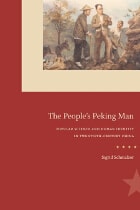
The People's Peking Man
Popular Science and Human Identity in Twentieth-Century ChinaSigrid Schmalzer
University of Chicago Press, 2008
In the 1920s an international team of scientists and miners unearthed the richest evidence of human evolution the world had ever seen: Peking Man. After the communist revolution of 1949, Peking Man became a prominent figure in the movement to bring science to the people. In a new state with twin goals of crushing “superstition” and establishing a socialist society, the story of human evolution was the first lesson in Marxist philosophy offered to the masses. At the same time, even Mao’s populist commitment to mass participation in science failed to account for the power of popular culture—represented most strikingly in legends about the Bigfoot-like Wild Man—to reshape ideas about human nature.
The People’s Peking Man is a skilled social history of twentieth-century Chinese paleoanthropology and a compelling cultural—and at times comparative—history of assumptions and debates about what it means to be human. By focusing on issues that push against the boundaries of science and politics, The People’s Peking Man offers an innovative approach to modern Chinese history and the history of science.
[more]