Results by title

3 books match the query 'Twentieth - Century Mexico'

cover of Caciquismo in Twentieth-Century Mexico

Caciquismo in Twentieth-Century Mexico

Edited by Alan Knight and Wil Pansters

University of London Press, 2006

Caciquismo (roughly translated as "boss politics") has played a major role in Mexican political and social life. Loosely knit interest groups, or "caciques", of diverse character - syndicates, farmers, left- and right-wingers, white-collar workers - have exercised great power within Mexico's distinctive political system. The peculiarities of Mexico's system have greatly depended on this kind of informal politics, which combines repression, patronage, and charismatic leadership. As such, caciquismo fits uncomfortably within the formal analysis of laws, parties, and elections and has been relatively neglected by academics. Though its demise has often been predicted, it has survived, evolved, and adjusted to Mexico's rapid post-revolutionary transformation. Incorporating the research of historians, political scientists, sociologists, and anthropologists, this book reevaluates the crucial role of the cacique in modern Mexico. It suggests that caciquismo has survived decades of change and upheaval and remains an important, if underestimated, feature of recent Mexican politics.
Contributors include Christopher Boyer (University of Illinois at Chicago, USA), Keith Brewster (University of Newcastle upon Tyne, UK), Matthew Butler (Queen's University, Belfast, UK), Marco Calderon (El Colegio de Michoacan, Mexico), Maria Teresa Fernandez Aceves (Centro de Investigaciones en Estudios Superiores en Antropologia Social [CIESAS], Mexico), Rogelio Hernandez Rodriuez (El Colegio de Mexico), Stephen Lewis (California State University, Chico, USA), Salvador Maldonado Aranda (El Colegio de Michoacan, Mexico), Jennie Purnell (Boston College, USA), Jan Rus (Tzotzil Instituto de Asesoria Antropologica para la Region Maya, and Center for U.S.-Mexican Studies, University of California, San Diego, USA), Pieter de Vries (Wageningen University, Netherlands), and J. Eduardo Zarate H (El Colegio de Mexico, Michoacan, Mexico).
[more]
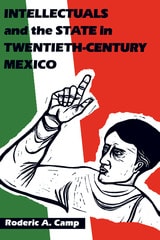
cover of Intellectuals and the State in Twentieth-Century Mexico

Intellectuals and the State in Twentieth-Century Mexico

By Roderic A. Camp

University of Texas Press, 1986

In developing countries, the extent to which intellectuals disengage themselves in state activities has widespread consequences for the social, political, and economic development of those societies. Roderic Camps’ examination of intellectuals in Mexico is the first study of a Latin American country to detail the structure of intellectual life, rather than merely considering intellectual ideas. Camp has used original sources, including extensive interviews, to provide new data about the evolution of leading Mexican intellectuals and their relationship to politics and politicians since 1920.
[more]
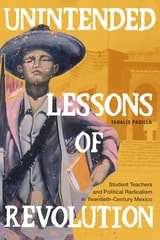
cover of Unintended Lessons of Revolution: Student Teachers and Political Radicalism in Twentieth-Century Mexico

Unintended Lessons of Revolution

Student Teachers and Political Radicalism in Twentieth-Century Mexico

Tanalís Padilla

Duke University Press, 2021

In the 1920s, Mexico established rural normales—boarding schools that trained teachers in a new nation-building project. Drawn from campesino ranks and meant to cultivate state allegiance, their graduates would facilitate land distribution, organize civic festivals, and promote hygiene campaigns. In Unintended Lessons of Revolution, Tanalís Padilla traces the history of the rural normales, showing how they became sites of radical politics. As Padilla demonstrates, the popular longings that drove the Mexican Revolution permeated these schools. By the 1930s, ideas about land reform, education for the poor, community leadership, and socialism shaped their institutional logic. Over the coming decades, the tensions between state consolidation and revolutionary justice produced a telling contradiction: the very schools meant to constitute a loyal citizenry became hubs of radicalization against a government that increasingly abandoned its commitment to social justice. Crafting a story of struggle and state repression, Padilla illuminates education's radical possibilities and the nature of political consciousness for youths whose changing identity—from campesinos, to students, to teachers—speaks to Mexico’s twentieth-century transformations.
[more]