Results by title
141 books match the query 'Twentieth Century' and 20 start with a
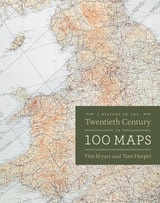
A History of the Twentieth Century in 100 Maps
Tim Bryars and Tom Harper
University of Chicago Press, 2014
As Bryars and Harper reveal, maps make ideal narrators, and the maps in this book tell the story of the 1900s—which saw two world wars, the Great Depression, the Swinging Sixties, the Cold War, feminism, leisure, and the Internet. Several of the maps have already gained recognition for their historical significance—for example, Harry Beck’s iconic London Underground map—but the majority of maps on these pages have rarely, if ever, been seen in print since they first appeared. There are maps that were printed on handkerchiefs and on the endpapers of books; maps that were used in advertising or propaganda; maps that were strictly official and those that were entirely commercial; maps that were printed by the thousand, and highly specialist maps issued in editions of just a few dozen; maps that were envisaged as permanent keepsakes of major events, and maps that were relevant for a matter of hours or days.
As much a pleasure to view as it is to read, A History of the Twentieth Century in 100 Maps celebrates the visual variety of twentieth century maps and the hilarious, shocking, or poignant narratives of the individuals and institutions caught up in their production and use.
A Land Apart
The Southwest and the Nation in the Twentieth CenturyFlannery Burke
University of Arizona Press, 2017
Winner, Spur Award for Best Contemporary Nonfiction (Western Writers of America)
A Land Apart is not just a cultural history of the modern Southwest—it is a complete rethinking and recentering of the key players and primary events marking the Southwest in the twentieth century. Historian Flannery Burke emphasizes how indigenous, Hispanic, and other non-white people negotiated their rightful place in the Southwest. Readers visit the region’s top tourist attractions and find out how they got there, listen to the debates of Native people as they sought to establish independence for themselves in the modern United States, and ponder the significance of the U.S.-Mexico border in a place that used to be Mexico. Burke emphasizes policy over politicians, communities over individuals, and stories over simple narratives.
Burke argues that the Southwest’s reputation as a region on the margins of the nation has caused many of its problems in the twentieth century. She proposes that, as they consider the future, Americans should view New Mexico and Arizona as close neighbors rather than distant siblings, pay attention to the region’s history as Mexican and indigenous space, bear witness to the area’s inequalities, and listen to the Southwest’s stories. Burke explains that two core parts of southwestern history are the development of the nuclear bomb and subsequent uranium mining, and she maintains that these are not merely a critical facet in the history of World War II and the militarization of the American West but central to an understanding of the region’s energy future, its environmental health, and southwesterners’ conception of home.
Burke masterfully crafts an engaging and accessible history that will interest historians and lay readers alike. It is for anyone interested in using the past to understand the present and the future of not only the region but the nation as a whole.

A Short History of the Future
W. Warren Wagar
University of Chicago Press, 1992
A Short History of the Future
W. Warren Wagar
University of Chicago Press, 1999
"Thanks to Wagar's magisterial command of futurist information and theory, his extrapolated near-term future is an incisive, dynamic vision of where we may indeed be heading."—H. Bruce Franklin, Washington Post
"A comprehensive, massively detailed script of a possible near future. . . . Intriguing."—San Francisco Chronicle
"A Short History of the Future reads with ease, raises provocative possibilities and presents challenging occasions for thought and argument."—Chicago Tribune
"A breathtaking future history in the manner of Wells and Stapledon, unnerving in its mixture of fact, fiction, and personal perspectives."—George Zebrowski, New York Review of Science Fiction
A Short History of the Future
W. Warren Wagar
University of Chicago Press, 1989
Jensen's tale traces the flow of the future from the early twenty-first-century reign of a megacorporate global economy, to its sudden collapse in 2044, when nuclear catastrophe envelops the world. In the traumatic aftermath, a socialist world commonwealth comes into being in the year 2062, followed by a lengthy transition to a decentralized order of technologically mature autonomous societies, many located in outer space. The riveting literary interludes that follow each chapter take the form of letters and documents from the history of Jensen's family, evoking the everyday lives of people in the midst of these global-historical events. Here we meet a woman in Brazil whose son is dying from a new immuno-deficiency disease, two brothers comparing life on earth with life in a space colony, and many more.
Neither fiction nor nonfiction, Wagar's brilliantly creative work is not meant to forecast the future, but rather to draw attention to possibilities and alternatives for humankind and planet Earth. In doing so, it also serves as an unforgettable reminder that the future is being made now.
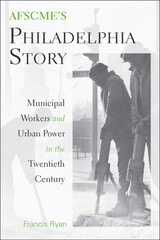
AFSCME's Philadelphia Story
Municipal Workers and Urban Power in the Twentieth CenturyFrancis Ryan
Temple University Press, 2011
AFSCME's Philadelphia Story provides the most comprehensive account of the early years of the American Federation of State, County and Municipal Employees, which is one of the nation’s largest and most politically powerful unions in the AFL-CIO. Author Francis Ryan details the emergence of the Quaker City's interracial union, charting its beginnings in the political patronage system of one of the nation's most notorious political machines to the first decade of the twenty-first century. Ryan provides new insight into the working class origins of African American political power in the late twentieth century as well as a thorough overview of the role the municipal state played in the urban economy of one of the nation's largest cities.
Ryan describes the work processes and how they changed, and uses workers' testimonies to ground the detailed accounts of issues and negotiations. Beginning in the 1920s and ending in the 2000s, Ryan's study offers a long-term analysis of the growth of a single union in a major American city.
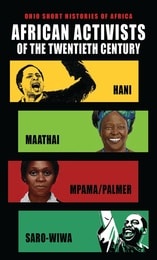
African Activists of the Twentieth Century
Hani, Maathai, Mpama/Palmer, Saro-WiwaHugh Macmillan
Ohio University Press, 2022
An omnibus collection of concise and up-to-date biographies of four influential figures from modern African history.
Chris Hani, by Hugh Macmillan
Chris Hani was one of the most highly respected leaders of the African National Congress, the South African Communist Party, and uMkhonto we Sizwe. His assassination in 1993 threatened to upset the country’s transition to democracy and prompted an intervention by Nelson Mandela that ultimately accelerated apartheid’s demise.
Wangari Maathai, by Tabitha Kanogo
This concise biography tells the story of Wangari Maathai, the Kenyan activist and Nobel Peace Prize winner who devoted her life to campaigning for environmental conservation, sustainable development, democracy, human rights, gender equality, and the eradication of poverty.
Josie Mpama/Palmer: Get Up and Get Moving, by Robert R. Edgar
Highly critical of the patriarchal attitudes that hindered Black women’s political activism, South Africa’s Josie Mpama/Palmer was an outspoken advocate for women’s social and political equality, a member of the Communist Party of South Africa, and an antiapartheid activist.
Ken Saro-Wiwa, by Roy Doron and Toyin Falola
A penetrating, accessible portrait of the Nigerian activist whose execution galvanized the world. Ken Saro-Wiwa became a martyr and symbolized modern Africans’ struggle against military dictatorship, corporate power, and environmental exploitation.
African Americans and Jews in the Twentieth Century
Studies in Convergence and ConflictEdited by V.P. Franklin, Nancy L. Grant, Harold M. Kletnick, & Genna Rae McNeil
University of Missouri Press, 1998
In 1993 distinguished historian Nancy L. Grant organized "Blacks and Jews: An American Historical Perspective," a conference held at Washington University in St. Louis and dedicated to the exploration of Black-Jewish relations in twentieth-century America. Featuring presentations by historians, sociologists, and political scientists, this conference reflected Grant's devotion to scholarship on multicultural relations and the continuing struggle for racial equality in the United States. After Grant's untimely death in 1995, V. P. Franklin and the other contributors completed the work of readying these essays for publication with the assistance of the coeditors. African Americans and Jews in the Twentieth Century is the culmination of the innovative research and ideas presented at the conference.
In the long struggle to bring social justice to American society, Blacks and Jews have often been close allies. In both the past and the present, however, there has also been serious conflict and competition between the groups in social, economic, and political spheres.
Focusing on the complexity of the relationships between Blacks and Jews in America, these essays examine the convergence and conflict that have characterized Black-Jewish interactions over the past century. African Americans and Jews in the Twentieth Century provides an intellectual foundation for continued dialogue and future cooperative efforts to improve social justice in this society and will be an invaluable resource for the study of race relations in the United States in the twentieth century.
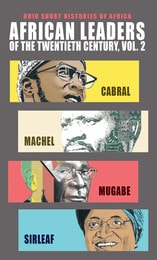
African Leaders of the Twentieth Century, Volume 2
Cabral, Machel, Mugabe, SirleafAllen F. Isaacman
Ohio University Press, 2022
This omnibus edition brings together concise and up-to-date biographies of Amílcar Cabral, Samora Machel, Robert Mugabe, and Ellen Johnson Sirleaf. African Leaders of the Twentieth Century, Volume 2 complements courses in history and political science and is an informative collection for general readers.
Amílcar Cabral: A Nationalist and Pan-Africanist Revolutionary, by Peter Karibe Mendy
Amílcar Cabral’s charismatic and visionary leadership, his pan-Africanist solidarity and internationalist commitment to “every just cause in the world,” remain relevant to contemporary struggles for emancipation and self-determination. This concise biography is an ideal introduction to his life and legacy.
Mozambique’s Samora Machel: A Life Cut Short, by Allen F. Isaacman and Barbara S. Isaacman
From his anti-colonial military leadership to the presidency of independent Mozambique, Samora Machel held a reputation as a revolutionary hero to the oppressed. Although killed in a 1987 plane crash, for many Mozambicans his memory lives on as a beacon of hope for the future.
Robert Mugabe, by Sue Onslow and Martin Plaut
For some, Zimbabwe’s Robert Mugabe was a liberation hero who confronted white rule and oversaw the radical redistribution of land. For others, he was a murderous dictator who drove his country to poverty. This concise biography reveals the complexity of the man who led Zimbabwe for its first decades of independence.
Ellen Johnson Sirleaf, by Pamela Scully
Nobel Peace Prize–winner and two-time Liberian president Ellen Johnson Sirleaf speaks to many of the key themes of the twenty-first century. Among these are the growing power of women in the arenas of international politics and human rights; the ravaging civil wars of the post–Cold War era in which sexual violence is used as a weapon; and the challenges of transitional justice in building postconflict societies.

African Leaders of the Twentieth Century
Biko, Selassie, Lumumba, SankaraLindy Wilson
Ohio University Press, 2015

African Literature in the Twentieth Century
O.R. Dathorne
University of Minnesota Press, 1976
African Literature in the Twentieth Century was first published in 1976. Minnesota Archive Editions uses digital technology to make long-unavailable books once again accessible, and are published unaltered from the original University of Minnesota Press editions.
This paperback makes available the major part of Professor Dathorne's The Black Mind.It concentrates on the writings of Africans in various African and European languages and provides insight, both broad and deep, into the Black intellect. Professor Dathorne examines the literature of Africans as spoken or written in their local languages and in French, Portuguese, and English. This extensive survey and interpretation gives the reader a remarkable pathway to an understanding of the Black imagination and its relevance to thought and creativity throughout the world.
The author himself lived in Africa for ten years, and his view is not that of an outsider, since it is as a Black man that he speaks about Black people. Throughout the book, a major theme is the demonstration that, despite slavery and colonialism, Africans remained very close to their own cultures. Professor Dathorne shows that African writers may be, like some Afro-American writers, "marginal men," but that they are Black men and it is as Black men that they feel the nostalgia of their past and the corrosive influences of their present.
O. R. Dathorne is a member of the Department of Black Studies and of the Department of English at Ohio State University. He has taught at universities in Nigeria and Sierra Leone and served as a UNESCO adviser in Sierra Leone. He also has taught at Ohio State University, Howard University, and the University of Wisconsin and lectured at Yale, Federal City College, Michigan State, and other universities in and out of the United States. He is the author of two novels and editor of a number of anthologies of Black literature, and has written widely in journals on his subject.
African Print Cultures
Newspapers and Their Publics in the Twentieth CenturyEdited by Derek R. Peterson, Emma Hunter, and Stephanie Newell
University of Michigan Press, 2016
The essays collected in African Print Cultures claim African newspapers as subjects of historical and literary study. Newspapers were not only vehicles for anticolonial nationalism. They were also incubators of literary experimentation and networks by which new solidarities came into being. By focusing on the creative work that African editors and contributors did, this volume brings an infrastructure of African public culture into view.
The first of four thematic sections, “African Newspaper Networks,” considers the work that newspaper editors did to relate events within their locality to happenings in far-off places. This work of correlation and juxtaposition made it possible for distant people to see themselves as fellow travellers. “Experiments with Genre” explores how newspapers nurtured the development of new literary genres, such as poetry, realist fiction, photoplays, and travel writing in African languages and in English. “Newspapers and Their Publics” looks at the ways in which African newspapers fostered the creation of new kinds of communities and served as networks for public interaction, political and otherwise. The final section, “Afterlives, ” is about the longue durée of history that newspapers helped to structure, and how, throughout the twentieth century, print allowed contributors to view their writing as material meant for posterity.
After the Map
Cartography, Navigation, and the Transformation of Territory in the Twentieth CenturyWilliam Rankin
University of Chicago Press, 2016
In After the Map, William Rankin argues that although this shift did not render traditional maps obsolete, it did radically change our experience of geographic knowledge, from the God’s-eye view of the map to the embedded subjectivity of GPS. Likewise, older concerns with geographic truth and objectivity have been upstaged by a new emphasis on simplicity, reliability, and convenience. After the Map shows how this change in geographic perspective is ultimately a transformation of the nature of territory, both social and political.
Against the Deportation Terror
Organizing for Immigrant Rights in the Twentieth CenturyRachel Ida Buff
Temple University Press, 2017
Despite being characterized as a “nation of immigrants,” the United States has seen a long history of immigrant rights struggles. In her timely book Against the Deportation Terror, Rachel Ida Buff uncovers this multiracial history. She traces the story of the American Committee for the Protection of the Foreign Born (ACPFB) from its origins in the 1930s through repression during the early Cold War, to engagement with “new” Latinx and Caribbean immigrants in the 1970s and early 1980s.
Functioning as a hub connecting diverse foreign-born communities and racial justice advocates, the ACPFB responded to various, ongoing crises of what they called “the deportation terror.” Advocates worked against repression, discrimination, detention, and expulsion in migrant communities across the nation at the same time as they supported reform of federal immigration policy. Prevailing in some cases and suffering defeats in others, the story of the ACPFB is characterized by persistence in multiracial organizing even during periods of protracted repression.
By tracing the work of the ACPFB and its allies over half a century, Against the Deportation Terror provides important historical precedent for contemporary immigrant rights organizing. Its lessons continue to resonate today.

Alabama in the Twentieth Century
Wayne Flynt
University of Alabama Press, 2004
An authoritative popular history that places the state in regional and national context.
Penned by one of Alabama’s most distinguished historians, this masterful work offers a sweeping yet intimate portrait of a century that reshaped both the state and the nation. With clarity, wit, and deep insight, the author traces the dramatic arc of the 20th century—from the dawn of flight and the rise of industrial power to revolutions in psychology, literature, and morality—all through the lens of Alabama’s unique experience.
Far more than a catalog of events, this book is a meditation on transformation. It captures the spirit of Alabamians as they confronted change with determination and vision, reckoning with the promises and perils of modernity. The author’s deep respect for archival sources and fellow scholars is matched by his gift for storytelling, making this an accessible and compelling read for both academics and general audiences.
With a voice honed by decades of scholarship and a heart rooted in Southern soil, the author brings history to life—illuminating how one state mirrored the nation’s evolution while forging its own path. This is essential reading for anyone seeking to understand Alabama’s place in the American story.
American Melancholy
Constructions of Depression in the Twentieth CenturyHirshbein, Laura D
Rutgers University Press, 2009
American Melancholy traces the growth of depression as an object of medical study and as a consumer commodity and illustrates how and why depression came to be such a huge medical, social, and cultural phenomenon. It is the first book to address gender issues in the construction of depression, explores key questions of how its diagnosis was developed, how it has been used, and how we should question its application in American society.
American Popular Music
New Approaches to the Twentieth CenturyRachel Rubin
University of Massachusetts Press, 2001
Designed as a broad introductory survey, and written by experts in the field, this book examines the rise of American music over the past hundred years — the period in which that music came into its own and achieved unprecedented popularity. Beginning with a look at music as a business, eleven essays explore a variety of popular musical genres, including Tin Pan Alley, blues, jazz, country, gospel, rhythm and blues, rock and roll, folk, rap, and Mexican American corridos. Reading these essays, we come to see that the forms created by one group often appeal to, and are in turn influenced by, other groups—across lines of race, ethnicity, class, gender, region, and age. The chapters speak to one another, arguing for the primacy of such concepts as minstrelsy, urbanization, hybridity, and crossover as the most powerful tools for understanding American popular music. Moving beyond outdated music-industry categories and misleading genre labels, while acknowledging the complexities of the market, the book recovers and reinforces the essential blackness of much popular music—even a presumably white form like country and western. In addition to Rachel Rubin and Jeffrey Melnick, contributors include Reebee Garofalo, Geoffrey Jacques, Kip Lornell, Mark Anthony Neal, Millie Rahn, David Sanjek, James Smethurst, Elijah Wald, and Gail Hilson Woldu.
American Women Stage Directors of the Twentieth Century
Anne Fliotsos and Wendy Vierow
University of Illinois Press, 2007
Presenting a historical overview of female stage directors in the United States, this valuable reference tool focuses on fifty women who have made significant contributions to professional directing during the twentieth century. Anne Fliotsos and Wendy Vierow collect biographical details and important directing data on each woman, including information on training and career path, notable productions, critical reception, directing style, major awards, and bibliographic materials. Insightful commentary from the directors themselves also provides rich details on the theatre business and working process. This collection recognizes the much overlooked contributions of women directors and is an essential introductory tool for students and researchers of American theatre.

Artful Noise
Percussion Literature in the Twentieth CenturyThomas Siwe
University of Illinois Press, 2020
Percussionist Thomas Siwe organizes and analyzes the groundbreaking musical literature that arose during the twentieth century. Focusing on innovations in style and the evolution of the percussion ensemble, Siwe offers a historical overview that connects the music to scoring techniques, new instrumentation and evolving technologies as well as world events. Discussions of representative pieces by seminal composers examines the resources a work requires, its construction, and how it relates to other styles that developed during the same period. In addition, Siwe details the form and purpose of many of the compositions while providing background information on noteworthy artists. Each chapter is supported with musical examples and concludes with a short list of related works specifically designed to steer musicians and instructors alike toward profitable explorations of composers, styles, and eras.
At the President's Side
The Vice Presidency in the Twentieth CenturyEdited by Timothy Walch
University of Missouri Press, 1997
The nation's first vice president, John Adams, called his job "the most insignificant office ever the invention of man contrived or his imagination conceived." And many of the forty-four men who succeeded him in the office have said much worse. Perhaps the biggest problem is that the job has a fancy title, but few responsibilities. Other than presiding over the Senate, the vice president of the United States has no constitutional duties. In fact, it is not even clear that the founders of the republic ever intended that the vice president would succeed to the presidency upon the death of an incumbent.
Yet, despite the relative obscurity of the position, few politicians turn down the opportunity to serve as vice president of the United States. Being elected vice president is often a stepping-stone to the presidency. Since World War II, five vice presidents—Harry Truman, Richard Nixon, Lyndon Johnson, Gerald Ford, and George Bush—have gone on to become president. While it may not be glamorous, the vice presidency is an important training ground for national leadership.
The essays in this book trace the evolution of the vice presidency in the twentieth century from Theodore Roosevelt to Dan Quayle. The first five chapters tell the stories of a colorful collection of the men chosen because of their native states or their political acumen, but not their leadership abilities. The next four chapters form a mosaic of tragedy. Richard Nixon rose from the vice presidency to the presidency only to be forced from office. Lyndon Johnson's tenure ended unhappily because of the prolonged fighting in Vietnam. Hubert Humphrey was humiliated as vice president by a man who should have known better. And Spiro Agnew was rousted from the office by petty greed.
The following four chapters tell the story of a new vice presidency. Nelson Rockefeller, Walter Mondale, George Bush, and Dan Quayle redefined the job that not many people wanted but that few could refuse. In a particularly valuable essay, Quayle reflects on the checkered past of his predecessors, gives credit to Walter Mondale for rehabilitating the vice presidency, and tells of his working relationship with George Bushþoffering a unique glimpse of an office that is quickly becoming the second most powerful in the nation.
Addressing the future of the office, Richard E. Neustadt provides a detailed analysis of the nucleus of vice presidential powerþproximity to the president. To whit, we have Neustadt's maxim: "The power and influence of a vice president is inversely proportional to the political distance between that vice president and his president. The greater the distance the less the power."
At the President's Side includes anecdotal and informative essays by presidential scholars John Milton Cooper Jr., Robert H. Ferrell, Elliot A. Rosen, Richard S. Kirkendall, Richard Norton Smith, Robert Dallek, Joel K. Goldstein, John Robert Greene, and Steven M. Gillon. Also included are incisive commentaries by such Washington insiders as Hugh Sidey, R. W. Apple Jr., James Cannon, and Chase Untermeyer. This book will inform and entertain general readers and also challenge scholars interested in the presidency and the vice presidency.