Results by title

9 books match the query 'Twenty - First Century America'
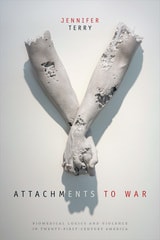
cover of Attachments to War: Biomedical Logics and Violence in Twenty-First-Century America

Attachments to War

Biomedical Logics and Violence in Twenty-First-Century America

Jennifer Terry

Duke University Press, 2017
In Attachments to War Jennifer Terry traces how biomedical logics entangle Americans in a perpetual state of war. Focusing on the Afghanistan and Iraq wars between 2002 and 2014, Terry identifies the presence of a biomedicine-war nexus in which new forms of wounding provoke the continual development of complex treatment, rehabilitation, and prosthetic technologies. At the same time, the U.S. military rationalizes violence and military occupation as necessary conditions for advancing medical knowledge and saving lives. Terry examines the treatment of war-generated polytrauma, postinjury bionic prosthetics design, and the development of defenses against infectious pathogens, showing how the interdependence between war and biomedicine is interwoven with neoliberal ideals of freedom, democracy, and prosperity. She also outlines the ways in which military-sponsored biomedicine relies on racialized logics that devalue the lives of Afghan and Iraqi citizens and U.S. veterans of color. Uncovering the mechanisms that attach all Americans to war and highlighting their embeddedness and institutionalization in everyday life via the government, media, biotechnology, finance, and higher education, Terry helps lay the foundation for a more meaningful opposition to war.
[more]
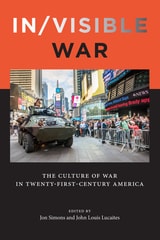
cover of In/visible War: The Culture of War in Twenty-first-Century America

In/visible War

The Culture of War in Twenty-first-Century America

Jon Simons and John Louis Lucaites

Rutgers University Press, 2017

In/Visible War addresses a paradox of twenty-first century American warfare. The contemporary visual American experience of war is ubiquitous, and yet war is simultaneously invisible or absent; we lack a lived sense that “America” is at war. This paradox of in/visibility concerns the gap between the experiences of war zones and the visual, mediated experience of war in public, popular culture, which absents and renders invisible the former. Large portions of the domestic public experience war only at a distance. For these citizens, war seems abstract, or may even seem to have disappeared altogether due to a relative absence of visual images of casualties. Perhaps even more significantly, wars can be fought without sacrifice by the vast majority of Americans.
 
Yet, the normalization of twenty-first century war also renders it highly visible. War is made visible through popular, commercial, mediated culture. The spectacle of war occupies the contemporary public sphere in the forms of celebrations at athletic events and in films, video games, and other media, coming together as MIME, the Military-Industrial-Media-Entertainment Network.  
 
[more]
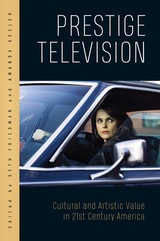
cover of Prestige Television: Cultural and Artistic Value in Twenty-First-Century America

Prestige Television

Cultural and Artistic Value in Twenty-First-Century America

Seth Friedman

Rutgers University Press, 2023
Prestige Television explores how a growing array of 21st century US programming is produced and received in ways that elevate select series above the competition in a saturated market. Contributing authors demonstrate that these shows are positioned and understood as comprising an increasingly recognizable genre characterized by familiar markers of distinction. In contrast to most accounts of elite categorizations of contemporary US television programming that center on HBO and its primary streaming rivals, these essays examine how efforts to imbue series with prestigious or elevated status now permeate the rest of the medium, including network as well as basic and undervalued premium cable channels. Case study chapters focusing on diverse series, ranging from widely recognized examples such as The Americans (2013-2018) and The Knick (2014-15) to contested examples like Queen of the South (2016-2021) and How I Met Your Mother (2005-2014), highlight how contributing authors extend conceptions of the genre beyond expected parameters.
 
[more]
cover of Prisms of the People: Power & Organizing in Twenty-First-Century America

Prisms of the People

Power & Organizing in Twenty-First-Century America

Hahrie Han, Elizabeth McKenna, and Michelle Oyakawa

University of Chicago Press, 2021

Grassroots organizing and collective action have always been fundamental to American democracy but have been burgeoning since the 2016 election, as people struggle to make their voices heard in this moment of societal upheaval. Unfortunately much of that action has not had the kind of impact participants might want, especially among movements representing the poor and marginalized who often have the most at stake when it comes to rights and equality. Yet, some instances of collective action have succeeded. What’s the difference between a movement that wins victories for its constituents, and one that fails? What are the factors that make collective action powerful?

Prisms of the People addresses those questions and more. Using data from six movement organizations—including a coalition that organized a 104-day protest in Phoenix in 2010 and another that helped restore voting rights to the formerly incarcerated in Virginia—Hahrie Han, Elizabeth McKenna, and Michelle Oyakawa show that the power of successful movements most often is rooted in their ability to act as  “prisms of the people,” turning participation into political power just as prisms transform white light into rainbows. Understanding the organizational design choices that shape the people, their leaders, and their strategies can help us understand how grassroots groups achieve their goals.

Linking strong scholarship to a deep understanding of the needs and outlook of activists, Prisms of the People is the perfect book for our moment—for understanding what’s happening and propelling it forward.
[more]
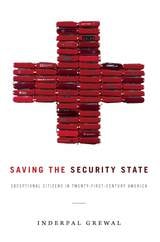
cover of Saving the Security State: Exceptional Citizens in Twenty-First-Century America

Saving the Security State

Exceptional Citizens in Twenty-First-Century America

Inderpal Grewal

Duke University Press, 2017
In Saving the Security State Inderpal Grewal traces the changing relations between the US state and its citizens in an era she calls advanced neoliberalism. Marked by the decline of US geopolitical power, endless war, and increasing surveillance, advanced neoliberalism militarizes everyday life while producing the “exceptional citizens”—primarily white Christian men who reinforce the security state as they claim responsibility for protecting the country from racialized others. Under advanced neoliberalism, Grewal shows, others in the United States strive to become exceptional by participating in humanitarian projects that compensate for the security state's inability to provide for the welfare of its citizens. In her analyses of microfinance programs in the global South, security moms, the murders at a Sikh temple in Wisconsin, and the post-9/11 crackdown on Muslim charities, Grewal exposes the fissures and contradictions at the heart of the US neoliberal empire and the centrality of race, gender, and religion to the securitized state.
[more]
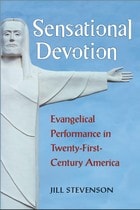
cover of Sensational Devotion: Evangelical Performance in Twenty-First-Century America

Sensational Devotion

Evangelical Performance in Twenty-First-Century America

Jill Stevenson

University of Michigan Press, 2015
Sensational Devotion examines contemporary Passion plays, biblical theme parks, Holy Land recreations, creationist museums, and megachurches in order to understand how they serve their evangelical believer-users while also shaping larger cultural and national dialogues. Jill Stevenson explores how performative media support specific theologies and core beliefs by creating sensual, live experiences for those who use them. The book explores evangelical performance across a range of media and sites, including film, television, theater, tourist attractions, museums, and places of worship. Using historical research coupled with firsthand experiences, it critically examines these spaces and events within their specific religious, cultural, and national contexts, while placing them within a long devotional tradition to suggest how they cultivate religious belief by generating vivid, sensual, affectively oriented, and individualized experiences. Stevenson’s analysis builds upon existing work on performance and cognition, as well as theories of affect, as it contributes to existing scholarship on American evangelicalism and evangelical Christian media. 
[more]
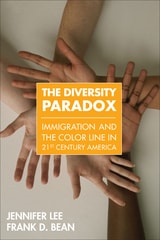
cover of The Diversity Paradox: Immigration and the Color Line in Twenty-First Century America

The Diversity Paradox

Immigration and the Color Line in Twenty-First Century America

Jennifer Lee

Russell Sage Foundation, 2010

African Americans grappled with Jim Crow segregation until it was legally overturned in the 1960s. In subsequent decades, the country witnessed a new wave of immigration from Asia and Latin America—forever changing the face of American society and making it more racially diverse than ever before. In The Diversity Paradox, authors Jennifer Lee and Frank Bean take these two poles of American collective identity—the legacy of slavery and immigration—and ask if today's immigrants are destined to become racialized minorities akin to African Americans or if their incorporation into U.S. society will more closely resemble that of their European predecessors. They also tackle the vexing question of whether America's new racial diversity is helping to erode the tenacious black/white color line. The Diversity Paradox uses population-based analyses and in-depth interviews to examine patterns of intermarriage and multiracial identification among Asians, Latinos, and African Americans. Lee and Bean analyze where the color line—and the economic and social advantage it demarcates—is drawn today and on what side these new arrivals fall. They show that Asians and Latinos with mixed ancestry are not constrained by strict racial categories. Racial status often shifts according to situation. Individuals can choose to identify along ethnic lines or as white, and their decisions are rarely questioned by outsiders or institutions. These groups also intermarry at higher rates, which is viewed as part of the process of becoming "American" and a form of upward social mobility. African Americans, in contrast, intermarry at significantly lower rates than Asians and Latinos. Further, multiracial blacks often choose not to identify as such and are typically perceived as being black only—underscoring the stigma attached to being African American and the entrenchment of the "one-drop" rule. Asians and Latinos are successfully disengaging their national origins from the concept of race—like European immigrants before them—and these patterns are most evident in racially diverse parts of the country. For the first time in 2000, the U.S. Census enabled multiracial Americans to identify themselves as belonging to more than one race. Eight years later, multiracial Barack Obama was elected as the 44th President of the United States. For many, these events give credibility to the claim that the death knell has been sounded for institutionalized racial exclusion. The Diversity Paradox is an extensive and eloquent examination of how contemporary immigration and the country's new diversity are redefining the boundaries of race. The book also lays bare the powerful reality that as the old black/white color line fades a new one may well be emerging—with many African Americans still on the other side.
[more]
cover of The New Metropolis: Power, Place, and Inequality in Twenty-First-Century America

The New Metropolis

Power, Place, and Inequality in Twenty-First-Century America

Margaret Weir

University of Chicago Press, 2027

A path-breaking investigation of changing patterns of inequality and contestation in America’s metropolises.

Since 1990, a new political geography of winners and losers has emerged in metros across America. This new metropolis looks nothing like the old. In many exurbs, suburban mansions abut declining towns and distressed communities. In historic central cities, African American communities reel from institutional stripping, even as gentrification and immigration revitalize once forgotten neighborhoods. The New Metropolis considers why, despite all the changes over the past four decades, we have recreated a metropolis that makes it harder for low-income Americans—especially low-income Americans of color—to thrive and why some efforts to promote equitable opportunity succeed against the odds.

With a focus on Chicago, Atlanta, and Houston, The New Metropolis shows how multi-level political actors and translocal networks build power across political boundaries to determine the pool of local public resources and the scope of local powers. Weir demonstrates how the timing of urbanization set up distinct conflicts over the public sector in Frostbelt versus Sunbelt metropolises, explaining how partisan divisions now supercharge these conflicts.

The New Metropolis shows why the battle over the metropolis sits at the center of American politics. It determines the shape of the public arenas where we make decisions and, ultimately, the kinds of connections Americans have with one another.
[more]
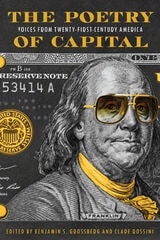
cover of The Poetry of Capital: Voices from Twenty-First-Century America

The Poetry of Capital

Voices from Twenty-First-Century America

Edited by Benjamin S. Grossberg and Clare Rossini

University of Wisconsin Press, 2021

What do we talk about when we talk about money? As the forty-four poets in this brilliant new anthology show, the answer is everything. From the impact of global economic crises to local tag sales, from the subversive effects of dark money on politics to the freedom granted by a summer job, from sweatshops where our clothes are produced to the malls where they are sold, this volume gets to the heart of Americans’ relationships to capital as only poetry can.

Editors Benjamin S. Grossberg and Clare Rossini selected poems to reflect broad themes of labor, history and economic forces, social equity, and the environment. In addition, they asked each poet to provide a brief prose comment to introduce their work. Some give broad statements on the nature of wealth in America today; others are intimate, offering insight into how life experiences inform their writing; still others reflect on the art of poetry itself and its unique power to speak to economic pressures of the moment.

Contributors include Mary Jo Bang, Xochiquetzal Candelaria, Alan Chazaro, Mark Doty, Denise Duhamel, Tony Hoagland, Yusef Komunyakaa, Dorianne Laux, Kimiko Hahn, Sharon Olds, George Perreault, Robert Pinsky, Minnie Bruce Pratt, Afaa Michael Weaver, David Wojahn, and others.
[more]