Results by title
18 books match the query 'Twilight'
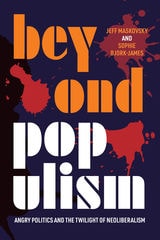
Beyond Populism
Angry Politics and the Twilight of NeoliberalismJeff Maskovsky
West Virginia University Press, 2020
Across the world, politics is lurching to the right, ethnic nationalism is on the rise, and people are furious. Beyond Populism critically examines the new destructive projects of resentment that have surfaced in the political spaces opened by neoliberalism’s failures, particularly since the financial collapse of 2008. It contextualizes the recent history of the Global North—notably Brexit and the Trump election—among wider comparative politics, with chapters on India, Colombia, Eastern Europe, the Philippines, Ethiopia, and other parts of the globe marked by populist insurgencies.
The essays collected here explore how global, regional, national, and local structures of power produce angry politics. They go beyond conventional academic debates about populism to explore the different kinds of anger that shape politics today and to make legible the multiplicity of forces, antagonisms, conflicts, and emergent political forms that mark the present. By examining the politics of anger, Beyond Populism also considers what is needed to transform anger from a reactionary to an emancipatory force.

Days of Twilight, Nights of Frenzy
A MemoirWerner Schroeter and Claudia Lenssen
University of Chicago Press, 2017
Written in the last years of his life, Days of Twilight, Nights of Frenzy sees Schroeter looking back at his life with the help of film critic and friend Claudia Lenssen. Born in 1945, Schroeter grew up near Heidelberg and spent just a few weeks in film school before leaving to create his earliest works. Over the years, he would work with acclaimed artists, including Marianne Hopps, Isabelle Huppert, Candy Darling, and Christine Kaufmann. In the 1970s, Schroeter also embarked on prolific parallel careers in theater and opera, where he worked in close collaboration with the legendary diva Maria Callas. His childhood; his travels in Italy, France, and Latin America; his coming out and subsequent life as an gay man in Europe; and his run-ins with Hollywood are but a few of the subjects Schroeter recalls with insights and characteristic understated humor.
A sharp, lively, even funny memoir, Days of Twilight, Nights of Frenzy captures Schroeter’s extravagant life vividly over a vast prolific career, including many stories that might have been lost were it not for this book. It is sure to fascinate cinephiles and anyone interested in the culture around film and the arts.
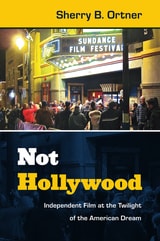
Not Hollywood
Independent Film at the Twilight of the American DreamSherry B. Ortner
Duke University Press, 2013

Order In The Twilight
Bernhard Waldenfels
Ohio University Press, 1996
“Whoever distrusts the barking of watchdogs, however, does not immediately have to begin howling with the wolves.”—Bernhard Waldenfels
In this seminal work, acclaimed philosopher Bernhard Waldenfels deals with the problem of the nature of order after the “shattering of the world,” and the loss of the idea of a universal or fundamental order.
Order in the Twilight unites phenomenological methodology with recent work on the theory of order, normativity, and dialogue, as well as structuralism and Gestalt theory. Philosophically stringent, it expresses a more optimistic attitude than much modern philosophy, especially deconstruction.
Waldenfels passes the question of order through numerous defining aspects, and concludes that there is not one global order, but rather various conflicting domains of order. Whenever the boundary of a vital or experiential domain is crossed, a discourse speaks at the boundary, not about it, and across a threshold without abolishing it. The rest is rationalization, i.e., an attempt to find a place in the respective order for what is to-be-ordered. But why, the author concludes, should a theory be more unambiguous than reality?
Order in the Twilight is an important book at this time, because it may help lift the humanities out of the skeptical, relativistic disarray in which they have been embroiled in recent decades. Waldenfels does not attempt to dictate what reality should be; rather, he is open to any valid evidences. His book offers a solid footing to the human and social sciences as they seek to escape from deconstructive irrationalism.

Queer Emergent
Scandalous Stories from the Twilight of AIDS in PeruJustin Perez
Duke University Press, 2025
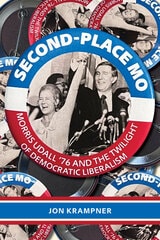
Second-Place Mo
Morris Udall ’76 and the Twilight of Democratic LiberalismJon Krampner
Michigan State University Press, 2027
Second-Place Mo examines the rightward drift of the Democratic Party that began in earnest with Jimmy Carter’s defeat of Morris “Mo” Udall for the Democratic presidential nomination in 1976—a turning point that set the party toward a free-market economy and away from economic liberalism.
The candidacy of Mo Udall, a congressman from Arizona, was the first time in almost a century that a member of the House of Representatives had a chance to become president; it also promised a continuation of the Democrats’ tradition of New Deal liberalism, which had been the party’s guiding star since the 1930s. But the Udall campaign was rocked by events beyond its control, its own mistakes, and the whirlwind candidacy of Jimmy Carter, who went on to win the nomination and the presidency.
Mo Udall chalked up eight second-place primary finishes without a victory. His candidacy was memorable for his dogged persistence, sunny good humor, and unabashed liberalism. This book chronicles a Democratic primary filled with memorable candidates, including the militarist and arch-Zionist Scoop Jackson; the newly minted more-populist-than-thou Fred Harris; the Hamlet-like figures of Birch Bayh and Hubert Humphrey; the fading, injured apostle of the Confederate South, George Wallace; the affable yet ineffective Kennedy in-law, Sargent Shriver; the anti-abortion housewife from Long Island, Ellen McCormack; and others. All are vividly brought to life—including Jimmy Carter, a thrower of sharp elbows before he became the beloved, humanitarian former president—set against the backdrop of Udall’s doomed effort.
Second-Place Mo examines why Udall’s 1976 campaign failed and what lessons his near misses hold for contemporary politics. Along the way, it recovers a figure whose principled liberalism and self-deprecating humor offer an instructive contrast to the politics of our own moment.

Shakespeare's Roman Trilogy
The Twilight of the Ancient WorldPaul A. Cantor
University of Chicago Press, 2017
Cantor analyzes the way Shakespeare chronicles the rise and fall of the Roman Republic and the emergence of the Roman Empire. The transformation of the ancient city into a cosmopolitan empire marks the end of the era of civic virtue in antiquity, but it also opens up new spiritual possibilities that Shakespeare correlates with the rise of Christianity and thus the first stirrings of the medieval and the modern worlds.
More broadly, Cantor places Shakespeare’s plays in a long tradition of philosophical speculation about Rome, with special emphasis on Machiavelli and Nietzsche, two thinkers who provide important clues on how to read Shakespeare’s works. In a pathbreaking chapter, he undertakes the first systematic comparison of Shakespeare and Nietzsche on Rome, exploring their central point of contention: Did Christianity corrupt the Roman Empire or was the corruption of the Empire the precondition of the rise of Christianity? Bringing Shakespeare into dialogue with other major thinkers about Rome, Shakespeare’s Roman Trilogy reveals the true profundity of the Roman Plays.
The Twilight of Politics
Mario Tronti
Seagull Books, 2024
Italian political thinker Mario Tronti is most famous for being the author of Workers and Capital, which became the central theoretical formulation of Italian operaismo or workerism, a current of political thought emerging in the 1960s that revolutionized the institutional and extra-parliamentary Left in Italy and beyond. In The Twilight of Politics, written originally in 1998, Tronti argues that modern politics, which reached its apogee in the twentieth century, has ended.
Realism and Utopia, Tronti explains, were the foundational qualities of modern politics, which it always tried to clasp together. But behind this highwater mark of politics was a history over the longue durée, encompassing the wars of religion, Hobbes’ Leviathan, revolution, great individuals, and popular movements, as well as innovations such as the nation-state and the party-form. Historically, the modern period is also a coming together of the categories of the political and the laws of political economy. At the heart of this book is Tronti’s attempt to hold together a view of the course of political history with a critique of the “dictatorship of the present” to help us escape being “chained to the bars of an eternal present . . . which deprives us both of the freedom to look back and to see ahead.”
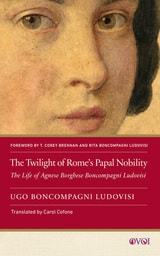
The Twilight of Rome's Papal Nobility
The Life of Agnese Borghese Boncompagni LudovisiUgo Boncompagni Ludovisi (1856–1935)
Rutgers University Press, 2025
First privately published in 1921, The Twilight of Rome's Papal Nobility provides an intimate look at a family who grew up accustomed to almost unimaginable wealth, power, and glamour. A descendant of two popes, Ugo Boncompagni Ludovisi recounts the life story of his mother Agnese, who was raised in a palace full of priceless artwork, including pieces by Caravaggio and Michelangelo. We get a window into Agnese's private life—her girlhood, marriage, and raising of several children—as her public life becomes increasingly tumultuous amid the family’s struggles to retain its property. A tender elegy to a bygone era, Boncompagni Ludovisi's story provides a unique perspective on Italian history and Rome’s urban redevelopment.
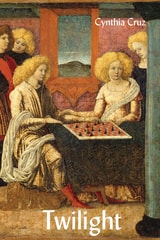
Twilight
Cynthia Cruz
Four Way Books, 2026
Twilight is the intermediary state of becoming, the suspension between, when one is no longer who one was and not yet who they will be. At the end of psychoanalysis, after one has worked through the symbolic investitures one has been relegated to, one is reduced to such a state. In this state of momentary suspension, one is, in a sense, nothing.
Twilight also names a historical moment, when one world is ending but the next has yet to appear. That we are existing in the suspension between the the end of the world as we have known it and the void of what has yet to come is a commonly repeated truth. Hegel describes twilight as “a flash” that in “a single stroke brings to view the structure of the new world,” suggesting that novelty arises out of darkness and obscurity. We are living, in other words, in a state of twilight.
Cruz’s tenth poetry collection takes the concept of twilight and presents, through a series of elliptical poems, a working through of the term. The speakers in these poems exist within this wavering. As she writes in one of several poems titled “Twilight,” “Twilight, its world between worlds / its miraculous suspension. / I belong to the school of Freud’s / hypothetical boarding school girls. / We wait and we wait / for the world to begin.”
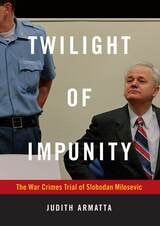
Twilight of Impunity
The War Crimes Trial of Slobodan MilosevicJudith Armatta
Duke University Press, 2010
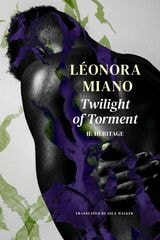
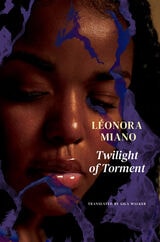
Twilight of Torment
II. HeritageLéonora Miano
Seagull Books, 2023
After beating his girlfriend and leaving her for dead on the street, Amok retraces his steps. Frightened by his act, which reproduces the violence of his father, he hopes to save the woman. But it is too late when he arrives at the scene; two women are already carrying the injured woman. Overwhelmed and not daring to reveal himself, he decides to find his father in order to learn how to rid himself of the dark force that he believes runs through the men of his lineage. He embarks on a journey that will be, more than anything, an inner one, forcing him to understand his story and choose a healthier way of being in the world. This second volume of Twilight of Torment is both intimate and political. Through the story of a man and his family, we discover an African bourgeoisie and its many social wanderings in a contemporary Africa whose future seems nebulous.
Twilight of Torment
MelancholyLéonora Miano
Seagull Books, 2022
Four women speak. They speak to the same man, who is not there. He is the son of the first, the great-yet-impossible love of the second, the platonic companion of the third, the older brother of the last. Speaking to him in his absence, it is to themselves that these women turn, examining their own stories to make sense of their journey, from twilight to twilight, through a mysterious stormy night in the middle of the dry season.
Together, the voices in Twilight of Torment: Melancholy, the first volume of a two-volume novel, perform a powerful and sometimes discordant jazz-inspired chorus about issues such as femininity, sexuality, self-love, and the intrusion of history into the intimate lives of people of African descent. Blackness confronts African-ness, love is sometimes discovered in the arms of another woman, the African renaissance tries to establish itself on the rubble of self-esteem damaged by history. Each of these women, with her own language and rhythm, ultimately represents a specific aspect of the tormented history of Africans in today’s world, and at the end of the night, they will each arrive at a dawn of hope.

Twilight of a Golden Age
Selected Poems of Abraham Ibn EzraWeinberger, Leon J.
University of Alabama Press, 1997

Twilight of the American State
Pierre Schlag
University of Michigan Press, 2023
Finalist: 2024 Order of the Coif Book Award | March 3, 2025
The sudden emergence of the Trump nation surprised nearly everyone, including journalists, pundits, political consultants, and academics. When Trump won in 2016, his ascendancy was widely viewed as a fluke. Yet time showed it was instead the rise of a movement—angry, militant, revanchist, and unabashedly authoritarian.
How did this happen? Twilight of the American State offers a sweeping exploration of how law and legal institutions helped prepare the grounds for this rebellious movement. The controversial argument is that, viewed as a legal matter, the American state is not just a liberal democracy, as most Americans believe. Rather, the American state is composed of an uneasy and unstable combination of different versions of the state—liberal democratic, administered, neoliberal, and dissociative. Each of these versions arose through its own law and legal institutions. Each emerged at different times historically. Each was prompted by deficits in the prior versions. Each has survived displacement by succeeding versions. All remain active in the contemporary moment—creating the political-legal dysfunction America confronts today.
Pierre Schlag maps out a big picture view of the tribulations of the American state. The book abjures conventional academic frameworks, sets aside prescriptions for quick fixes, dispenses with lamentations about polarization, and bypasses historical celebrations of the American Spirit.
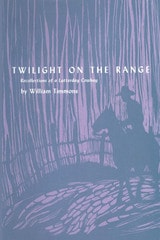
Twilight on the Range
Recollections of a Latterday CowboyBy William Timmons
University of Texas Press, 1962
Billie Timmons was fourteen when he met Charles Goodnight—over a wagonload of manure that had been jammed on a gatepost—and he went to work on the Goodnight Cross J Ranch shortly thereafter. The spirit of helpfulness that led Mr. Goodnight to strip off his coat and lift the wagon free for a lad in need sets the tone of this book, in which the author unwinds a spool of recollections of range-riding in Texas and North Dakota over an eighteen-year period.
When Billie Timmons went to work for Mr. Goodnight in 1892, Texas was undergoing a rapid transition from open range to fences. But around Texas campfires he heard tales about the northern range, told by cowboys who had ridden there and who had seen the northern lights, the tall free grass, swollen streams, and stampeding cattle. A longing to see that exciting country took hold of young Timmons.
His chance came when four buffaloes from the Goodnight ranch needed a nursemaid for their freight car trip to Yellowstone Park. Once in the northern country, Timmons stayed, casting his lot with the cowmen of North Dakota. He became the protégé of an extraordinary man, William Ray; he was foreman, friend, and confidant of banker-rancher Wilse Richards, a member of the Cowboy Hall of Fame. But even during his days in North Dakota he never lost touch with Charles Goodnight, a lifelong friend, and his portrayal of Goodnight provides much insight into the character of the man whose name belongs to the West.
In this book you experience the terror of being lost in the dead-white expanse of a North Dakota snowstorm; the gaiety of cowboy dances, for which there were never enough women available; the excitement of a near-riot in a Hebron, North Dakota, saloon, where cowboys from the 75 Ranch drank up or poured out all the liquor, then smashed all the glasses and bottles—one day before the state became bone-dry; and the loneliness of work on the range, where a flickering lantern on the side of a chuck wagon on a stormy night meant home for many a cowboy. Running like a bright thread through the narrative is Billie Timmons’s love of horses, from whom he learned the wisdom that some horses and some men are to be handled with great care and others are not to be handled at all. His chapter on Buck, his best-loved horse, is memorable.
In North Dakota, as in Texas, fences brought the end of the big herds and the end of cowboying for a man who enjoyed it to the hilt.

Waterways of Bangkok
Memory, Landscape and TwilightMichael Hurley
National University of Singapore Press, 2025
This ethnographic study explores memory along the waterways, a realm of boats and hovels, merchants and war captives, temples and ghosts. The river also flows into the dissonant realities of Thailand, a country of deep conflicts over power and national ideology. Based on research in a time of political turmoil, centered on the late years of the long-reigning monarch, Rama IX, this book invites readers to look beyond established images of Thai society. More broadly, this work will speak to readers interested in water, cities, and the bonds of memory and landscape.

We Make Our Own History
Marxism and Social Movements in the Twilight of NeoliberalismLaurence Cox and Alf Gunvald Nilsen
Pluto Press, 2014
We live in the twilight of neoliberalism: the ruling classes can no longer rule as before, and ordinary people are no longer willing to be ruled in the old way. Pursued by global elites since the 1970s, neoliberalism is defined by dispossession and ever-increasing inequality. The refusal to continue to be ruled like this - "ya basta!" - appears in an arc of resistance stretching from rural India to the cities of the global North.
From this network of movements, new visions are emerging of a future beyond neoliberalism. We make our own History responds to these visions by reclaiming Marxism as a theory born from activist experience and practice.
This book marks a break both with established social movement theory, and with those forms of Marxism which treat the practice of social movement organising as an unproblematic process. It shows how movements can develop from local conflicts to global struggles; how neoliberalism operates as a social movement from above, and how popular struggles can create new worlds from below.