Results by title
2 books match the query 'Two Hundred Years'
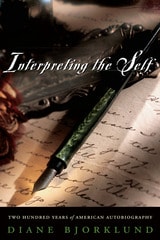
Interpreting the Self
Two Hundred Years of American AutobiographyDiane Bjorklund
University of Chicago Press, 1998
In this ambitious study, Diane Bjorklund explores the historical nature of self-narrative. Examining over 100 American autobiographers published in the last two centuries, she discusses not only well-known autobiographies such as Mark Twain and Andrew Carnegie but also many obscure ones such as a traveling book peddler, a minstrel, a hotel proprietress, an itinerant preacher, a West Point cadet, and a hoopskirt wire manufacturer. Bjorklund draws on the colorful stories of these autobiographers to show how their historical epoch shapes their understandings of self.
"A refreshingly welcome approach to this intriguing topic. . . . [Bjorklund's] extensive and systematic approach to her source material is impressive and enriches our understanding of this essential subject."—Virginia Quarterly Review
"Bjorklund studies both famous and obscure writers, and her clear prose style and copious quotations provide insight into the many aspects of the changing American self." —Library Journal
[more]
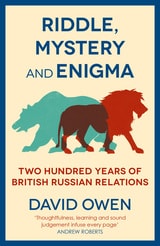
Riddle, Mystery, and Enigma
Two Hundred Years of British–Russian RelationsDavid Owen
Haus Publishing, 2022
A history of relations between Britain and Russia from the nineteenth century to the present.
With Riddle, Mystery, and Enigma, statesman and author David Owen tells the story of Britain’s relationship with Russia, which has been surprisingly underexplored. Through his characteristic insight and expertise, he depicts a relationship governed by principle as often as by suspicion, expediency, and necessity.
When the two nations formed a pragmatic alliance and fought together at the Battle of Navarino in Greece in 1827, it was overwhelmingly the work of the British prime minister, George Canning. His death brought about a drastic shift that would see the countries fighting on opposite sides in the Crimean War and jostling for power during the Great Game. It was not until the Russian Revolution of 1917 that another statesman had a defining impact on relations between Britain and Russia: Winston Churchill, who opposed Bolshevism yet never stopped advocating for diplomatic and military engagement with Russia. In the Second World War, he recognized early on the necessity of allying with the Soviets against the menace of Nazi Germany. Bringing us into the twenty-first century, Owen chronicles how both countries have responded to their geopolitical decline. Drawing on both imperial and Soviet history, he explains the unique nature of Putin’s autocracy and addresses Britain’s return to “blue water” diplomacy. Newly revised, this paperback edition features extended chapters on Putin’s Russia and the future of British–Russian relations after the Russo-Ukrainian War.
[more]